An Interesting Experiment
In the July number of the World’s Work, a magazine which, as the name implies, deals with the great practical issues of the day, there appeared a deeply interesting article entitled, “An Educational Experiment with Cannibals.” The writer is Mr. Samuel P. Verner, a professor in Stillman Institute, at Tuscaloosa, Alabama. Through the courtesy of the journal named, the INSTRUCTOR is permitted to reproduce the illustrations, and to make free use of the article accompanying them.
Two African lads came under the charge of Professor Verner over five years ago, when he was in the central part of the Dark Continent. This was at the time of the Belgian expedition against the Arabs. While General Kitchener advanced against the Mahdi from Egypt, Baron Dhanis ascended the Kongo, and then its greatest southern tributary, the River Kasai, at whose sources he recruited allies from the Batetela tribe for the war against the Arabs. Among the Batetela natives were these boys, Kassongo Lusuna and Kondola Mukusa. They accompanied the army with other boys to help carry food and ammunition.
Their ages at that time were fourteen and ten years. The older, Kassongo, is a nephew of the king, and heir to the throne, while Kondola is the son of a fisherman, a common native. The Batetela negroes are famous over a large area of Central Africa for their bravery, intelligence, and industry, but they are the most confirmed cannibals. Kassongo was present at the battle of Nyangwe, when the Arabs were so signally routed, and when, after the engagement, the Batetela soldiers held a banquet over the remains of their foes. The country of this tribe is just south of the equator in the Kongo Free State, and about midway between the eastern and western oceans.
When these two cannibal youth fell to the charge of Professor Verner, their traits of character came into bold prominence, and day after day they became a fascinating study. At that time they would lie, fight, steal, and gamble whenever occasion offered. To break these habits was not an easy nor a short task. The methods used were the Scriptural ones, consisting both of moral suasion and the rod; and before leaving Africa, the writer states that his life and goods were safe in their hands. It was evident that their bad habits were the result of their surroundings, and not of some defect in their moral constitution. While in Africa, both boys learned to read and write in their native dialect, which had been reduced to alphabetical characters for this purpose.
In the article published in the World’s Work several incidents are related which show the devotion and fidelity of these African youth. On one occasion the professor went to the summit of a high mountain to make some geographical observations. While there, he fell into a concealed game-pit ten feet deep, set with sharp, poisoned stakes. Kassongo got him out, and then ran five miles for help, returning in a little more than an hour. He then sucked the poison from the wound, and nursed his master through the almost fatal illness that followed. The writer states positively that he owes his life to this faithful lad.
At another time it was necessary to make a forced journey into a dangerous country to attend to an unpleasant business matter. With Kondola they walked fifty miles the first day, sleeping in jungles infested by leopards and elephants; and though the little lad was only twelve years old, he neither complained nor faltered. When the journey’s end was reached, the professor was so exhausted that he had to be lifted into a boat; but Kondola promptly joined in a game of ball which the youngsters of the town were playing! This shows the remarkable physique of these youth.
On one occasion Mr. Verner was obliged to make a perilous trip by canoe down the cataracts of the River Kasai to meet a steamer coming up from below. Kassongo volunteered for the dangerous place of paddler at the prow, watching for rocks, crocodiles, and hippopotami, and to do a large part of the steering. He maintained his post all day long without complaint, while they passed through what the writer calls one of the worst pieces of water on earth.
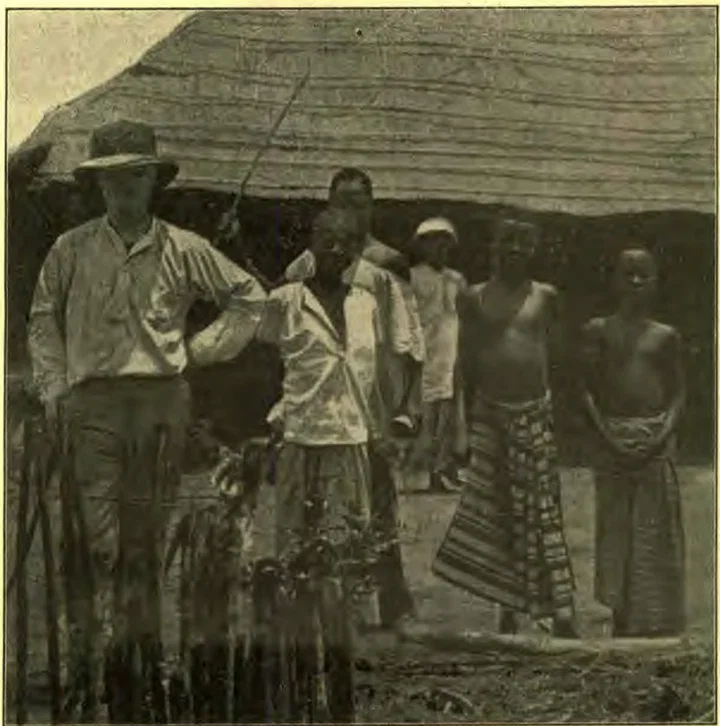
A touching instance of the power of nobler ideas in these late cannibal minds was shown in their treatment of a sick comrade who was being taken down the river to his old home at Stanley Pool on the Kongo. This was Bundu, a Mukongo native who had been the cook of the camp. He was dying of the sleeping sickness, that strange malady which carries off whole villages. The Batetela boys nursed him, fed him, watched over him, and when the poor lad died, they helped bear him to his lonely grave. Then they made their way, weeping, back to the steamer, and solemnly said that “poor Bundu had gone to his own country at last.” Their language has no word for home.
A great surprise waited them at Stanley Pool, where they first saw a locomotive. They promptly named it “steamer on land,” and with wide-opened eyes they said, “What wizards these white men are!” An accident made it necessary to telephone for another engine. When it steamed up, Kondola exclaimed, “See, his brother has come to help him!” Kassongo then observed that even the white man “could not make an animal that would not stop.”
On the passage to Europe the boys had several wild animals that they cared for, and they managed to keep them all alive except some chameleons and a little green monkey. The latter drank sea water and died. The little Africans wept over him sorely, then had a funeral service for him, and consigned his body to the deep.
As the steamer neared Antwerp, the young negroes were observed with much interest. The towers, the spires, the great buildings, the cathedral, bells ringing, whistles sounding, ship after ship lining the quay, and all the roar and bustle of city life,—these strange, new things overwhelmed these lads from the dark recesses of Ethiopia. The passengers crowded around to note the effect. The boys’ eyes grew bigger, and Kondola ventured to exclaim, “Oh, we must be at heaven now!” Kassongo thoughtfully asked, “Masterp. 282 why do the white men leave all this to come to our land?”
The trip across the Atlantic was uneventful, and the steamer reached New York in February, in a raging blizzard. On landing, the boys were left temporarily in the care of the clerk of a lodging-house, the proprietor being absent. Imagine the professor’s dismay when, returning after a half-hour’s absence, he learned that his wards had been put out, and the explanation from the lodging-keeper was, “I don’t want any niggers here; I put ’em out!” The police were called up, and after several hours’ search Mr. Verner found the boys at midnight standing near a fruit-stand in sight of the familiar bananas. Each caught sight of the other at the same time, and Kassongo exclaimed: “Is it not a great city, master? We would not go far away, because we feared we should be lost. In the morning we thought you would find us.”
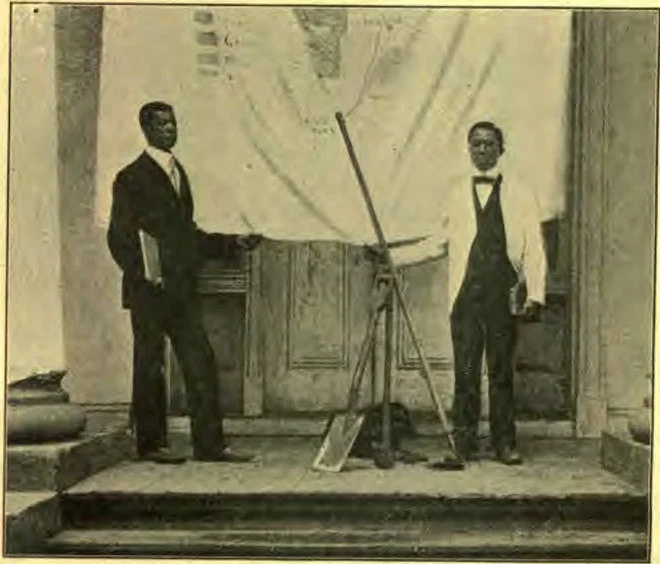
While absent to deliver a lecture, the Africans were left at the Thornwell Orphanage in South Carolina. On returning, Professor Verner learned that a general pilgrimage had taken place from all over the country to see Kassongo and Kondola; indeed, they had caused a great sensation. In Columbia the little fellows were the recipients of many attentions, and the house where they stayed was a real Mecca for the colored people for a month. Later they were taken to the Stillman Institute at Tuscaloosa, where they are now being educated.
The progress of these youth has been extraordinary. Both can now read and write, and are quite familiar with elementary geography and arithmetic. Both have professed Christianity, and are of sound moral character. They are faithful workmen on the farm, and can use ordinary mechanical tools fairly well. One is leading his class with an average of ninety-three in scholarship, and the other is not far behind.
The gentleman who has taken such a deep interest in these dark-skinned Africans hopes to secure a grant of land for them in the Kongo Free State, from the king of Belgium, that they may return to elevate their people.
Reader, can we not discern the hand of God in this interesting experience?
G. W. AMADON.