“SCIENCE needs no God,” declared a handsome, proud young university student the other day. “We account for all natural phenomena nowadays without bringing him into the question at all.”
By way of answer, the minister with whom he was chatting set a microscope on the study table, together with a glass of water, some little bottles of salt, alum, and other chemicals, and some slips of glass.
In a few drops of the water he dissolved a pinch of salt. In a few drops more he put some alum; and so on till he had a number of different solutions. Then he took a tiny drop of the salty water on a toothpick, and therewith moistened the center of a slip of glass in the microscope.
“Now,” he said, “look, and explain what you see.”
The young fellow tried the solutions, one after another; and this is what he saw: the tiny drops of water soon dried away; and as they dried, the chemicals in it crystallized into most beautiful forms—some like little pansies, some in little cubes and hair-like lines, some like moss, some in spires, some like ferns, but no two alike. Another drop of salty water placed by the first, crystallized in exactly the same way it had before. It could not be mistaken for any of the other chemicals, any more than President Roosevelt’s face would be mistaken for Abraham Lincoln’s. There were the crystal pansies, the crystal ferns, the crystal lines, every one declaring the chemical that made it.
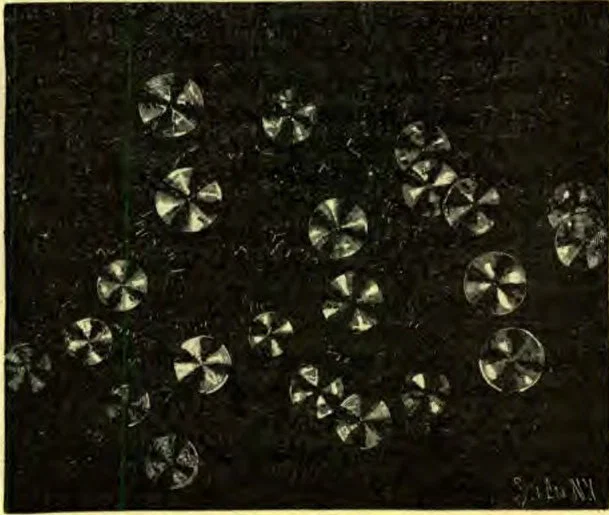
Chemists enjoy watching the process of crystallization, even though they have seen it a thousand times; for it is one of the most marvelous things in the world. So with the young skeptic. He forgot to answer the minister’s question for some time, but finally he said, “I see here the beautiful crystallization of salt, alum, potassium bichromate, lithic acid, salicine, and a number of others I can not name. It is very interesting to me.”
“Yes,” replied the other, “it is interesting. But tell me why the salt always forms in those short, chunky pieces, with just so many faces; why the lithic acid makes variegated plates; why the salicine gives little round discs,—can you?”
“Why, of course,” said the young fellow, “that is easy enough. Each chemical element or combination has characteristic properties, governed by laws; and in crystallizing it simply obeys those laws, and comes into the shape they direct.”
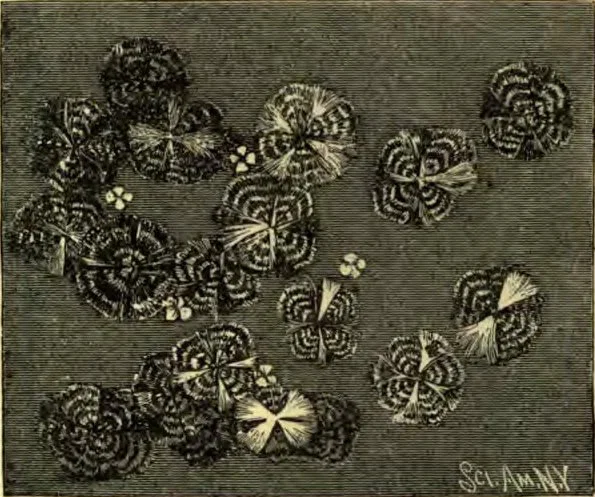
The minister smiled at the answer. “Now, my friend,” he said, “just lay aside your ‘characteristic properties’ for a moment, and your ‘governing laws,’ and think of this little drop of salty water. Here are countless millions of little lumps of salt floating around, grinding together, mixing up—what happens? The water begins to dry. Those particles begin to arrange themselves like well-drilled soldiers. There is motion, there is just enough motion, there is intelligence to take each one of those little particles to just the place it belongs; and you look at it, and say: ‘Yes; those are salt-crystals.’ But tell me, if you can, what governing law there is to take each one to its right place in combination with millions of others. Each one shapes its action according to the action of all the others. Can it see them? Can it see what they are doing, and reason with itself that there is need for it in just such a place—a place it has never been before, and then move into that place? Does it know beforehand that it is to be part of a cube or a fern crystal or a pansy? Can science explain it?”
The young fellow thought a while, with a puzzled expression on his face, and finally said:
“No, it can not. I have never before thought of it in just that way, but I see you have the argument, plainly enough. There is an Intelligence behind the crystals, and I suppose I might as well recognize that it is the wisdom of the God of order. What an incomprehensible thought it is, that the great Maker of worlds is working right here under our very eyes to-night!” EDISON DRIVER.