“THE germ in the seed grows by the unfolding of the life principle, which God has implanted.” This life principle, and the first nourishment for it, were considered in our last study. The next step—how the plant gets its start in the world—furnishes many interesting lessons. Let us learn, first, the conditions necessary for the germination, or sprouting, of seeds:—
1. Warmth. Hardy plants, such as wheat, oats, rye, corn, lettuce, cabbage, and wild plants require a temperature of from forty-five to sixty-five degrees. Tender vegetables, like tomatoes and conservatory plants, start with from sixty to eighty degrees of warmth, while tropical plants require seventy-five to one hundred degrees. I have garden seeds in a hot-bed, which are starting nicely with a temperature of fifty to eighty degrees. While these figures give the range of temperature at which various seeds will sprout, each class of seeds has a preference for a certain degree of warmth in which it will do its best. Wheat, rye, oats, and flax germinate most rapidly at seventy-seven to eighty-seven degrees; and corn and pumpkins do best at ninety-two to one hundred and one degrees. If the soil where your corn is planted has a temperature of fifty-one degrees, eleven days are required for it to sprout. If it is warmed at sixty-five degrees, the sprouting is accomplished in only three days.
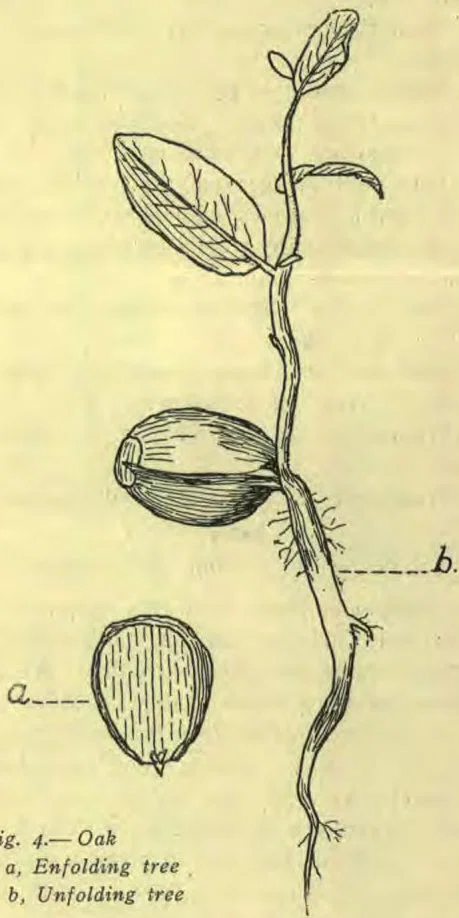
Fig. 4.— Oak
a, Enfolding tree
b, Unfolding tree
So it is important to know how to get your soil warmed as early in the spring as possible; for if the seeds remain long in the cold, wet ground, they are likely to decay. Warmth for your seeds is provided in two ways. The first is by the direct action of the sun. It is known that the sun warms sandy soil more quickly than clay, and that water requires a longer time than either sand or clay. Thus you can see that when your ground is water-soaked, it takes a long time for the sun to warm it, and seeds are often spoiled before there is sufficient warmth to start their growth. It is plain, therefore, that land with abundance of water should be drained. The temperature of the soil is also raised by warm spring rains. Each pound of rain at sixty degrees carries ten heat units into the ground, and each heat unit can raise the temperature of a pound of sand 5.24° (an inch of rainfall amounts to one hundred and thirteen tons an acre). If the land is well drained, so that the cold water of winter is carried away, the warm spring rains sink quickly into it to impart their warmth. “Thou visitest the earth, and waterest it, thou greatly enrichest it; the river of God is full of water: thou providest them corn, when thou hast so prepared the earth. Thou waterest her furrows abundantly; thou settlest the ridges thereof: thou makest it soft with showers; thou blessest the springing thereof.” Ps. 65:9, 10, R. V.
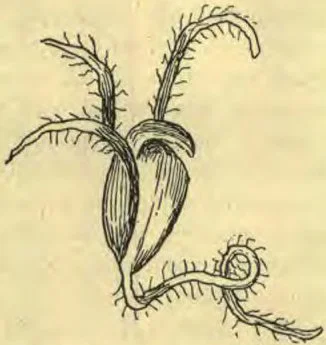
Fig. 5.— Germinating corn with root hairs, from life
2. Moisture is the second condition required for germination. Seeds can neither sprout nor grow in absolutely dry soil.
3. Air is the third requirement. Seeds have been placed in a jar, the air pumped out, and though warm and moist, would not germinate.
Do you want to watch for yourself just how the plant gets its start in the world? If you will take a piece of blotting-paper, and fold it so that, when folded, it will be about four inches square, soak it full of warm water, and lay it on a dinner plate, you will be ready for the experiment. Put between the folds a few kernels of corn, wheat, or any other seeds you can get. Cover the plate with a pane of glass, or another plate, to keep the moisture from escaping. Set your plate of seeds under the kitchen stove or in a warm place.
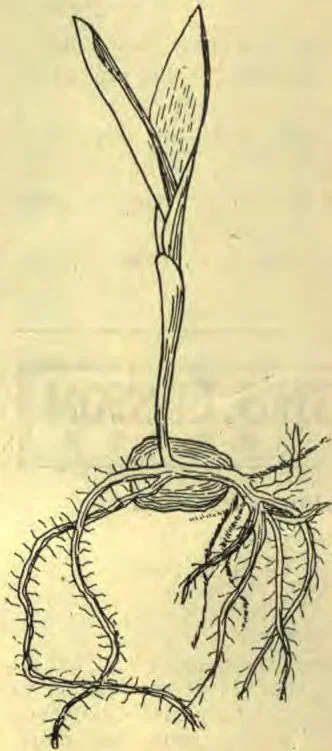
Fig. 6.—Corn getting its start
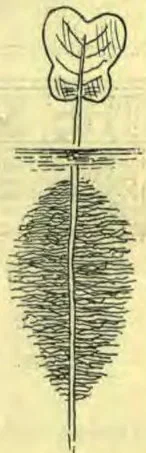
Look at your experimental garden about every twelve hours. At the first look, notice that your seeds are swollen and feel soft. Next time you may not see much change; but if you have them in a real warm place, look carefully for some change on the embryo side of your corn. At the third or fourth look, you are quite sure to be rewarded by seeing a little rootlet pushing itself out to make its acquaintance with the world. Watch it closely, and within twenty-four hours, you will see a little tuft of root-hairs surrounding the rootlet, making it look like Fig. 5, which is drawn from corn sprouting in a plate now before me. You will wish you had been looking when this bunch of hairs came out. Keep your blotting-paper moist (not wet), and watch how these hairs increase along the root as it lengthens. If you have several kinds of seeds, notice the different arrangement of the root-hairs. A growing turnip seed is shown in Fig. 7.
Root-hairs have an important office in giving the plant its start. Their specific work is to take in water, containing dissolved food elements, to nourish the plant. Like the open mouth of the bird receiving food from the mother's bill, the root-hairs are the open mouth of the plant. When the seed is in the ground, this bunch of hairs clings firmly to the soil, each hair seeming to grasp a particle of earth, and draw from it the needed food. If you lift from the ground, with a knife, a cabbage, tomato, or other plant just starting, you will find a little bunch of earth clinging close about the root. The earth is held by the root-hairs. A magnifying-glass will enable you to get a better idea of root-hairs.
As the plant extends and multiplies its roots, the hairs are no longer needed, and with the seed itself they die and disappear. In this dying of the seed, our Saviour brought out a beautiful lesson. “Except a corn of wheat fall into the ground and die,” he said, “it abideth alone: but if it die, it bringeth forth much fruit.” As the seed must give its life to multiply other lives like itself, “so in human life, to give is to live. The life that will be preserved, is the life that is freely given in the service of God and man. The life must be cast into the furrow of the world’s need. Self-love, self-interest, must perish.” Jesus himself set us the blessed example of this kind of sacrifice.
Fig. 7.— Germinating turnip seed
“The germination of the seed represents the beginning of spiritual life. The mystery of the germination and growth of the seed he [the sower] can not understand.” Like the new birth, only its results can be seen and understood.
Seed-planting beautifully illustrates death, and its springing up, the resurrection. I Cor. 15: 35-45. “The seed dies to spring forth into new life, and in this we are taught the lesson of the resurrection.” J. C. ROGERS.