As the water soaks into the rocks, and freezes in the winter, the strongest rocks are cracked and broken, and finally crumble to pieces. You can scarcely find a large stone that does not have some cracks in it, and there is no stone so hard but some water soaks into it. You know how water freezing in a tub or a barrel expands, and bursts it. It is just this way that the rocks are broken to pieces. In the spring the frost goes out of them, and these pieces fall to the ground. Year after year they break up finer and finer until they are so small that the water can wash them away. This very fine rock is called Soil. If you will look at the water in any creek, you will see that it is carrying soil, and you will remember how muddy the water is just after a rain. In speaking of this, God says, “Surely the mountain-falling cometh to naught, and the rock is removed out of his place. The waters wear the stones: thou washest away the things which grow out of the dust of the earth.”
The high land between two valleys is called a Divide, or a Watershed, because it divides the water that falls upon it, part of it running down one side, and part down the other. As the waters flow down into the valleys, they carry with them some of the soil from the higher land.
In each continent there are large watersheds that consist of mountain ranges.
Of course there are more stones in the mountains, and the water runs more swiftly there, so this work of the wearing away of the stone is best seen in such a place, though it may be seen anywhere. This new soil that is taken from the rocks is very fertile. The earth was much more fertile before the flood than it is now, but as wicked men used its products for sinful purposes, much of the most fertile part of the earth was stored up in the rocks, and is now given back slowly, as they wear away.
In the mountains so much soil is often washed away that great gorges are formed by the rivers. Such a gorge is called a Cañon if it is wide. We find many rocks near the mountains, but the best land is in the valleys, where it has been washed in. Of course most of the soil was formed at the time of the flood, but every time a river overflows its banks, it leaves a rich deposit of mud that is very productive.
See if you can find any soil near your schoolhouse that has been formed by the action of water.
REVIEW.—What causes the rock to crack and break in pieces? What is soil? Tell how the water carries the soil from the watersheds, and drops it in the valleys. What is a watershed? Why is the new soil formed from the rocks very fertile? What is a cañon, or gorge? Why is the earth not so fertile now as before the flood? Why is the soil fertile that is left by a river when it overflows?
Lesson XXI
As water always runs down-hill, the source, or beginning place, of most rivers is in the high hills or mountains. We call this beginning place the Head of a river. There is some salt mixed with almost all soil, and in certain parts of the world, the salt is in great beds of rock. The water washing through the salt, or over these salt beds, gradually washes the salt away. There is not enough of it to make the water taste salty, but if it flows into a lake that has no outlet, except as the sun draws the water up to the clouds, the lake becomes salty. In some parts of the world there are many salt lakes. The Great Salt Lake in Utah is a good example of salt lakes. This large lake is drying away, and a great deal of salt is left along its shores. It is said that before many years, there will be only a salty desert where this lake now is.
During the flood the surface of the earth was all broken up, and if the water had not been salty before that time, it would have dissolved enough salt to make it so; at any rate, all the water in the ocean is very salty. The mouth, or outlet, of most rivers is in the ocean, and they constantly carry their little particles of salt in it. When the sun draws the water back up into the clouds, the salt is left behind. You can see how this is done by putting some salt in a cup of water, and allowing the water to evaporate. The ocean is not so salty in some places as in others, but it is always too salty for men to drink. For this reason every ship that crosses the sea has to carry enough water in it for all the passengers to drink until they reach land again. Sometimes they carry an arrangement for boiling the water and cooling the steam. In this way they can get fresh water from the ocean. The fish and plants that live in our fresh-water lakes and rivers can not live in the ocean, neither can those that live there live in fresh water.
Ice is lighter than water, and therefore it floats on the water. The ice on the top of the water keeps the cold out, and so the ocean is not frozen to the bottom. Were this not true, the Arctic and Antarctic oceans would soon be frozen solid, and the whole world would be much colder. As it is, the snow and ice that have come as the result of sin, cover the earth as a warm blanket, and keep the cold from freezing everything to death. Thus we see how God has overruled all the results of sin, so that, after all, they benefit man.
Yet in the cold oceans the ice freezes hundreds of feet deep. Often the action of the waves causes large pieces to break off, and float in the water. These are called Icebergs. They sometimes float far south into our warm oceans before they are melted.
REVIEW.—Where is the head, or source, of most rivers? What causes salt lakes? Why is the ocean salty? How do men get water to drink while they are crossing the ocean? Can fish from fresh water lakes and rivers live in the ocean? Why? How do ice and snow protect the earth? What is an iceberg?
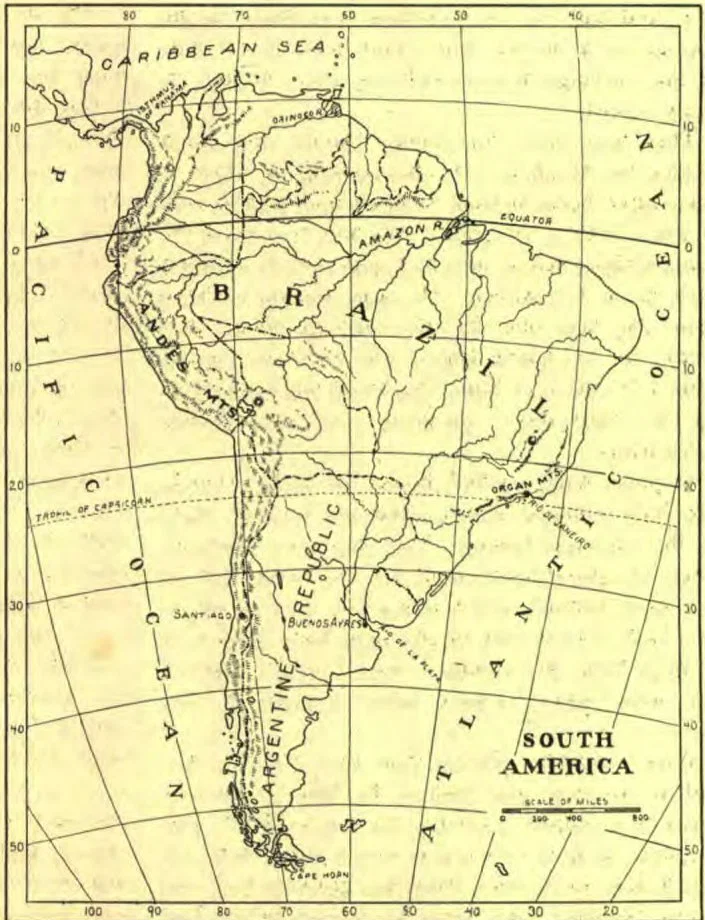
QUESTIONS ON MAP OF SOUTH AMERICA
What country is south of North America? What three large rivers in South America? In what direction does each flow? Why is there no large river in South America flowing west? What ocean is east of South America? What ocean is west of South America? What sea is north of South America? What mountains are in the eastern part of South America? What mountains are in the western part of South America? What isthmus connects South America with North America? What three large cities in South America?