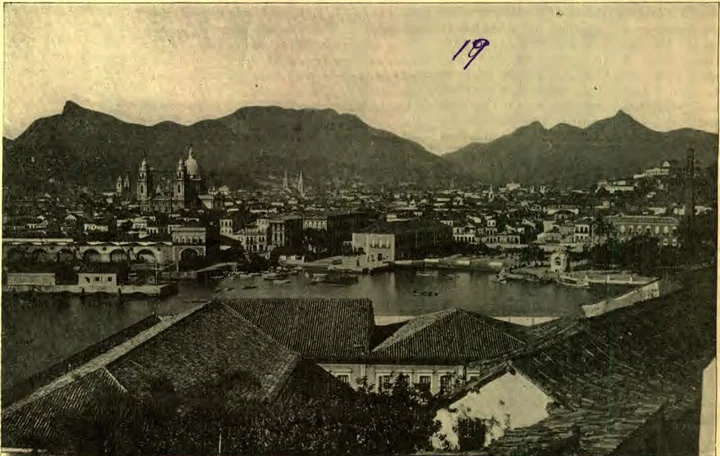
ONE of the most picturesque cities in Brazil, South America, is the city of Rio de Janeiro, with the great sugar-loaf mountain looming up at the entrance. Especially in the evening when first sighted from the harbor, under the soft southern twilight and the myriad twinkling lights from the different hillsides, the city makes a picture like that of fairyland. There are several large mountains situated near the city which are said to have passed through the usual eruptions, but even now look as if they were ready to burst forth any moment.
Although Rio de Janeiro (River of January) is a beautiful city, its comeliness is greatly marred by the careless way the natives distribute their waste substances over the hillsides where they live. This profuse but unsightly ornamentation can be seen for long distances.
The prevailing language is Portuguese. To the natives every foreigner who can speak English is an Inglezer (Englishman). In their slow and easy way the people are very hospitable. The Portuguese are not great meat eaters; their favorite dish is black beans seasoned with a little dried meat. Mandioc, which is the root of the mandioc plant ground into flour, is a nourishing article of diet, and is extensively used. This may be eaten raw or cooked.
Yellow fever is a common but ever-dreaded disease. One case that I observed was of a woman who took the fever one day, and died the next day. The husband hired an old woman to mourn for his wife. This woman was expected to scream in a most uncanny way; first she would begin rather low, then gradually ascend until she reached a piercing scream. She was obliged to keep this up all day. One living in this city for some time grows accustomed to such things, for many of the customs of the ancient civilized and heathen nations are zealously followed here.
One that I thought ridiculous is that of the priest passing along the street, carrying a long stick with the image of some saint on the top; this he would hold up to the windows of the houses, expecting all to kiss the image, and drop a piece of money in the box which was attached.
Saints’ days abound here, almost every evening marks the celebration of some saint day. The gatherings and processions resulting from these celebrations cause a great deal of unwelcome noise to those not participating in the celebration. One of the special days in Rio de Janeiro is the Carnival; at this time all the senoras and senorettas come forth in gay attire. A simple but common custom observed at such a time is that of throwing upon another bits of sweetly scented paper. The one receiving this attention regards it as a compliment. In the processions images of the saints are carried, and every one is expected to bow or remove his hat in reverence. An Englishman passing in the crowd failed to do this; the people became angry and threw stones at him so that he was badly injured. The Roman Catholic faith is the predominant feature of everything here, as it is in all the South American countries.
Everything in the city is expensive, but usually of a good quality. The people generally charge the “Inglezer” twice the proper amount, for he is always regarded as rich. Some of the fruits are curious both in looks and taste. Mamao, similar to our muskmelon in form and size, grows on a slender tree about fifteen feet high; the leaves and fruit are at the top of the tree, and the wood is soft and fibrous. The Jaboticaba is a tree much like the apple-tree in shape, and when in flower is a pretty sight, for the flowers and fruit grow all around the trunk of the tree, instead of on the branches. The fruit, however, is sweet and insipid. The Jaca, one of the queerest of all, has the fruit, which is about the size of a watermelon, grouped near the top. We had much fun throwing long sticks into these Jacas, the juice squirting out on our hands and clothes. Since it is almost impossible to remove the gummy liquid, our fun was followed by something altogether less enjoyable.
We will now say adieu to Rio de Janeiro. Perhaps I may tell you at another time about the interior of South America, where I lived for a while among almost savage people, catching a glimpse of cannibals who had eaten several missionaries. VIOLET G. HAWKSWORTH.