Another Work-basket

8%

Review and Herald Publishing Assn. · Washington, D. C. · March 7, 1905

FromThe Youth’s Instructor, Vol. LIII, No. 10

Read the full edition

Another Work-basket

Model No. 3

MATERIAL, reeds Nos. 3, 4, and 5. Make a base exactly as directed for Model No. 2, but make it seven inches in diameter. The spokes should always be cut one inch longer than diameter of base. Cut thirty-eight stakes of No. 4 reed, each twenty-two inches long. Insert one stake each side of each spoke. Bend up sharply. If you have a small pair of pincers, give the well-soaked stakes a hard squeeze just at the edge of base. This will enable them to make a sharp bend without danger of breaking. This basket will be woven with double stakes,—two stakes (one each side of spoke) used as one,—and will not have a rope. Bend one long No. 3 weaver near its center, and place the loop over one pair of stakes; insert one end of another weaver into the base at the right of the next pair to the right of the one just used. With the bottom of basket toward the worker, and using the three weavers now ready, put on the upset—four rows of triple twist, drawing the first row very tight.
FIG. 1
FIG. 1
The ends of spokes may be left exposed, but they will be covered later with a braid. Above the upset put one and three-fourths inches of single weaving, then three rows of waling twist, and finish with one row of pairing, as in Model No. 2.
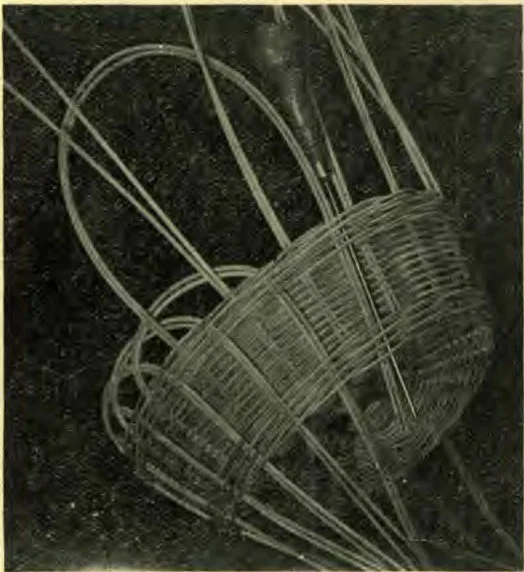
For the border, take any pair of stakes, pass them to the right back of two pairs of stakes, and with the aid of the awl drawn through pairing and waling, outside of single weaving and through the upset, leaving a loop one inch deep at top. Take next pair of stakes at right, and treat in the same manner. Fig. 1. Repeat until all are used. Give special attention to the last two pairs, and see that all the loops are even. Invert the basket; cut the right stake of each pair as short as possible. Pinch each of the remaining stakes close to the bottom of the basket.
FIG. 2
FIG. 2
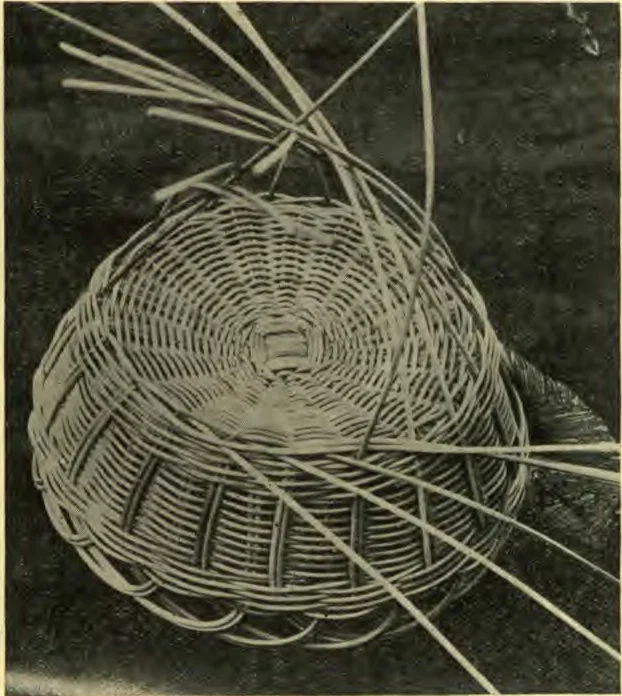
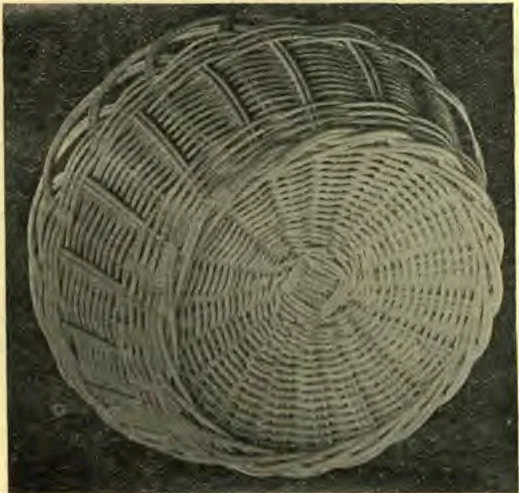
To form the braid, take any stake, pass it to the right back of one stake, and draw it well down with end on outside; treat next stake at right in same way. Repeat until four are down. Take the left stake of the group laid down, pass it to right over the others that are down, in front of the first standing stake, back of the next stake and out at first vacant space; holding this firmly in position, lay the first standing stake down close behind it, bringing the end out in same space. Fig. 2. Keep the two side by side, not one above the other. Now with the thumb of left hand placed in front of what has become first standing stake, let the forefinger hold in position the two stakes laid back of it. With the right hand take the left stake of the group that are down, pass it to right over those that are down, in front of first standing stake, back of next and out. Lay first standing stake close down behind it. Repeat until all the stakes are down. When the first four stakes have been used, the rest will be found in pairs. Always use the right one of the pair—the longer one. The last four stakes will have to be threaded in beside the first four to complete the first part of braid. Tying a bit of thread near to basket around each of the first four stakes before they are laid down will help you to locate them in finishing off. When all the stakes are down, it will be seen that there are still four pairs, and also four vacant spaces. Take the long stake of the left pair, pass it to right, and with the help of the awl slip it in front of the first stake laid down,—the left of the group with thread tied around,—bring it out next to weaving of basket, in first vacant space. The long stake of next pair should be placed in front of next one with thread, etc. When finished, this part should be exactly like the rest of the braid, and there should be one stake projecting from each space around the basket just below the braid. Give each a firm pull to insure its being tight, then cut close to basket. The ends should scarcely be visible. To avoid having them in the outside of basket, this braid may be made by working toward center of base instead of outside of basket.
FIG. 3
FIG. 3
A coat or two of white shellac added to any reed work gives greater firmness, and protects from soil. Wood-alcohol may be used to lessen the expense.
MRS. E. M. LONG.
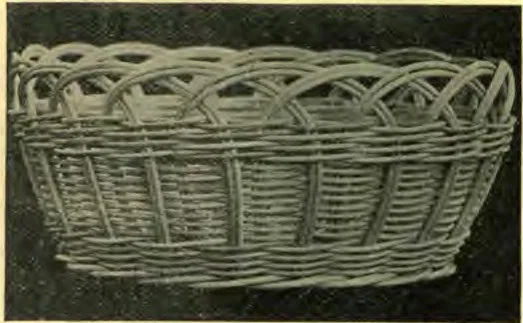
FINISHED BASKET
FINISHED BASKET