Golden Gate Park
SAN FRANCISCO contains many parks scattered about in different parts of the city; but most of them are small, covering from one to three blocks, and are called “squares.” These are well laid out and well cared for. Pleasant walks lead among trees and shrubs, flowers and lawns, while comfortable benches are to be found everywhere. These squares are well patronized, those in the residence districts being used as playgrounds by laughing children and resting-places by tired women; while those situated near the business sections are made to serve as lounging-places for idlers. But to speak of “The Park” in San Francisco is to speak of none of these.
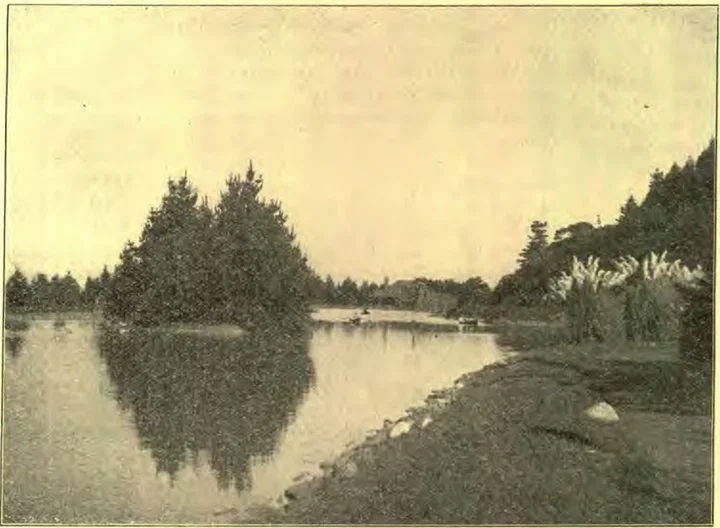
The city’s pleasure-ground and pride is a tract of land half a mile wide, and three miles long, extending from the outskirts of the city proper to the wave-washed sands of the ocean beach. Here the city, represented by its people, repairs every afternoon and all day on Sunday to get a breath of fresh air, a whiff of the fragrance from green grass and blooming flowers, and a respite from the noise and bustle of the busy metropolis.
When the city secured title to this tract of land, and determined to make of it a park, it was an area of barren sand that for ages the unceasing wind from the ocean had been piling into great, bleak dunes, and was entirely destitute of vegetation, save for an occasional patch of chaparral that had taken root in some sheltered spot. But the ocean breezes, though they seem cold to one who must face them, bring from the Japan current some of the heat that that great ocean river has stored up in its waters, and brought from its birthplace, thousands of miles away in the tropical seas. Before this breeze the snow of the arctics melts and falls to the earth as rain; so that, summer or winter, the whole coast region of California is blessed with a semi-tropical climate. With this advantage the men who first conceived the project knew that time and patient labor would turn the great waste of sand into a landscape garden of which the city might well be proud. From that day to this the park commissioners have labored along lines of progressive improvement. The park now contains a splendid system of roads, some thirty miles in all, artistically laid out and well kept, besides innumerable paths for the use of wheelmen and pedestrians. Through these the visitor may ride or stroll for hours, or even days, surrounded by luxuriant grass and flowers and shrubs, and nowhere reminded of the shifting sands from which the park was reclaimed. Nor need the pedestrian confine himself to the paths alone; there are no “Keep off the Grass” signs in Golden Gate Park, and he may wander where he will o’er wooded hill or grass-grown slope, through shaded dell or flower-decked vale.
In so brief an article as this it will hardly be possible to enumerate the principal features of interest, much less describe them in detail, for every one of the thousand acres of the park contains something worth seeing, and failing that, worth hearing about.
The tea garden, a quaint bit of transplanted Japan, never fails to interest the visitor; especially if he is unfamiliar with the architecture of the Japanese.
Strawberry Hill is well worth the climb up the rustic stairs or around the winding road that leads to the observatory on its summit, from which one gets a splendid view of the park, part of the city, and the surrounding country. Strawberry Hill is an island in Stow Lake, upon which, if the visitor feels so disposed, he may take a row in one of the boats furnished at a nominal rental.
In the conservatory will be found many rare and curious tropical plants and flowers, each marked with its name and native country. In the animal paddocks, buffalo, elk, and several species of deer roam about at will. A number of carnivorous animals are confined in strong cages and especially constructed pits. Among these latter is a monstrous grizzly bear, said to be the largest in captivity. It is certainly the largest the writer has ever seen, and as large as he would care to see unless a fence of good strong iron bars stood between it and him.
To a bird-lover the aviary will be an interesting feature of the park. It is simply a cage of closely woven wire. But it is large enough to inclose a number of fair-sized trees, and give the thousands of birds that inhabit it plenty of room to stretch their wings without danger of interfering with their neighbors. Many of the birds have been brought from distant foreign lands; but natives and foreigners seem to get along in perfect harmony, and all appear quite contented with their lot. They certainly ought to be contented; for here they enjoy all the comforts of freedom, without its trials and dangers, and all the luxuries of confinement, without its galling restraint.
So many and so varied are the attractions of Golden Gate Park, that if all the prominent features mentioned in this article were removed, with the room they occupy, they would scarcely be missed.
J. EDGAR ROSS.