The Passing of Finland

7%

Review and Herald Publishing Assn. · Washington, D. C. · August 23, 1904

FromThe Youth’s Instructor, Vol. LII, No. 34

Read the full edition

“The Passing of Finland”

HEAVEN is but earth with one word lost from its vocabulary,—selfishness. Were all the misery, wretchedness, sorrow, falsity, and sin of all hearts in all the world and of all the ages crowded into one living picture, it should be labeled selfishness. Just that bit which has sometimes been found in one isolated human heart, has made thousands of other hearts bleed for long years. A strong, greedy, conquering nation is but the combined, multiplied selfishness of the millions; and earth’s history is but a record of the woe and devastation wrought upon sensitive souls by such fearful combinations.
Fresh in the minds and hearts of a people of superior culture, and with a distinct literature and art of its own,—a law-abiding, industrious, prosperous people,—is the record of a recent event caused by a nation’s selfishness. Russia in 1899 laid her iron hand upon the little country of Finland, and it resulted in a tragedy that has touched the heart of the world. To-day, Finland is dying.
Since 1362 this country has enjoyed home rule; it had been in possession of its political rights, having had representative right in the Swedish Parliament, for Finland was long subject to Sweden. A prosperous, progressive country, enjoying all the blessings of liberty, no better form of government was desired by the Finns.
In 1808, however, Russia concluded that a change in affairs would be well for “The Bear” if not for Finland; whereupon, like a bolt from the blue, the Russians crossed the eastern frontier, and forcibly wrested, on Feb. 12, 1808, the little country from Sweden. Whether from policy or from the kindness of the reigning czar, Alexander II, the Finns were allowed to keep their own independent government. In fact, the czar promised not to disturb their peace or prosperity in any way,—all things were to continue as they were, save that he would be commander-in-chief of the army, and would direct in the management of foreign affairs. The change was to be regarded more as annexation than conquest. The Finns accepted gratefully this promise of Alexander II.
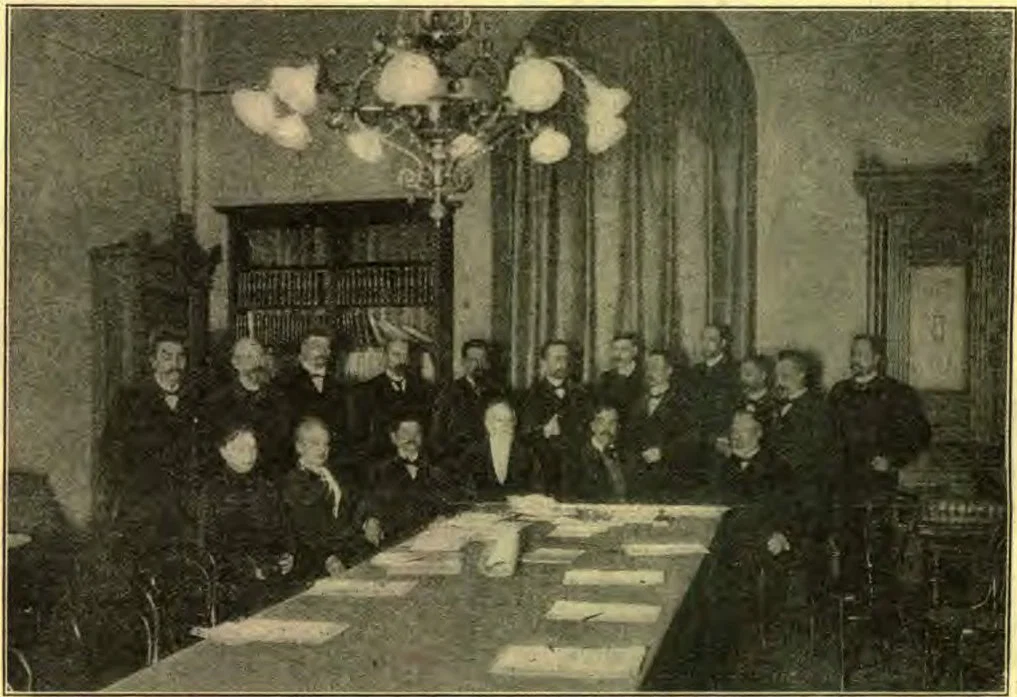
GUESTS OF THE SECRET DINNER AT DR. SALZMA'S HOUSE
Not until 1899 did the people come to realize the full meaning of the invasion of 1808. But on that fatal day in 1899 Nicholas II, with one stroke of his pen, broke the heart of the justly proud and sensitive Finland. That stroke said that “it was necessary that Finland be united by closer bonds to the empire of Russia,” and the humane czar proceeded to effect the closer union by abolishing the Diet of Finland, promising in future himself to legislate for the country without her assistance. He furthermore demanded that the Finland army be disbanded, and the soldiers scattered throughout Russia’s wide domains.
By all this Finland was not angered so much as crushed. The reception of the czar’s edict put the whole country in mourning; every man, woman, and child wore black, and the public buildings were draped in crape. A force resistance meant simply the utter extinction of the race; therefore the people thought it wise to appeal. Delegates and petitions were hastened to St. Petersburg; but the “humane czar” received neither. In silence, however, his iron hand continued to execute his determinations. The leading men of Finland were arrested, imprisoned, or exiled; statesmen, writers, educators, men of wealth,—all alike. Then began the exodus of the people, the Russian persecution forcing many to leave their country. Incredible as it may seem, Nicholas II was the originator of The Hague peace document that called The Hague Peace Council a few years ago. The Finnish tragedy succeeded very quickly that temporary pacific outburst of the czar.
“In 1898 the number of Finn immigrants to America was less than three thousand. In 1899, when the czar issued the fatal decree, the number increased to twelve thousand; in 1900 to twenty-five thousand; and in 1903 to half a hundred thousand. Since 1898 more than one hundred fifty thousand Finns have come to the United States, and there are now over two hundred thousand under the American flag.” Italy sends annually more immigrants than any other country; but only one sixty-fourth of her population is now here, while one tenth of all Finland’s inhabitants has come to this country since 1898. What this great exodus stands for in sorrowing hearts, broken homes, lost property, maltreatment, and wretchedness in general, only the Finns themselves can tell.
So loyal are the leading men, that they will not leave until their goods are confiscated, and they are forced to leave by order of the czar. They remain even at the risk of being banished to Siberia, regarding it the duty of the educated and influential men to “stick to their country to the last, the same as a captain to a ship,” thus helping to hold the peasants, and prevent a panic that would utterly depopulate the country.
Russia for some time had held quite a strong censorship over the press of Finland. No paper was allowed to go from the press without examination, and whole issues were ofttimes withheld until revised. Papers coming into the country were also noted, and anything that the authorities preferred not to have the receiver read, was marked out with black ink. After the trouble, no public meetings were allowed, it having been decreed that not more than three persons of different families were to assemble without first supplicating permission from the Russian dictator; and Russian spies were ever on the alert to prevent any evasion of His Majesty’s commands.
Secret councils were held by the leading men, but at a very great risk to all in attendance. One of the illustrations shows a company secretly gathered at the home of Dr. Salzma, the leader of the Finnish National Party, and a man of wide reputation. At this dinner were present senators, the mayor of the chief city, professors from the university at Helsingfors, editors, a minister, and the chief architect of the capital city. One American then visiting in the country was invited, and to him we doubtless are indebted for the picture of the illustrious gentlemen in attendance. In less than forty days after this meeting, ten of the men were bidden to leave the country. Three are now in the United States, forced to begin life anew on a foreign shore.
Such is one picture in the long, dark history of selfishness. May the Saviour soon come to establish his rule of justice and peace upon the whole earth.