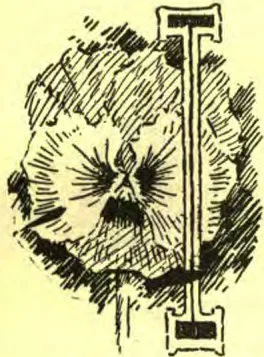
HAVE known a great many plants, and have been fond of them all. Some have been beautiful and interesting for one reason, and some for another. And all of them, from the seeds and slips that refused to grow, to my most cherished palms and geraniums, have been among my choicest friends. One of my first acquaintances was the pansy, a charming flower. It has a bright little face, which will smile back into your own if you look at it with the right eyes. If you hardly believe this, examine the first pansy that you find, unless it happens to be one of solid color. Another of my early acquaintances was a geranium which bore striped scarlet and white florets, and pure scarlet florets in the same cluster. The blossoms were single.
I know of a lady who says that she once planted a packet of choice carnation seeds, but when they came up, they were tomatoes! The florist, you see, had made a mistake. I never had quite so exciting an adventure as that, but I have known a number of freak plants of which I will tell you. In my garden there is a rose-bush which bears, at the same time, solid, deep-pink flowers, together with nearly white flowers having bright pink centers. This came to me as a striped rose, and as the colors grow less pronounced every year, the bush may, in time, blossom as originally expected.
I once came across a fine specimen of “Bouncing Bet,” which was bearing handsomely variegated foliage of white, cream, and green. Regardless of the fact that the plant might spread and cause me trouble, I took it home, and gave it a place of honor in my flower garden. But it did not take kindly to the roses and phlox, and it soon died. Since then I have seen the foliage of clover, corn, and potatoes marked in the same way as the saponaria officinalis that refused to live in my garden. I once had a Marguerite carnation that bore both double and single flowers. It was quite a curiosity, and many people would hardly believe their eyes when they were looking directly at it.
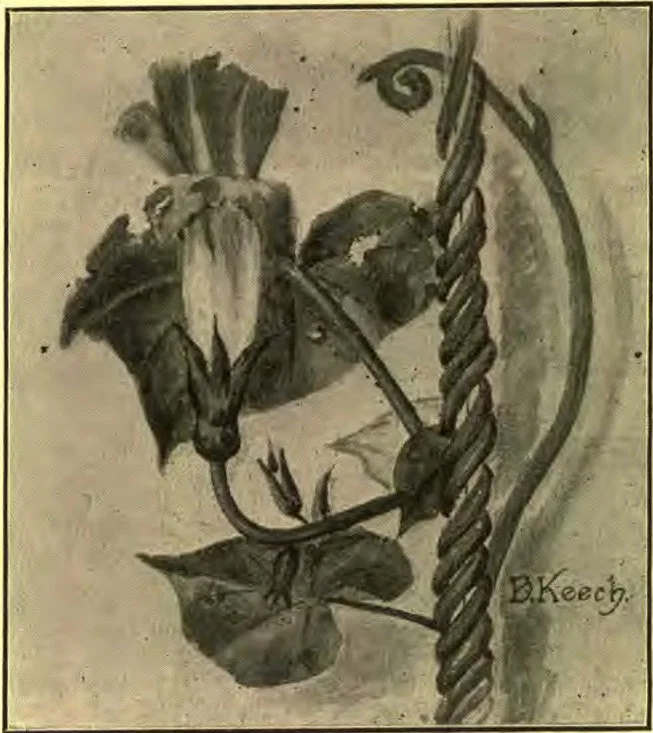
Each plant, you will find, has interesting habits and “ways of its own.” While sitting near a vine-shaded window one day, I spied a morning-glory trying to bloom by thrusting its little head up through a hole in a leaf that grew directly above it. I got my paints and made a picture of the flower, which is reproduced on this page. Morning-glories, by the way, are very satisfactory vines to cultivate; any one can grow them. It is a pleasure to drop the little black or white seeds in the earth; for you are almost sure they will “come up” and do well. It is also fun to provide the little vines with strings upon which to clamber. One can almost see them grow.
The wild cucumber is another interesting and satisfactory vine. It is a rapid grower, and with assistance will soon reach the roof. It can be made to shade a porch or window; and, if desired, will run over the ground or climb a fence in an equally obliging manner. It bears fragrant, white, spray-like blossoms, which in time “turn into” small, fat, prickly “cucumbers.” Last summer, in a distant city, I became acquainted with a collection of orchids, and so admired them that it was really difficult for me to leave them. Orchids are certainly beautiful; their coloring is exquisite, and their manner of growth interesting. But I wonder if there are not a great many plants better known than the orchid which are really as beautiful. It is their commonness that makes them seem less interesting.
HOW A MORNING-GLORY TRIED TO BLOSSOM
For instance, there is the gladiolus, which possesses colors that any orchid might covet. Then, again, there is the iris, the texture and coloring of which are all that could be desired. I have known many beautiful roses, a number of which have become to me particular favorites. I wonder if most of my readers can not invest in a little rose called Clothilde Soupert. This plant is very free-flowering, and has small, compact, white blossoms with peach-pink centers. It is not difficult to grow with success. A good companion for Clothilde is Champion of the World, which has bright pink blossoms freely produced. Meteor is another fine and easily cultivated rose. It has rich scarlet blossoms. See if you can not have these plants, sometime.
I have known many ferns in their native woods, and have liked them so well that I have adopted them, and given them a permanent home on the north side of the house. They always interest me, and I can not resist them. I have there likewise hepaticas, violets, and other wild flowers. Almost any one can start a similar garden. I renew my acquaintance with hyacinths, crocuses, and other bulbs every winter, and like them more the longer I grow them. Did you plant a few, as advised in this paper last autumn? If so, you have also begun to know a very satisfactory and beautiful class of plants. Continue to cultivate them. I hope you are also familiar with Chinese primroses; for these excellent little flowers are among one’s choicest acquaintances.
Sometimes a person will learn to like a plant so well that he will call it endearing names. I have a nice big palm that I call “’Rastus.” I don’t know why it should be ’Rastus more than John or Harry, but ’Rastus appealed to me, and ’Rastus he is. His real name is Kentia belmoreana, and perhaps that’s the reason I changed it. It is much easier to say, “I think I’ll give ’Rastus a bath this morning,” “’Rastus must have some nice new plant-food to-day,” than to announce that Kentia belmoreana would like a drink. ’Rastus and I like each other very much. I have several palms that have no names except their Latin ones; perhaps some day I’ll find better names for them. But don’t fail to make friends with the plants; they can teach you many things even of eternal worth, and give you a wealth of pleasure every day.