Hats and Other Head-gear
A CERTAIN author of a book on Korea has an entire “Chapter on Hats;” so I need not offer any apology for devoting one of these short sketches to the subject.
The use and significance of these head-dresses can best be explained by first describing the manner of wearing the hair. The hair is left to grow long by men, women, and children. No part of the face or scalp is ever shaved or clipped, so there are no native barbers in Korea. If, perchance, a Korean has his hair cut, or his face shaved, he is departing from the traditions of his forefathers.
Unmarried boys and men wear the hair in a long braid, like the Chinese, except that it is not pieced out with silk cord. But why say unmarried boys?—Because in Korea many boys are married while yet in their early teens. The rule seems to be, the better the circumstances of the family, the younger the boys are married; for a poor young man must defer marriage till he can support a wife.
After marriage, the hair is combed up and tied, then twisted into a slender pug at the crown of the head. When the hair is dressed in this way, loose locks are liable to hang down the neck and about the temples. To keep these in place, a band about three inches wide, woven of horsehair, or sometimes of human hair, is bound about the head, from the forehead to the base of the skull. This is not worn by all.
Unmarried boys and men may not wear any kind of hat or head-dress. After marriage even till middle age, a tall, four-sided, horsehair coronet may be worn. The man on the left in our illustration wears such a one. It is open at the top, hence affords no protection to the head. A modified form lacks the lower, outside crown. Aged men may wear a box-shaped hair coronet, closed at the top. The form shown upon the head of the man in the center of our illustration, is that worn by scholars. These hair head-dresses are commonly worn about home, in the house as well as out.
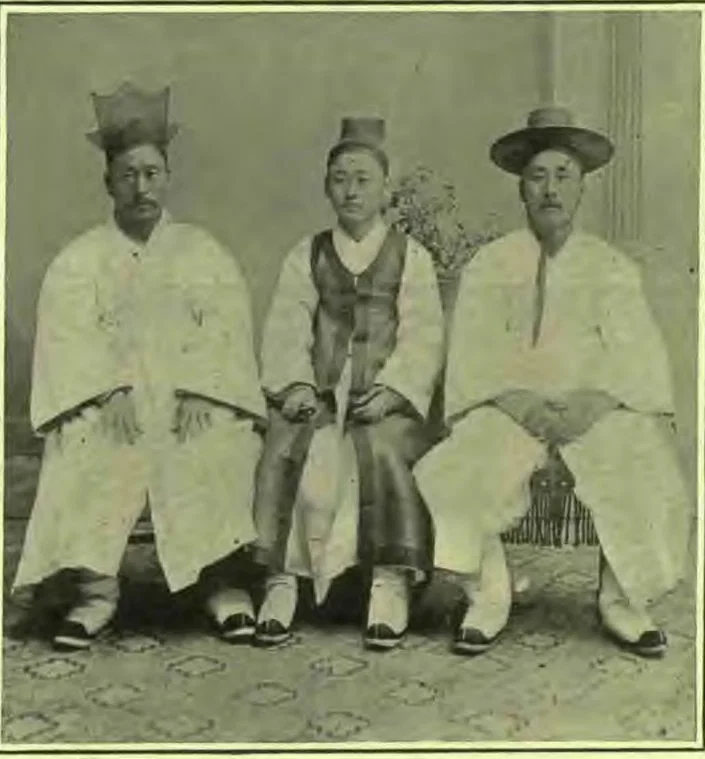
The form of hat worn by the third man in the picture, is that commonly worn upon the street. It is made of white or black gauze cloth over a very light bamboo frame. The white one is the mourning hat, and is now almost universally worn in memory of the empress, who died some years ago. But the black hat may be worn if a piece of white paper is pasted over the crown.
There is a curious tradition about the origin of this form of hat. Long ago a certain Korean king wished to restrain his excitable subjects from the frequent broils and fights which disturbed the peace of his realm. So he enacted that the men should use earthenware hats; and further decreed that whoever got his hat broken should be punished. So it was not necessary for the prosecuting attorney to prove that a man had quarreled; the broken hat was all the evidence required. We are not told how long this unique law remained in force; but even after its abrogation, hats of the same shape continued to be worn, even to the present time.
Then there is the cap worn as a sign of mourning for one’s relatives. This is made of a piece of coarse linen, and so formed that the crown resembles the roof of a house, with the gable ends at the sides. Very rigid rules govern the wearing of this cap. It may not be worn longer than three years in any case. The length of time it should be worn for the death of father, mother, and other relatives, is definitely prescribed. This cap is worn about home; but during a journey or on the street, it is replaced by a splint hat as large as a market-basket. Such hats may be easily picked out in the illustration accompanying No. V of this series.
Then there are sun-shades, varying in size from that of a broad-brimmed straw hat to a large clothes-basket. These also are made of splints, and may be distinguished in the illustration mentioned above.
Korean etiquette does not require that the hat shall be removed upon entering a house. So even in church, horsehair coronets, mourning caps, and hats with tapering crowns, all remain upon the heads of the worshipers during the service. Again we lay aside our prejudices, and appear not to be shocked, that we may become “all things to all men.” F. W. FIELD.