(Concluded)
You may be interested to know how the country people of Finland live. There is generally one large room in the home of wealthy families. There may be one or two smaller rooms, for strangers and the accommodation of the friend, when he comes. In the large room is a table, and there may be one or two benches, upon which the people sit. In some of these large rooms they have beds. In east Finland there are generally no beds; the people sleep on box-like benches, made around the walls, or on the floor. In these benches are the mattresses and bedclothes. The rooms are heated by a large brick oven. They also use the regular log house fireplace for cooking. In summer the peasants work about eighteen hours a day, and in winter they sleep about twelve hours. In the north even longer sleeping hours are observed.
The poor people working for the farmers get about ten cents a day and some food. There are no plates on the table. The potatoes are put in one dish, herring in another, and then there is a dish of mush or soup. The hired people sit around the table, using nature’s fingers, save when it comes to soup, which is eaten with wooden spoons. Generally these poor peasants are not paid in silver or gold or paper; they receive their wages in potatoes and rye. The grain is harvested as in Ruth’s time—by women, who seize on a handful of grain and cut it down with the sickle. The grain can not be dried in the open air by the sun. It is placed on the ground, in a large, tightly built log house, around a big heated brick oven. Such a house is called a reea. The grain is either flailed out, or threshed by a very slow, simply constructed native threshing-machine.
But of course in more wealthy communities there are modern threshing-machines.
The people do not live in scattered, widely separated houses, but in village communities, as in southern Germany. Within the last ten or fifteen years public village schools have been established, in which are taught the common branches and the Lutheran religion. The children attend these schools until they are thirteen years of age. Completing, at this time, the work offered in these schools they are examined, and then study for a few months with the priest on certain days of the week. This is the confirmation school. After finishing the work here, they are confirmed and take part in the Lord’s supper. No one can get married or obtain a state office of any kind unless he has gone through this confirmation school. A person can not sever his connection with the church unless he unites with a body recognized by the state. He must pay his church dues even though belonging to a non-recognized sect. The Methodists and Baptists are recognized by law, and of course the Russian church has all the rights it wants.
Certain interesting facts should be noted with reference to these churches recently recognized by the state. For example: The law granting them their rights says they shall not baptize a candidate under twenty-one years of age. Of course a father whose children are minors may leave the Lutheran Church with them; but the children who are of age must decide for themselves. A man who unites with the Baptist or Methodist Church ever remains a member of that, though he may become a backslider and reprobate, until he comes before the proper church officials and renounces his former faith. This makes it necessary for these churches to have two church records—one for members in “good standing,” and the other for “backsliders.” Not all the individual Baptist and Methodist churches have accepted this law. After a church does accept it, that church must have the senate of Finland sanction its choice of pastor, before he is recognized as the regular pastor of that church.
Sometimes the senate has failed to sanction the first choice, and another man has had to be chosen. All of our people, and all sectarians, and all individual Baptists and Methodists, and all local Baptist and Methodist churches who have not accepted the provisions of the law, are still members of, and must pay their dues to, the state church.
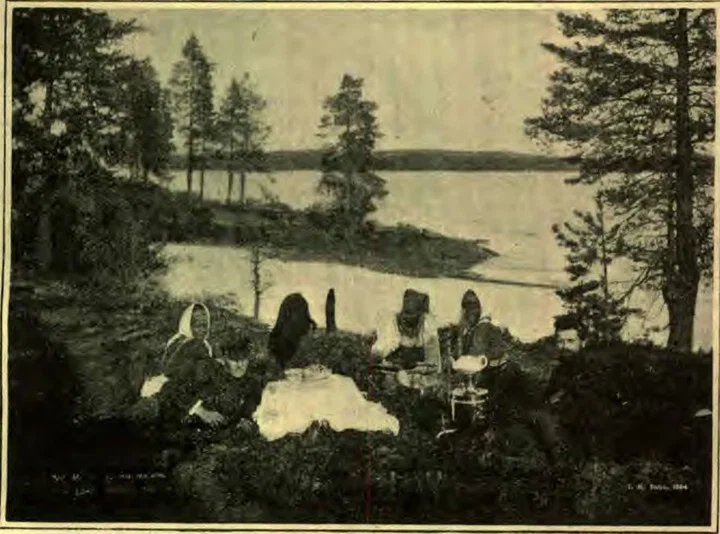
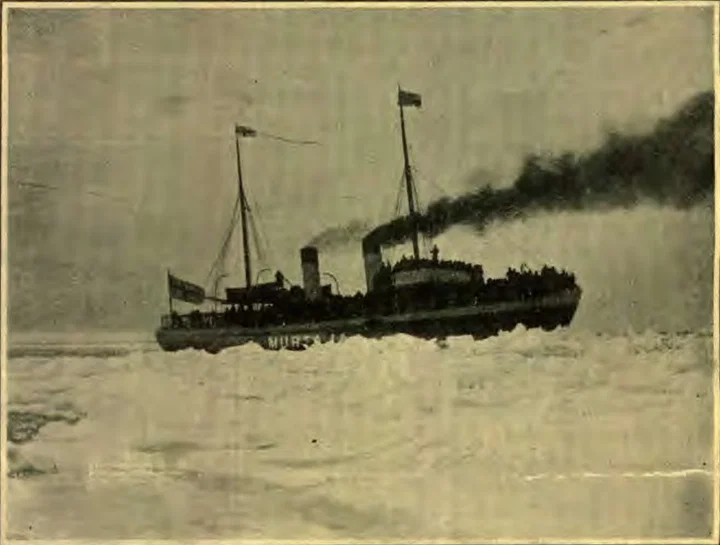
I send two photos. One is of a genuine outing scene in east Finland. In the foreground is the tea-pot. The round loaves of bread are in the basket, and there are also cakes. On the white cloth is the sugar, and you can see the small fish. In many places for a meal the people have only sour rye bread (sometimes mixed with bark), potatoes, salt, and coffee. Fish is also largely used. The land, pine trees, and water and rocks form a typical Finnish scene. The other is of the ice-breaker boat, which opens the harbor in spring. There are two of these boats. The other is much larger and stronger, and cost more than a million Finnish marks. The coming of these boats is a great event, as it betokens the opening of the spring season. The whole city is full of rejoicing when the boat comes.
Our Work in Finland
While there are some things that might be changed for the better, as in every other field, there are many encouraging features. There are always minor difficulties that have their influence in drawing away those who are weak in the faith, and no one can fail to see that only those who love the truth above anything else in the world will be able to stand. If it is not one thing, it is another, that tries the faith.
Financially the cause here is in a comparatively good condition. For the twelve months ending Oct. 1, 1903, the tithe amounted to 3,486.42 Finnishp. 2 marks; Sabbath-school donations, 194.68 marks; raised for the Finnish mission, 959.07 marks; for general gifts, 256.22 marks (5.10 Finnish marks equal one dollar). Swedish papers to the number of 15,200 copies have been sold; 33,500 copies of the Finnish paper, Aikain Wartija, which has a monthly issue of 3,500; 12,029 copies of books were sold in Finnish and Swedish, valued at about 25,000 Finnish marks; 645,075 pages of tracts have been sold; 298 copies of “Christ’s Object Lessons” in Swedish. During the same twelve months we published here “Christ Our Saviour,” Swedish, 6,450 copies; “Steps to Christ,” Swedish, 8,000, Finnish, 13,000; Swedish tracts, 30,000 copies. This Helsingfors house also sold 5,000 copies of “Christ Our Saviour” to Sweden. These books are not included in the reckoning given above. It is expected that the book, “Thoughts on Revelation,” by Elder L. R. Conradi, in both Finnish and Swedish, will be published here the coming year, as well as “Ministration of Angels” (Finnish) and “Christ Our Righteousness” (Swedish). (It will be remembered that there are in Finland about 300,000 Swedes, and about 2,300,000 Finns, and there are a number of Russians. Number baptized, ten; present membership, sixty-five, divided among the church in Helsingfors and the companies in Borga, Bjorneborg, Vasa, Åbo. Nine of the sixty-five are isolated Sabbath-keepers.
For the coming year the same officers have been chosen as served last year.
There has been a ten-days’ canvassers’ institute in connection with the meeting, and our nine canvassers have good success in this field.
The coming season Elder Anderson continues his meetings in Helsingfors until Christmas, and Brother Hoffman carries on the work in Åbo until next summer. Åbo, with its suburbs, has fifty thousand people. This city is where the Swedes landed when they first came to Finland. Here they built their first castle and church. Here the Swedish Catholic soldiers went out and gathered the heathen Finns into the city, and Bishop Henry sprinkled water on them, as soon as they could repeat the Lord’s prayer in Swedish after the priest. Whoever refused to accept of the baptism was killed. The well from which the water was taken for the baptism still exists, and is known as Kupp’s well. A large painting of this scene hangs in the cathedral at Åbo. The Finns, however, finally killed this bishop.
One Bible worker will be engaged in the Swedish work, also a sister, who will later, it is hoped, develop into a Bible worker for the Finnish people. The workers in Finland have had some interesting experiences. One man was recently baptized who first came into the meeting intoxicated. The subject under consideration was intemperance, and its effect upon one’s children was mentioned. (The second commandment was the real subject of the lecture). This man sat in the front seat, often interrupting the speaker with a demand for Bible proof for the statement made. He went away, stopped drinking, came to no more meetings for a long time. Then for a while he came again, and a few Bible readings were held with him, but there was no decided result. In a few months the minister moved to a city about three hundred miles distant. He exchanged one or two letters with the man. His mind had no rest. He went to the doctor, who examined him, and said his health was good, only there must be something his mind was troubled about. Eighteen months after the first sermon was heard, the man made an unannounced visit to the city of the minister, and, strange to say, found him at home, as he had been providentially detained from taking a journey he had planned for. The brother was baptized, and now desires to give himself to the work of warning others. God’s Spirit always strives with men, if there is any hope that they will yield to him,
The work in Finland should go forward. This seems a good field. The Finns are hospitable, liberal, kind-hearted. God has a people here. Pray for the workers, that more power may be given them, so that a rich harvest of souls may be gathered in. Here in Helsingfors we have a commodious hall, used by students and for public lectures, and the rent is not expensive. O that God’s power may unite all the hearts of the workers, and that the work may prosper!
GUY DAIL.