Sin Tsai Hsien

7%

Review and Herald Publishing Assn. · Washington, D. C. · August 30, 1904

FromThe Youth’s Instructor, Vol. LII, No. 35

Read the full edition

Sin Tsai Hsien

OUR mission station was reached November 7. The clean mission compound was a grateful refuge to us after our varied experiences; we appreciated the rooms Brother Piliquist had prepared and reserved for us. The cities in China are arranged in three classes or ranks. A city of the first rank is called a Fu city, as Runing-Fu; one of the second rank is called a Cheo city, as Sin-Iang-Cheo; of this kind was our old mission station; while one of the third class is called a Hsien city. Our city belongs to this third class, Sin-Tsai-Hsien. Besides these there are a number of towns and villages. All these cities are governed by a mandarin, who is the chief executive, and is respected by the people according to the size of the city which he governs. There are various minor officials, all under the mandarin, such as magistrates and the chief of police. The government is very corrupt, from the highest to the lowest; it is a system of extortion by taxes levied upon the people.
The imperial government demands a certain amount of silver from each Seng or province, and the governor of this province levies a certain amount that is apportioned to each city in his province, the amount depending upon the size of the city. The mandarin of the city must raise this amount. He does it by charging property owners a tax; he has also other resources for getting money. At each of the four gates of the city he has his tax collector stationed, who collects a tariff on all the produce brought into the city. He always makes this tax so high that there is a large surplus left to go into his own pocket. Besides this he receives a stated salary. This makes the office of mandarin much sought after by the people. Men will spend all the money they have in getting the office, being assured that it will all come back to them, and that they will be made rich thereby later on. The same is true of the governor of the province. He also requires more of the cities than the imperial government requires of him, and thus secures for himself a large booty.
The people of China placed two and a quarter million taels of silver in the hands of Li Hung Chang with which to repair the banks of the Yellow River. He used one million taels in the construction, and kept the rest. As a result the walls were imperfect; and when the waters raised, the river flooded the country, and over a million Chinamen fell victims to the swelling waters. Because of this act the Chinese have no love for Li Hung Chang.
There is much ill feeling on the part of the common people against the ruling element of the country. This feeling has brought about the present condition of the country in which there is no spirit of patriotism, and no interest in public improvements. The cities of the Fu, Cheo, and Hsien classes are walled, the walls as a rule being about thirty or thirty-five feet in height, built of kiln-dried bricks. Outside the wall is a deep moat filled with water; inside, the earth is banked up to within six feet of the top. The smaller cities have four gates—east, west, north, and south—and these are kept locked during the night. The larger cities not only have an outer wall, but inside this there are walls dividing the city into several divisions.
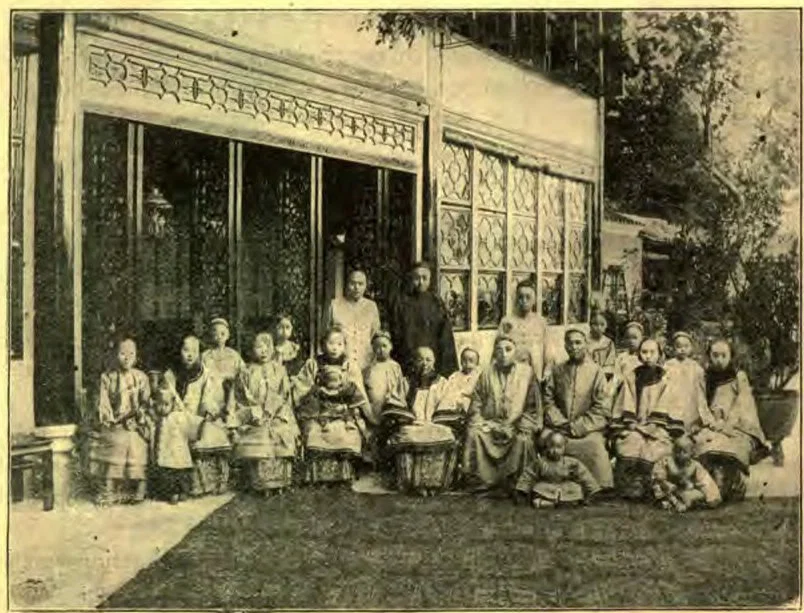
THE FAMILY OF A WEALTHY CHINAMAN
As a rule there are four main streets named after the four points of the compass. There seems to have been some order in the laying out of these four streets; otherwise the city is built promiscuously, with a few narrow streets and alleys here and there. Within the city there are always to be found several large ponds that were made when the earth was taken to build the wall. These ponds serve as a breeding place for fish, and for irrigating purposes. The women of the city resort here to do their washing.
Though the streets are supposed to be a passageway it is not an easy task to make one's way through them because of the many obstructions. The carpenter piles his logs in front of the shop, and fills up half the street; a man wants his house freshly plastered with mud, so he has five or six cart loads of earth hauled and dumped in the middle of the street, there to remain for probably three or four weeks. The tanner lines the street in front of his shop with hides for the people to trample on, and thus hasten the tanning process. The farmer, coming in with his load of straw, cane, stalks, or vegetables, sits down with his load in the midst of the street to rest and have a smoke; nobody tells him to get out of the way, but the people either stop and wait or go around him. On either side of the street the shopkeeper has benches, and on these are displayed the larger part of his stock of goods.
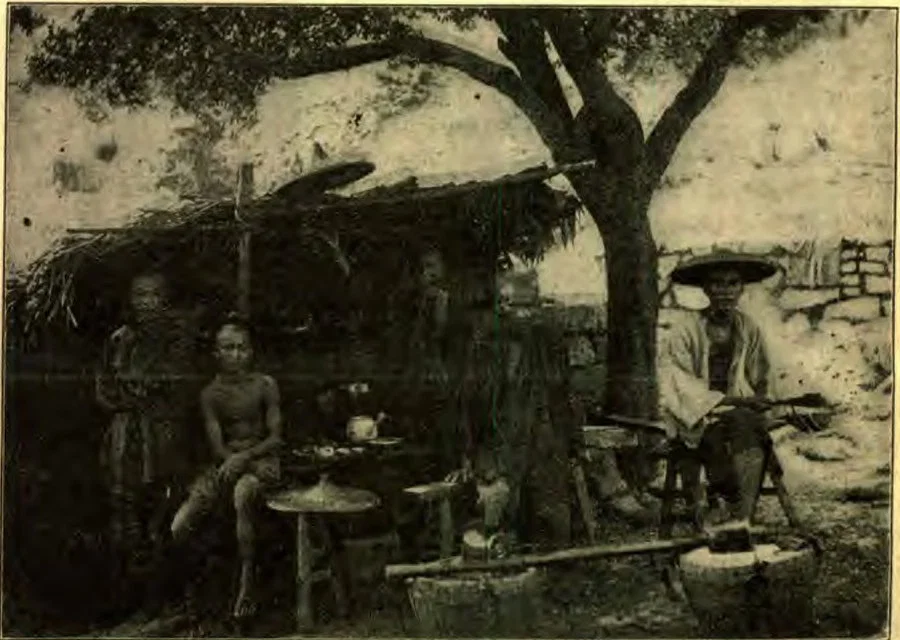
A BOOTH RESTAURANT IN THE STREET
The place of the lunch-counter and restaurant is largely supplied by the numerous food vendors. These men carry their outfit on a pole; on one end is a supply of foods and a table; on the other is a mud stove with a basin of rice or fried cakes or a mixture of vegetables cooking. If accosted by a hungry native, the man places his restaurant down in the center of the street, and serves his customer. The man who has bought the bowl of food squats down and takes his meal. At this season of the year while New-year's sales are in progress, not only the sides of the streets are lined with benches, but there is a row of benches in the middle of the street piled with goods, leaving a way on either side wide enough for pedestrians to pass single file.
Sin Tsai Hsien is in the east central portion of Honan, surrounded on all sides by a fertile farming country that sustains an immense population. While Brother Piliquist was preaching in a city about fifty miles to the east of here, a citizen of this place came requesting him to come and preach in Sin Tsai. From the first, the attitude of the people has been very friendly.
The mandarin and leading men of the city are kindly disposed, and have helped us in many ways. The people in the surrounding country and villages seem to be much more interested in the gospel, and the greater number of our converts are the country people.
Our mission quarters are on the main street running north and south, in a very favorable place to attract the attention of the passer-by. The mandarin issued a proclamation which was hung on the wall of our chapel, stating that if the passer-by wanted to hear the “true doctrine,” he should stop in and behave himself; if not, he should pass on and not molest us. One of our native converts remains in this street chapel the greater part of the time, preaching, selling Bibles, and talking to those who stop to inquire.
We have a large number of sick calling upon us daily for treatment, many of them in the very last stages of their disease, but all expect to be helped. From the country and cities around about comes the call for some one to come and teach them the true doctrine, but we are few in number and can not fill half the calls.
A. C. SELMON, M. D.