A short time ago, as the writer arose to greet the beautiful sunshine of a delightful May morning, he was invited by a friend to take a ride into the country. Without waiting for breakfast, we were soon beyond the confines of the town, coursing along one of the finest country roads I have ever seen in “merrie” old England. The ancient, arching elms by the roadside, with mellow gleams of sunshine penetrating their full-leaved branches; the sweet-scented clover of the fields, shining with clinging dewdrops; together with the balmy atmosphere of the morning, delighted the senses, and made a gratifying change from the narrow, walled streets left behind in the manufacturing town of Kettering.
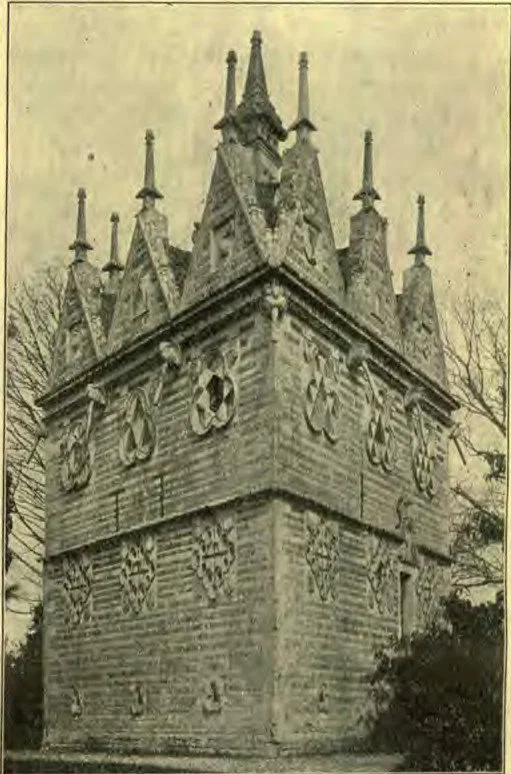
The course taken by the brother who drove was by the side of a sleepy little hamlet, the name of which I have forgotten, but which nestles among the trees on the bank of a brooklet that runs through a vast walled estate near by. On this estate stands a triangular-shaped building in which, so it is said, the notable “gunpowder plot” of the sixteenth century was hatched. This was a scheme by which Parliament was to be blown up with gunpowder. One Guy Fawkes was engaged to place the powder, and lay the train by which the explosive was to be fired. Everything was made ready for the terrible deed, and the time was set for its execution. The plot, however, was exposed just before the day set, by one of the conspirators revealing it to a personal friend in Parliament, whom he attempted to dissuade from attending the House of Commons on the would-be fateful day.
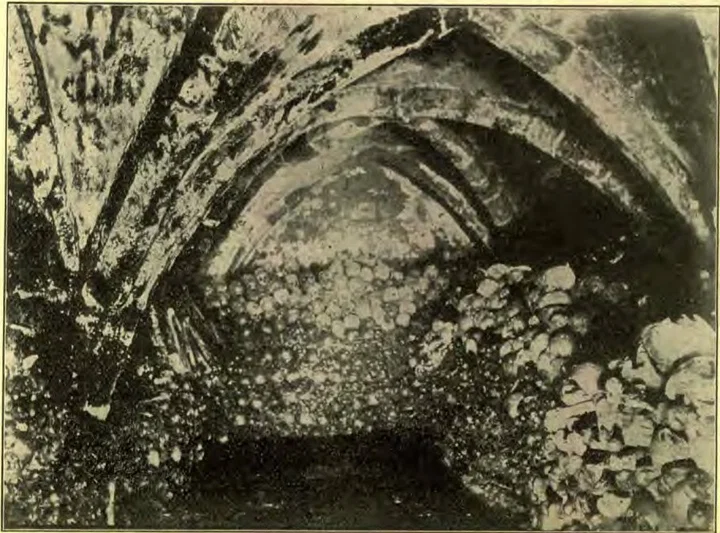
Making a detour through another small town, we soon came to the ancient village of Rothwell. Here we halted to view an old church, supposed to have been two or three hundred years in building, and which was completed about 1055 A. D. It certainly looks hoary enough to be as old as it is thought to be. It was originally built in the form of a cross, but one of the side extensions has gone to decay, and been removed. The other wing is now undergoing repairs in order to preserve it. This one has a great mystery connected with it. In the year 1820 the sexton tore up a piece of its pavement, for the purpose of burying one who was to be placed under the church, when by a smart stroke of his pickax, he broke through a cemented vault, from which issued a smell like that from a charnel-house. Upon lowering a lighted candle through the opening, he was horrified by the sight of a vast heap of human bones.
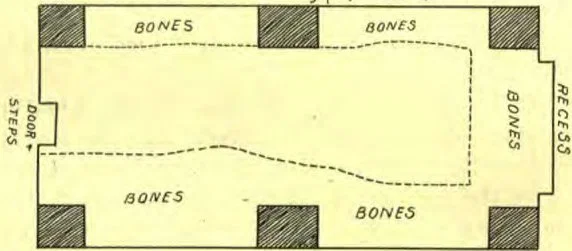
No one could be found who even knew of the existence of the newly discovered crypt below the church, to say nothing of the mystery attending the deposit of bones it contained. No way was found to enter the place, except by digging through the outer wall, but upon entering, an old passageway was discovered, which had been walled up for time out of mind. The kindly old parish clerk conducted me into the place, where I had a view of the gruesome sight. The accompanying diagram gives the form of the crypt, which is thirty feet three inches long, by fifteen feet in width. The dotted lines trace the dimensions of the bone heaps around the room, and the six squares in the diagram represent the stone pillars supporting that part of the church.
The bones were evidently all placed in the crypt at the same time, since they are all in about the same state of preservation, and were stacked, apparently, by the same person, as the same order of stacking is observed throughout. The bones have all been separated from each other, and closely corded in a way to take up as little space as possible. The measurements of the tiers show them to occupy 1275 cubic feet of space. Assigning three skeletons to each cubic foot, there are nearly four thousand dead persons represented in these heaps of bones.
It is useless to speculate as to how they came there, because there is not even a tradition concerning them. Had they been removed from some deserted burial-ground, a record would likely have been kept of the transaction; but no such record is extant. From the general condition of the bones, it would appear that the people they represent died during the same generation at least. Only the day of judgment can reveal their history; and what a record that will be! All the dark deeds of the darkest days of earth’s annals will then be brought to light, together with the life-work of the writer, and of those who read these lines. May it then appear that ours are approved, and that we are permitted to pass into that country where none shall die, nor any say, “I am sick.” J. O. CORLISS.
Leicester, England.