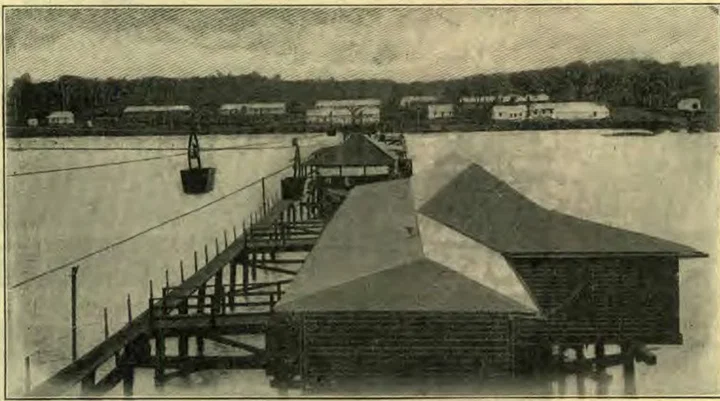
It is not my purpose to weary INSTRUCTOR readers with a subject worn out by many writers; yet I thought you would doubtless be interested in a report of a visit of our own missionaries to that quaint and only half-explained phenomenon, the “Trinidad Pitch Lake.” Our usual duties having taken us within a few miles of the lake, Elder W. A. Sweany and the writer decided to take a half day and visit the wonder of which we had heard so much. At San Fernando we boarded the little coastal steamer “Paria” at nine in the morning, and were soon steaming away to the southwest, along the lowland which forms the peninsular extremity of southwestern Trinidad, whose flat top is but little higher than the sea. At one time these lowlands were cultivated for sugar, but now, for the most part, they form a wild jungle. Soon after eleven o’clock our little steamer stopped at the village of La Brea, the place that is usually connected with the pitch lake, but we were not to land here. Before the advent of one of those modern productions, “trusts,” all pitch was shipped from this village. But the “Asphalt Trust,” an English corporation run by American push, found that it was a waste of time and money to carry all the pitch over this long route, so cut a new way across to the beach, and built their own village of Brighton. Our next stopping place was opposite this village. We stepped down into a little rowboat, which was loaded down almost to the gunwalls. In the moments we could snatch from anxiously watching the waves that continually threatened to swamp us, we saw, as we neared the landing-place, a long narrow wharf built out into the sea, at the end of which lay a steamer being loaded with asphalt for New York. Another steamer bound for London was anchored near by, awaiting its turn. Many of the large cities of Europe get their asphalt from Trinidad. The ships carrying pitch are loaded by iron buckets of about nine cubic feet capacity. These are strung one hundred ten feet apart, on a cable which connects the vessel with the “works” one-half mile away. These buckets each hold about one thousand pounds of asphalt, and the cable that carries them is supported by iron pillars, and works on the principle of the endless chain.
Immediately on reaching the shore we found an asphalt path which led us up over the little hill along the line of buckets. We followed this path through the village, noting that each room had its garbage box, nothing being allowed to be thrown carelessly about to decay and threaten the health of the workers, a necessary precaution in the tropics.
We soon reached the top of the small hill, where, just before us, were the works. We found them to be low sheds—all the building required in this climate—with a few small houses where tools and other necessaries are kept. In these sheds are the engines, with the appurtenances furnishing the power to run the endless chain conveying the buckets to the ship, and also to draw the cars from the lake. Only a small engine of thirteen-horsepower is needed, as it is all down grade to the ships, the force of gravity being almost sufficient to carry the loaded buckets down, and at the same time return the empty ones. We passed on through the works, as our interest was in the lake just beyond, and there it lay before us, a broad black expanse of one hundred acres.
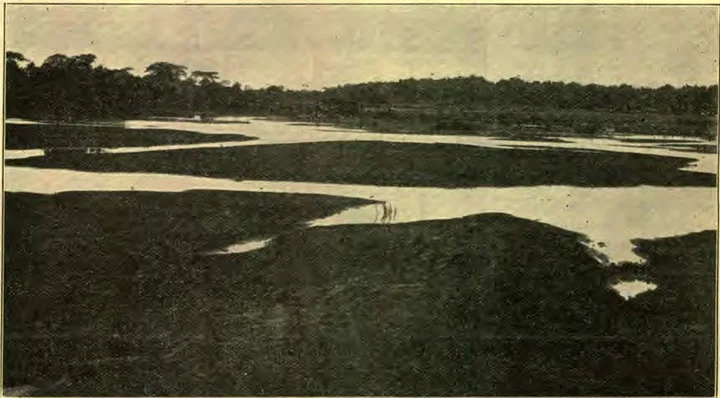
Containing millions of tons of asphalt, covered here and there with small islands of soil, with tropical vegetation growing upon them. We stood upon its brink with a feeling of wonder as to the origin of this great black lake, apparently solid, yet always in slow circular motion.
There are different speculations as to the origin of the pitch. Some contend that it is due to some convulsion of nature, such as volcanic action; but to us this seems impossible, as then the pitch, which is rich in oil, would have been burned by the intense heat, and we would have only a charred remnant. It seems far more reasonable to regard the pitch as having been formed in the same way as were the great coal-mines, a portion of the great mass of vegetation buried at the time of the flood having in some way been changed to asphalt instead of to coal.
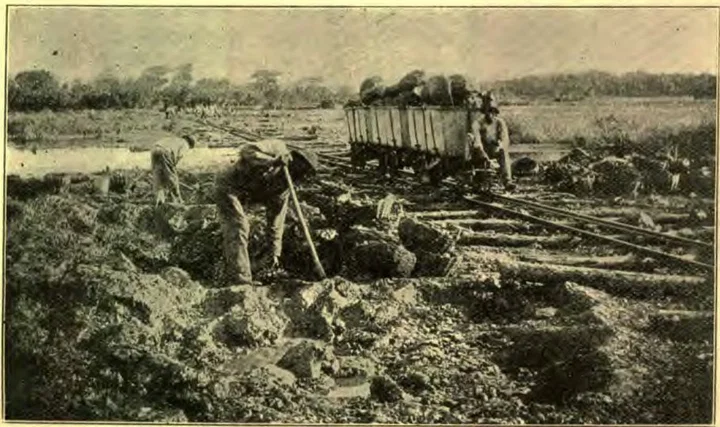
We walked with some misgivings on to the black Stygian-looking pool, and found it hard and fully able to bear our weight. As to-day is comparatively cool, we found the “pitch” quite solid; but on a hot day, one could not stand long in the same place. There is a diminutive railroad in the shape of a horseshoe, with the two ends in the sheds, running out to the center of the lake. Each car of this railway carries two of the half-ton iron buckets spoken of before.
As the men were at work out at the center of the lake, we made our way along the little road to the spot where they were working. They were all negroes. The first we approached was hard at work with a pickax, digging up blocks of the brittle asphalt about one foot each way, and weighing perhaps seventy-five pounds. This was broken into smaller pieces and laid up on the bank for the loaders. This hole is about one hundred feet in diameter, and from three to five feet deep. Strange to say, to-morrow morning it will be filled up again, and the lake will be as level as it ever was, and the man will be able to dig as much asphalt from the same spot as he dug to-day. Thousands of tons havep. 2 been removed from along the side of this same railroad, and thousands of tons will still be taken, without moving the road, and the workman stands in precisely the same spot day after day. A digger gets from ten to fifteen cents a load, and the loaders get six cents an hour, very good wages indeed for the West Indies. Nearly every island in the West Indies was represented in the gang before us.
Small oval or elongated air-bubble holes in the pitch were noticed; their oval shape indicates the slow movement of the great mass. The motion is so slow as to be almost imperceptible, so that some writers have questioned whether there was any; but the little railroad has demonstrated it beyond further question. You may lay the ties and rails ever so straight in the morning, but before night you will have it worked into innumerable forms of the letter S. Several men worked all day to keep this railroad sufficiently straight to be serviceable. It was formerly supposed that the lake was inexhaustible; but a commission of experts recently sent out from England to investigate the matter, have reported that while there is no diminution of supply perceptible to the eye alone, careful surveys show us that the center of the lake is sinking in proportion to the amount of pitch taken out, so that the actual shape of the surface of the lake at the present time resembles a saucer. The manager, however, informed us that he had run a gas-pipe three hundred feet straight down into the lake, before it was broken off, so there is no probability of a sudden failure of supply. There is also connected with the works, apparatus for purifying the pitch. This is done by boiling it to a liquid form by steam running through coils. During this operation all sediment sinks to the bottom, and the liquid is run into barrels, where it hardens. Most of the pitch exported to America and Europe is sent in the crude state.
Instead of returning by Brighton, we took the longer route to La Brea. The lake has overflowed both above and below the surface of the ground; and as a result one can find pitch for miles around the actual lake. At La Brea, on the beach, is located the claims of all the private diggers of pitch. They own the land, having purchased it in the usual way, and in spite of all that the concessioners at the lake can do, are still winning pitch from mother earth. A great hole is dug in the ground, perhaps one hundred feet square and from ten to twenty feet deep, then it is left for a few months, and lo it all fills up again, when it can once more be emptied of its valuable contents.
The lake itself is owned by the Trinidad government. The concessioners, or the company leasing the lake, who hold the sole right to win pitch from the lake, claim that this pitch came from the lake, and is theirs, although found on another’s land. This has led to endless litigation in the courts as injunction after injunction has been served. Thus the lake has proved a valuable mine to the lawyer, the owner, and the government. The government owns the lake and gets a royalty of $1.50 per ton from the concessioners. As one hundred thousand tons are shipped to the States every year, besides that going to Europe and other countries, we can see that it is a source of great revenue, and is rightly called “the black diamond mine.” At the lake eight hundred fifty tons per day, can be easily loaded on the steamers; nine hundred fifty-nine tons is the best record, but many days the workmen are idle.
There is a good lesson wrapped up in the history of this lake. It was discovered by Sir Walter Raleigh while he was searching for gold. He reported it to the English government, but could stop only long enough to note the fact, and then pushed on up the pestilential swamps of the Orinoco, vainly seeking El Dorado, which was always just beyond, and always of untold wealth, rivaling the riches of the Aztecs of Mexico and the Incas of Peru. The El Dorado of his imagination was to him of much more value than the plain black expanse of pitch lying within his grasp. He died without realizing his El Dorado, while later generations have found it in the lake he treated lightly.
At three o’clock, after enjoying one of the large luscious pineapples for which La Brea is famous, we were taken to our little steamer, feeling well repaid for our five hours’ visit. The next time you walk on your asphalt pavement, remember the great black lake surrounded by tall palm trees and jungle, beneath the blaze of a tropical sun, and remember that representatives of the third angel’s message are here, and a people is being gathered out on the firm platform of the commandments of God and the faith of Jesus. “And this gospel of the kingdom shall be preached in all the world for a witness to all nations, then shall the end come.”
GEO. F. ENOCH.