In answer to the frequently asked question, “What is the cause of the different phases of the moon, as new moon, half-moon, full moon?” a simple illustration is all that is necessary.
Take an orange or a round apple into a room at night. Stand at some distance from the lamp, and hold the orange at arm’s length between you and the light. It should be held a little above your direct line of vision so that the lamp can be seen at the same time. Notice that you can not see any light whatever shining from the lamp upon the orange, although it is shining on the opposite side. Turn it slowly round toward the left, still holding the orange at arm’s length, and note that you can begin to see the light shining on the side toward the lamp. At one fourth of the distance around, you can see the light on one half of the side of the orange nearest to you; at half way, you can see distinctly the whole illuminated outline; turning still further, the lightened part grows smaller, until at three fourths of the distance around, the light can be seen on only half of it again; and as it is brought to the original position, you can see, as at first, only the blackened disk.
In this illustration, the lamp takes the place of the sun, and the orange, the moon. Your position represents the earth, from which the moon is viewed.
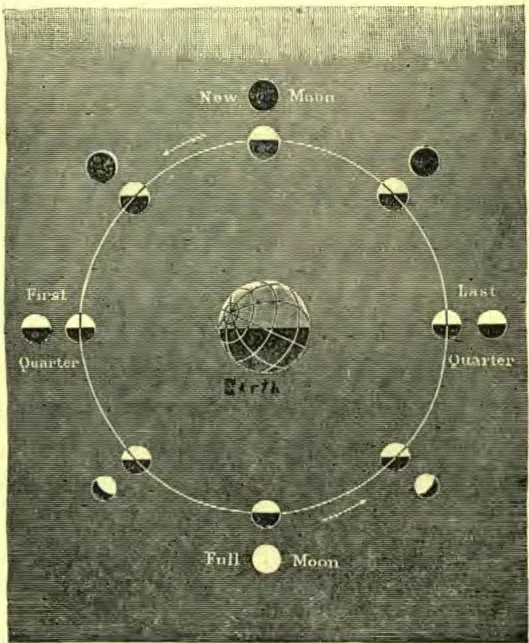
The moon passes around the earth once each month, or more definitely, in about twenty-nine and one-half days. Not being a body which gives off light of itself, the moon shines with a light borrowed from the sun; that is, it merely reflects the rays of sunlight which fall upon it. Hence, when the moon is between us and the sun, we can not have reflected to us any of this light shining upon it. This accounts for several nights and days in the month during which the moon is not seen at all. As it passes a little out of direct line between the earth and sun, we can begin to see the light reflected from one edge, so to speak, the same as we did the lamplight on the orange. This is what is called new moon.
A little more can be seen each night, until the end of the first week, when we can see the light shining on about one half of the moon’s disk, that is, the side toward us. This is known as the first quarter. In another week we have full moon; and then the illuminated part begins to wane, passing the last quarter at the end of the third week, then still growing smaller until it resembles a new moon, after which we lose sight of it altogether for a few nights, when it reappears, as it did a month before, in the form of a thin band of yellow light, to pass through the same phases during the next four weeks.
The accompanying diagram illustrates very nicely the phases of the moon. The figures on the outside represent the moon as it appears to us at stated periods during the month; those directly on the circle show the manner in which the sunlight shines on it all the time. At each phase represented we can see from the earth only the light part lying within the circle.
During the first and fourth weeks, or when less than half the moon is visible, it is said to be crescent; and during the second and third weeks, when more than half of its illuminated face is shown, it is known as the gibbous phase.
No doubt you have noticed during the early part of the new moon period, that the portion of the moon’s disk which does not get the direct sunlight is often visible, illuminated by a pale reddish light. This is due to the reflection of the sunlight from the earth, and is known as earth-shine. From the moon the earth would appear to have the same phases as the moon shows to us, only at opposite times of the month. Hence when the moon is full to us, the earth would be totally darkened to an observer on its surface. At the time of new moon, the earth is at its full, and it is this light reflected on the moon which enables us to see its reddish-brown outline.
CLAUDE CONARD.