Many people, including some scientists, believe that there exist in the sea to-day monster animals—sea-serpents, leviathans, and giant fishes—which have never been captured, and hence are unknown to zoologists, and have no place in scientific books. Whatever may be the facts in regard to such creatures, there are well-known members of the fish class which deserve to be regarded as monsters, and which may have given rise to the sea-serpent stories. Some of the most noteworthy of these fishes are here referred to and illustrated.
At the mention of giant fishes, many young folk will at once think of the sharks, among which, indeed, are found the largest existing fishes. Of the numerous kinds of sharks, noteworthy on account of their size, there are four in the front rank; these are the sleeper shark, the man-eater shark, the basking-shark, and the whale-shark.
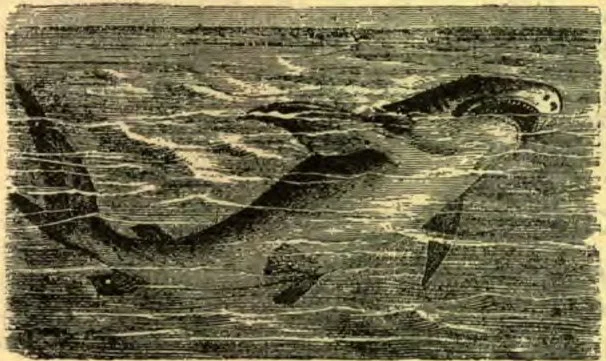
MAN-EATING SHARK
The sleeper-shark, whose scientific name (Somniosus microcephalus, meaning sleepy small-headed fish) fits it so admirably, appears to have developed its body at the expense of its brain; for it is a sluggish, stupid glutton, about six times as long as the average man. Its home is in the arctic regions, but it sometimes makes visits as far south as Massachusetts, Oregon, and the British Isles. It is usually seen lying quietly at the surface, apparently dozing, and is easily approached by vessels; but sometimes, when hungry, it rouses itself and goes in search of its prey, fiercely attacking and injuring whales, apparently unconscious of the great difference in their respective sizes.
One of the largest, and perhaps the most formidable of sharks is the “man-eater,” or great blue shark. It roams through all temperate and tropical seas, and is everywhere dreaded. Its maximum length is forty feet, and its teeth are three inches long. While there are few authentic records of sharks attacking human beings, there have undoubtedly been many cases of sharks simply swallowing people who have fallen overboard, just as they would swallow any other food. How easy it would be for a man-eater to devour a person, may be judged from the finding of a whole hundred-pound sea-lion in the stomach of a thirty-foot shark on the Californian coast. A certain man-eater, thirty-six and a half feet long, had jaws twenty inches wide inside, and teeth two and a half inches long.
SHARK'S TEETH
The basking-shark, known also as the elephant-shark and bone-shark, is an inhabitant of the polar seas, but is occasionally observed as far south as Virginia and California, and some years ago was not rare on the English and New England coasts. It reaches a maximum length of fifty feet, and is exceeded in size by only three or four animals now alive. Provided with small teeth, it feeds on fishes and floating crustaceans, and is not of a ferocious disposition. It is dangerous only because of its great bulk, and when attacked, its powerful tail easily demolishes small boats. The basking-shark was formerly hunted on the coasts of Norway and Ireland for its oil; it was also sought on the shores of Massachusetts in the early part of the last century; and many of these sharks from twenty-five to thirty-eight feet long were recorded. The liver of a large specimen sometimes yielded twelve barrels of oil.
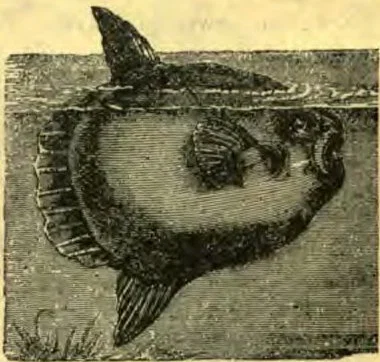
SUNFISH
The largest of all fishes, the largest of all cold-blooded animals, and the largest of all existing animals, except a few kinds of whales, is the whale-shark, originally discovered at the Cape of Good Hope, but now known in Japan, India, South America, Panama, California, and elsewhere, a specimen having recently been obtained in Florida. This shark is said to attain a length of seventy feet, and is known to exceed fifty feet.
A fish of such peculiar form that the Italians call it mola (millstone), and the Spaniards pes luna (moonfish), is known to Americans and English as the sunfish; for it appears at the surface of the ocean on bright days, and spends many hours basking listlessly in the sun, sometimes lying flat with one side out of the water, sometimes with the back fin projecting like a buoy above the surface. The fish is disk-shaped, its height nearly equaling its length. It is one of the most grotesque of fishes, being apparently nearly all head. Of almost world-wide distribution, it is particularly abundant on the southeastern coast of the United States and on the California coast. It swims but little, being usually content to be drifted along by the ocean currents. The Gulf Stream wafts many a sunfish north each summer, so that the species is not rare off southern New England. That the fish deserves a place on the list of giant fishes may be judged from the fact that examples weighing from two hundred to five hundred pounds are not rare, and that much larger ones are occasionally found. The weight of the largest known specimen, caught in 1893, at Redondo Beach, California, was eighteen hundred pounds. On such a monster, lying on its side, there would be room for thirty men to stand.
The valuable mackerel family has one member which easily ranks first in size among the “bony fishes,” as distinguished from the sharks, rays, sturgeons, etc., which have gristly skeletons; this is the horse-mackerel, or great tunny (Thunnus thynnus), whose range encircles the globe, and which is an object of fisheries in many countries, notably southern Europe. Built on the compact and graceful lines of our common mackerel, it excels in speed, alertness, and vigor among the fishes of the high seas, and might very easily make a trip across the ocean in one third the time of our fastest steamships. It preys on all kinds of small fish, and is often seen playing havoc among schools of luckless herring and menhaden. Fifteen feet is about its maximum length, and fifteen hundred pounds its estimated maximum weight, although it is likely that this weight is considerably exceeded. Thirty tunnies harpooned by one fisherman during a single season weighed upward of thirty thousand pounds. A mutilated specimen ten feet long was found by the writer on the coast of Massachusetts; its head weighed two hundred and eighty-two pounds; its carcass about twelve hundred pounds.—Hugh M. Smith, in St. Nicholas.