Insects and Their Habits, and What Harold Learned About Them
4%

Review and Herald Publishing Assn. · Washington, D. C. · August 22, 1905

FromThe Youth’s Instructor, Vol. LIII, No. 34

Read the full edition

Insects and Their Habits, and What Harold Learned About Them

“Come here, Harold,” said his uncle, as the next study hour approached, “I will show you a tiny insect that works havoc whenever it finds lodgment in the muscles of any living creature.”
“O uncle! what an ugly looking worm it is! but it doesn’t look so very tiny through this glass.”
“No, for it is highly magnified. But little as it is, it is a great destroyer of muscular tissue; and when once introduced into the human body, it causes the most intense suffering, which often results in death. This little pink speck,” said Uncle Frank, pointing to the tiny object under the lens, “is a small particle of the muscle of a man who died a victim to this little pest,—the trichina spiralis, or pork worm.”
“Isn’t it awful? But how did it get in the man’s muscle?—I presume the man ate the pork. But still I don’t see how one little worm like that could kill a man.”
“But you see, there were myriads more in the poor fellow’s muscles, as they multiply very fast.”
“I wonder if the man knew what the matter was. People learn by using a microscope ever so many things that they never would know without it.”
“That is true, Harold; and remember this: those who never make a right use of their eyes, fail in acquiring much true knowledge. There are some persons who seem to have closed their eyes to the beauty which God has placed all around them. Such persons never see a beautiful landscape or a lovely flower or a glorious sunset.”
“I suppose you mean blind people, don’t you, uncle?”
“O, no; I mean those who, having eyes, see not, and having ears, hear not. You know the human eye is so formed by our all-wise Creator that it acts in the capacity of both a microscope and a telescope. When used as a telescope, we may behold the wonders of the starry heavens, or gaze on the beauties of the distant landscape. But when we turn these same wonderful eyes of ours below, we are astonished at the myriads of objects which, although extremely small, are as perfect and their mechanism is as complete in each of their parts, as that of the largest animals. Then, of course, we are still more amazed when we turn the wonderful little eye of the microscope upon them.”
Just then Harold’s mother came from the kitchen, where she had been preparing dinner.
“Look here, Brother Frank, I’d just like to see what this looks like under your glass,” and she produced a small dried prune, selected from some she had been preparing for the table. It seemed covered with a kind of white dust, or powder; and it was this that she wished to examine.
Uncle Frank glanced at the dried fruit, and smiled, “All right, sister; you shall examine the white dust if you like, but I would advise you to wash your fruit very thoroughly before stewing it; for, well, how do you like the looks of this ‘white dust’ as you call it? Here, Harold, you may have the first look,” said Uncle Frank as he adjusted his glass.
“O mama! do, do see! they are the funniest-looking bugs I ever saw. O, O! see that fellow; he seems to be trying to get loose from the glass where uncle has stuck him. What a funny long trunk he has; it’s something like an elephant’s; and I do believe I see his eyes. They are black as two little beads, and he seems to be looking all around; poor thing! he wants to get away;” and Harold laughed heartily as he made room for his mother to look at the curiosity.
“Well, well; I’d no idea that my prunes were the pasturing-ground of such strange creatures. Indeed, I shall take your advice and wash them well in several waters before venturing to serve the fruit.”
“I think the grocer must have given you a lot of inferior fruit,” smiled Uncle Frank; “for this little insect is not at all partial to fine, plump, healthy fruit. It is a sort of parasite, you see. We ought to look sharp before we open our mouths to take anything into our stomachs. Now, here is a peculiar insect which I found some time ago in a sack of damaged flour.”
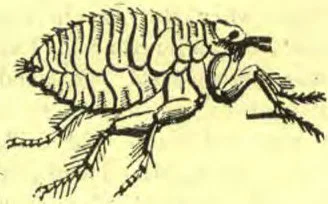
A FLEA
A FLEA
Look, Harold, he is not very much of a beauty, but he is certainly an interesting creature.”
“Ugh! do see him, ma! isn’t he ugly! I won’t dare to eat anything after a while.”
“O my dear, do not be needlessly alarmed,” said Uncle Frank. “You see, this fellow has no taste for good, wholesome flour; a kind of scavenger he is, answering very much the same purpose as the swine,—that of devouring stale and decomposing matter. We see in all this a wise arrangement of Providence; for were there no scavengers in sea or land, the very air we breathe would soon be so polluted with the odor of musty and decaying substances as to render it quite unfit to support human life. It is strange that even the most destructive and repulsive or mischievous insects have most wonderful and complex bodies. There is the flea, for example. Here he is, Harold, and a fine specimen, highly magnified.”
“Dear me! I’m glad the fellow isn’t really and truly so large as that; what long legs he has!”
“Yes, his hind legs are very long, and by their use the insect is capable of jumping great distances, for he is very muscular. Why, Harold, if you and I could jump as far according to our size and weight as a tiny flea, we need not jump many times to encircle the globe. But you would not dream, perhaps, that these insects, ugly and loathsome as they seem to us, still have a love for their young, which they feed as carefully as a mother hen her brood of chicks. Wherever there are to be found the eggs of the flea, we can always find tiny particles of dried blood, which the wise mother places close by for the use of her babies when they are hatched; and indeed she actually feeds her larvae with blood which she discharges from her own stomach.”
MRS. L. D. AVERY-STUTTLE.
(To be continued)