“So much about that most disagreeable insect, the flea,” continued Uncle Frank. “We see that it possesses the maternal instinct in a very marked degree; and what is most wonderful is the tiny brain which controls the movements of the insect. Here is a little clipping, Harold, which I have pasted in my scrap-book, which, to say the least, is very interesting. I clipped it from a book entitled ‘Wonders of Sea and Land,’ published by one of the most reliable and best-known houses in Ohio. It reads quite like a fairy tale, and seems almost too wonderful to be credited. Still, when we consider that the fingers of man have made some such tiny things as can be clearly seen only through a glass, why might not the Almighty make the brain of even an insect like the flea capable of being taught and trained by man? But here is the clipping:—
“Mr. Mark, an Englishman, succeeded in making a gold chain, the length of a finger, with a padlock and a key to fasten it, which weighed about one grain. A flea attached to the chain pulled it easily.
“Another English workman constructed a little carriage and six horses of ivory. The coachman was on the box, with a dog between his legs. There was also a postilion, four persons in the carriage, and two servants behind, and the whole of this was drawn by one flea.
“Many years ago, for twelve cents the people of Paris were admitted to a wonderful exhibition. Thirty fleas went through military exercises, and stood upon their hind legs, armed with pikes formed of very small splinters of wood. Two fleas were harnessed to and drew a golden carriage with four wheels and a postilion. A third flea was seated on the coach-box, and held a splinter of wood for a whip. Two other fleas drew a cannon on its carriage. This little trinket was admirably finished; not a screw or nut was wanting. These and other wonders were performed on polished glass. The flea horses were fastened by a gold chain attached to the thighs of their hind legs, which was never taken off. They had lived thus for two years and a half, not one having died during the period. To be fed they were placed on a man’s arm, which they sucked. When they were unwilling to draw the cannon or carriage, the man took a burning coal, and on its being moved about near them, they were at once aroused and recommenced the performance. The learned fleas, as they were called, were the admiration of Paris, Lyons, and the provincial towns of France. The people watched this wonderful sight through large magnifying-glasses.”
“My! but I would like to see such a sight as that! Only think how cunning those little black fellows must have looked taking the place of horses,” said Harold.
“Yes, indeed; and we can learn from this that man, with all his boasted powers, is yet inferior in some respects to the very insects which he despises.”
“There is a certain kind of beetle which is said to draw forty-two times its own weight. Then, to equal the beetle in strength, a man should be able to draw at least six thousand pounds!”
“It doesn’t seem possible; just imagine a man who could lift such a lot as that! I guess people would go a long way to see him; why, that’s almost as strong as Sampson, isn’t it, uncle?”
“Yes, and not only do insects have great strength, but they also have a regular, active circulation of the blood.”
“And veins, and a little heart, uncle?”
“No, my boy, they have no veins, but they do have a heart.”
“But what good is a heart and blood, if there aren’t any veins, Uncle Frank?”
“The blood of an insect is altogether different from ours; but it is a kind of fluid answering about the same purpose that our blood does, and the heart pumps it in every direction, supplying the head and the body, without veins.”
“Well, that’s hard to understand. I wish I could see the inside of some insect, and then maybe I could understand it better.”
“Very well,” said Uncle Frank, as he slipped a thin piece of glass under the eyepiece of his instrument. “I was just about to show you this, which will give you a very good idea of the matter.”
“O, isn’t it wonderful! I don’t see how any one could manage to cut a little insect in two.”
“It is a very particular task, indeed, to prepare these tiny creatures for the glass, but the instruments used are very fine and delicate. The vessels which supply air to the insect are simply little ducts which spread out in every direction. There are so many that they are almost incalculable, and they hide away among the other organs of the body just as the roots and rootlets of trees hide and bury themselves in the earth.
The goat-moth caterpillar is estimated to contain at least fifteen hundred of these little air-tubes.
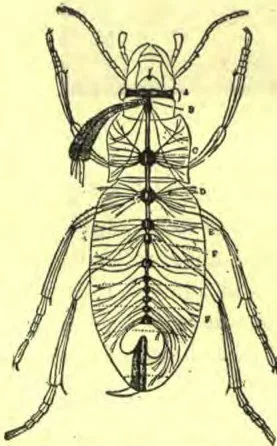
“And now, Harold, I will show you the picture of the nerves of an insect called the carabus.”
“Why, uncle, do insects have nerves? I wonder if they ever have headache like mama.”
“It may be. I dare say if little boys knew what a wonderful thing an insect is, they would never torture them needlessly, and pull out their legs and wings in cruel sport.”
“I never did that, uncle, nor I would not; but I shall always be more careful of the feelings of even a tiny bug than I have been.”
“That is right. ‘Blessed are the merciful: for they shall obtain mercy.’
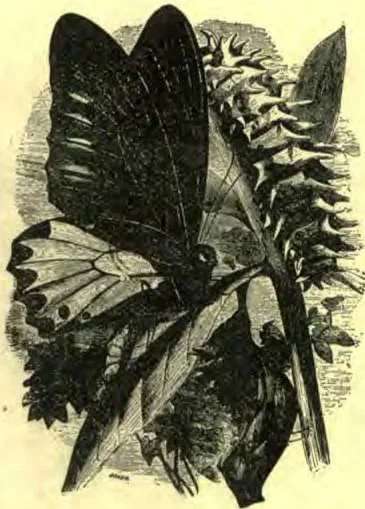
“Most insects have four different stages of existence. The third, or chrysalis, state is a most interesting one. The insect then looks much like a little babe after its mother has wrapped it up tight in its blanket.”
“I don’t see how it can walk or fly or move about then at all,” said Harold.
“They can not, they lie perfectly still; they can neither eat nor move; and it is one of the great mysteries how they live, for sometimes they continue in this condition for weeks, and even for months and years. But all this time nature is at work, slowly preparing the different organs of the body for future use.
“The ways of the Creator are surely most mysterious, and, my dear boy, I believe that eternity itself will be none too long in which to study his wonderful works.”
MRS. L. D. AVERY-STUTTLE.
(To be continued)