What We Are
People call us microbes, or germs. Sometimes the funny papers picture us as horrid-looking creatures with legs, claws, and great teeth, or in some other way which greatly misrepresents us. But we are innocent-looking little fellows, even though some of us do get into mischief.
It will be hard for me to make you understand how small we are. Much smaller are we than the smallest thing you ever saw. It would take many thousands of us to make a quantity equal to the ink in the period at the end of this sentence. Yet, by means of a powerful microscope, I might be seen as a fine small line like this (—) or still smaller. Some of us are so small that it is hard to see us with even the most powerful microscopes, and yet small as we are, this world would be entirely different without us, and our near relatives, the yeasts and the molds. The yeasts are larger than we germs, and the molds are still larger, so that the individual growths of mold can be seen without the aid of a microscope; but small as we are, we probably do far more work, and more varied work, than the yeasts and molds.
You may have heard the verse that runs something like this (apologies to Swift and others):— The little fleas that do us tease Have lesser fleas to bite ’em; And even these have smaller fleas, And so ad infinitum.
One thousand fleas placed end to end would about equal the length of one man. One thousand germs placed end to end would about equal the length of a flea, so a microbe is as small to a flea as a flea is to a man.
Do you suppose there are still smaller fellows to act as “fleas” to the microbes? I think not. We microbes, I think, have the honor of being the smallest living creatures in existence.
Scientists call us bacteria, a word meaning rods or staves, because many of us are in the shape of a very small rod like a lead pencil. The study of bacteria is called “bacteriology;” and the man who devotes himself to this study is called a “bacteriologist.” Before we have finished our studies on this subject, you will have learned that the bacteriologist has, within the last few years,—perhaps not much further back than you can remember,—made some most wonderful discoveries which are utilized to combat disease, to prevent destruction of property, and to aid in some of the useful arts.
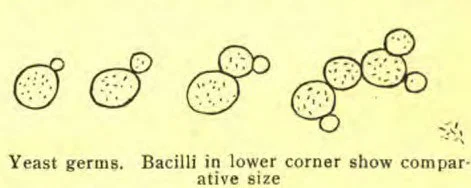
At one time even scientific men supposed us to belong to a low form of animal life, but now it is generally understood that we are forms of plant life. We belong to a family known as fungi (pronounced fun-jy). This word is the plural of fungus. The fungi include the toadstools, puffballs, mushrooms, molds, yeasts, and bacteria,—plants that do not have the green coloring matter called chlorophyl (clo-ro-fil). This not only makes a difference in color, but constitutes an important difference in the life habits of the plants and in the work that they do.
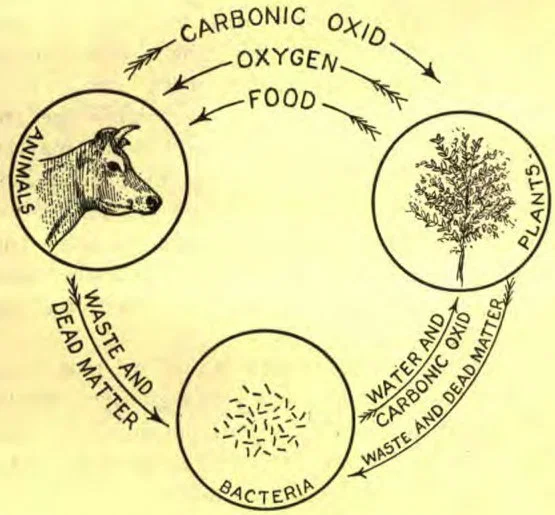
By means of chlorophyl, plants use the energy of the sun’s rays in building up, from water and carbon dioxide gas, the various plant tissues. That is, from non-living matter—what we commonly call inorganic or mineral matter—they build up complex organic matter, such as starch and woody fiber. Fungi, having no chlorophyl, are not able to live on inorganic matter, so they thrive on dead organic matter. This they break up until it is finally resolved into such substances as carbon dioxide and water.
We have here a complete cycle, or circle, each part ministering to the others, and each part receiving from the others. The plants build up plant tissues, using for this purpose carbon dioxide and water, and giving off oxygen. The animals use the vegetable tissues as food, and breathe the oxygen, giving off carbon dioxide for the nourishment of the vegetables.
But if it were not for the germs, the wastes given off from animals, and the dead animals and plants, would soon cumber the earth, and after a while the carbon dioxide would all be used.
Right here we germs come in and turn all this dead matter back to carbon dioxide gas, water, and other simple substances, which the green plants can again build up into plant tissues.
So, despised though we be, we are a very important factor in the great round of life which goes on from year to year, from century to century.
Movements of Germs
If you will place in a warm corner, for two or three days, a vessel of water containing a handful of hay, the water will probably be slightly colored from the hay. It may also have a perceptible odor and taste. There will also be other changes which can not be seen with the unaided eye. If you place a drop of this water, taken from near the grass, under the microscope, you will be surprised at the sight that greets your eye. Swimming, wriggling, twisting, a seething mass of living creatures will be seen, darting back and forth across the field of the microscope, some fast, some slow, some spinning around like a top. Sometimes two or three large fellows, fastened end to end, will be seen waddling their way lazily along. You would probably exclaim, “What are all these little animals?” When told that they are germs, you would be more surprised than ever, and say, “Germs! Why, I thought germs were plants; and just see how these little fellows swim around! You can not make me believe that they are plants.”

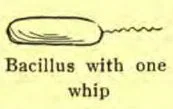
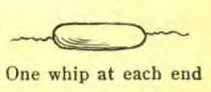
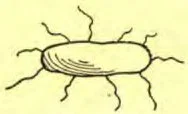
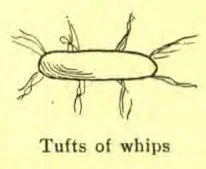
If some one should tell you that you could not tell a plant from an animal, you would feel indignant, perhaps, as you thought how easy it is to distinguish between a rosebush and a cow; but there are some little living fellows that you could not tell whether they were plants or animals. We are accustomed to see animals have legs and move around, yet there are little fellows on the seashore which are fastened to the rock like a plant, or which grow inside of the rock. Perhaps you have sometime read in the INSTRUCTOR about corals and sea anemones. Again, you think of plants as having roots and being stationary, but there are some plants that are not only loose in the water, but they have little paddles which cause them to move around from place to place. Some germs have the power of motion. If you could see them skipping through the water, turning one way and another as if looking for something or somebody, you would be inclined to believe that they have sense, and know where they want to go. But these motions are not the result of design or intention on their part. Small as they are, they have projecting from their ends or from their sides still smaller hairs, or whips, so very small that it is extremely difficult to see them by means of the most powerful microscopes. In fact, they can not be seen until they have undergone a special preparation.
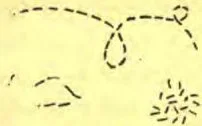
It is the constant lashing of these whips that produces the motion. There probably are many tiny animals also running about in the same drop of water; but a little study would enable you to distinguish them from the germs, or plants.
What We Look Like
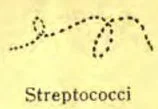
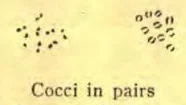
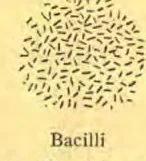
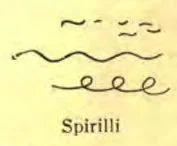
While we are called bacteria because many of us are like little rods, we are not, by any means, all of this shape. We might be compared to watermelons and squashes. Some are quite round, some oblong, and some quite long with round ends, then among the squashes some are long and shaped like a corkscrew. There are all these different shapes among us. The little round fellows are called cocci (pronounced cox-eye). This word is the plural of coccus, a ball. Sometimes they are called micro-cocci (micro-coccus, a small ball). The long fellows are called bacilli (pronounced ba-silly) plural of bacillus, a staff or rod. The corkscrew-shaped germs are called spirilli, plural of spirillum, a spiral or corkscrew.
How We Grow
Our method of growth is remarkable. We just keep lengthening out, elongating, stretching, as we take in food. Some of you have seen the yellow thread-like creeper that grows on low vines in the summer. It has no leaves. It is like a thick horse hair, only it is yellow; but it keeps getting longer all the time.p. 4
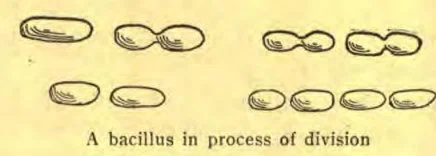
So it is with us germs, we keep getting longer as we partake of food; but we do not usually remain in one piece. We keep breaking up into small lengths, and the small lengths grow longer, and again break up. A germ may look like this (—) and in ten or fifteen minutes it may be like (——). There is trouble in the family, and a split up, so we have two instead of one. Which is father and which is son? Soon these two have become four, then eight, and so on. They are so small it ought to take a long time to grow many germs, if they double only every fifteen minutes. Let us see: 15 minutes, 2; 30 minutes, 4; 45 minutes, 8; 1 hour, 16; 1¼ hours, 32; 1½ hours, 64; 1¾ hours, 128; 2 hours, 256; 2¼ hours, 512; 2½ hours, 1,024.
Just think! The tenth generation from one germ would make 1,000 germs. The next tenth generation, or five hours from the start, would make a thousand thousand, or 1,000,000. Then each five hours thereafter would add six more ciphers to your number; so where would you be at the end of twenty-four hours? Your number would be sixty-four nonillions.
Fortunately for you and the rest of the world, we can not get food enough to grow that fast; and when we have plenty of food, we produce certain substances which are poisonous to ourselves, or which at least retard our further growth. If we could continue doubling once every five minutes, we would soon fill the earth!
I started to find where those nonillion germs would reach to if in one line. To the sun?—Yes, you could make so many separate chains of these germs to the sun that the rope would be many feet in thickness,—this the product of one germ in twenty-four hours! But as I said before, we do not continue to grow that fast. But one germ will amount in twenty-four hours to many millions, so that they can be readily seen.
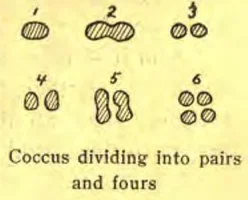
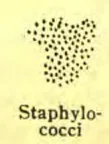
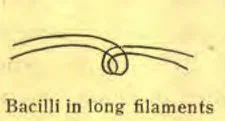
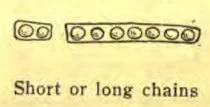
Sometimes in our growth, we break off, but there is an outer shell that does not break. This keeps us together in chains, as you have seen in the picture. This shell is so fine that it is difficult to detect it with the strongest microscopes, unless it is especially stained. The germs sometimes form in pairs, sometimes in long chains, before breaking up. The cocci often divide so as to form short or long chains. Sometimes the dividing is accomplished in two planes, forming, as shown in one of the illustrations.
Sometimes they divide in three planes so they form cubes of eight, and continue to multiply, forming large cubical packets. Such germs are often found in diseased stomachs. The illustrations given above are greatly magnified; for with the most powerful microscopes we look like little dots.
MIKE ROBE.