SEVENTY miles north of Assuan on the west bank of the Nile is the town of Edfu. Leaving the train at the station on the east side, we enter the small ferry-boat and cross the river. The usual fare (for natives) is two millimes (one cent), but a foreigner must pay three or four piasters (fifteen or twenty cents). This is an example of what the traveler may expect everywhere in Egypt.
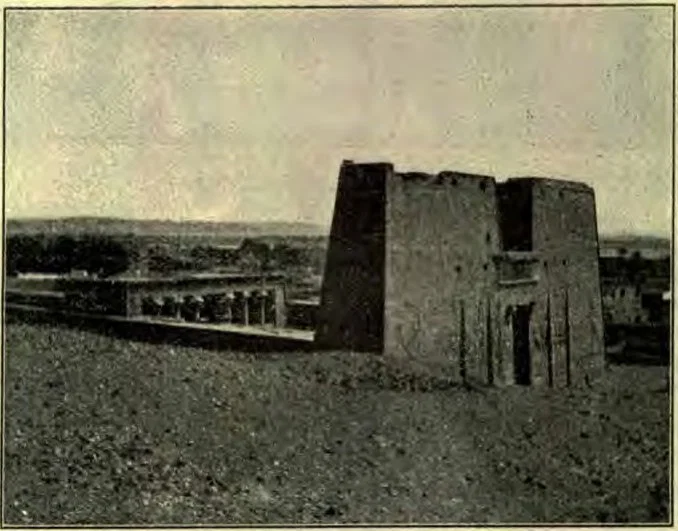
Leaving the river, we proceed along the narrow, crooked, dusty lanes that lead through the clusters of mud huts to the large temple of Horus, one form of the sun-god of Upper Egypt. This temple was built by the Ptolemies, and is one of the best-preserved in Egypt. The attractive view of the city of Edfu and the beautiful palm groves around it, obtained from the top of the unusually large pylons, is always greatly admired. Passing through the large court back of the pylons, we enter the vestibule, the roof of which is supported by twelve stately columns with beautiful floral capitals. In the sanctuary we find a large stone shrine which appears to have been used as a safe for the temple treasures. The sanctuary is surrounded with numerous chambers. One of these, which was used as a laboratory, is very interesting. With the ancients, chemistry was closely allied with magic; and all the Egyptian priests manifested profound skill in deceiving the multitudes with wonderful and apparently miraculous demonstrations of chemical phenomena. In leaving this temple we notice the complete calendar portrayed on the roof of the large vestibule.
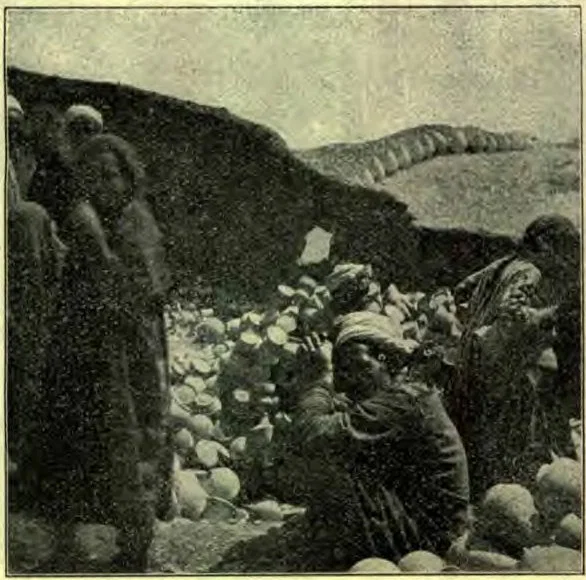
Continuing our journey down the Nile, we pass the familiar scenes around Luxor, and soon arrive at the large town of Kena, the principal center of the Copts in Upper Egypt. Here are situated the far-famed potteries; but the tourist is considerably disappointed to find that they consist only of a large collection of low mud huts, in which the most primitive hand machinery is used. In spite of this the “skilled workmen,” who receive about twenty-five cents a day for their services, manifest great ingenuity and dexterity at their tasks.
IN THE KENA POTTERIES
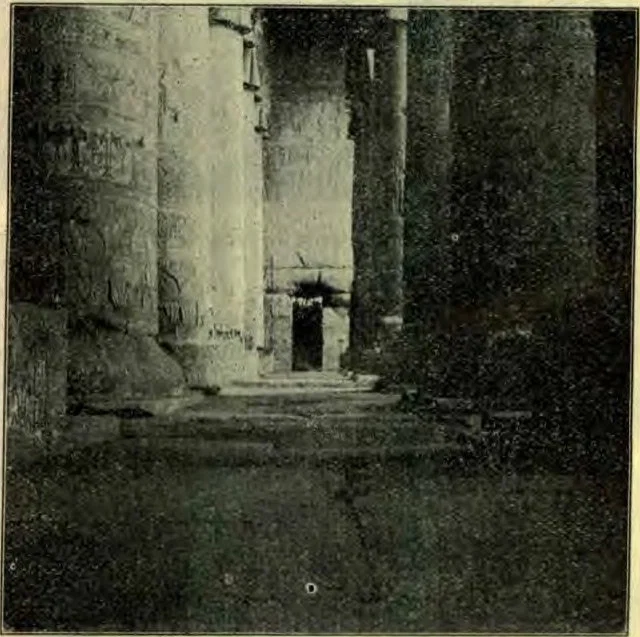
Crossing the river near Kena, and riding for about an hour, we come suddenly upon the temple of Hathor (the goddess of joy and love, corresponding to the Greek Aphrodite), at Denderah. The novel style of the architecture of this elegant temple, and its complete, clean-cut freshness, are quite a relief after the tremendous piles of ruins at Karnak. The pylons and court are conspicuous by their absence, having never been built; so we enter at once the great vestibule, the roof of which is supported by eighteen massive columns. Leaving this imposing hall, we proceed to explore the various storerooms, treasuries, laboratories, toilet-rooms, etc., which lie beyond, entering at last the sanctuary, which is perfectly dark. Only the king could enter this chamber, and he but once a year, at the new-year feast, arrayed in his sacerdotal robes; for the kings of Egypt were also high priests, and occasionally stepped into the shoes of the gods themselves as well.
TEMPLE AT EDFU
Under this temple are some very interesting subterranean crypts, doubtless the remains of an older temple, which originally stood on the site of the present one, the reliefs on their walls showing that they date from the sixth dynasty. The stairways and long, pitch-dark passages which lead to these chambers are in some places less than two feet high, making them very difficult of access, especially to stout persons; but the persevering traveler, armed with a magnesium lamp, is amply rewarded for his trouble. The freshness and clearness of the colors in the wall-paintings, executed perhaps four thousand years ago, are remarkable. In these secret chambers we can witness much of the chicanery with which the so-called miracles and mysterious marvels of deep-voiced idols, which deceived the multitudes of devotees, were produced.
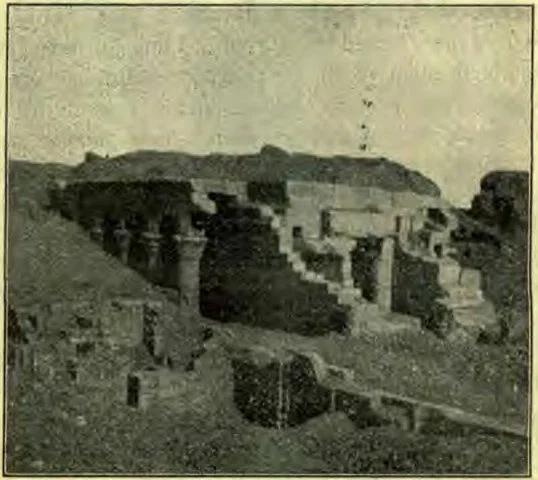
Near the temple of Denderah is the birth-house, connected with all the large Ptolemaic temples. These birth-houses are small temples dedicated to the worship of the offspring of the deity worshiped in the large one. The reliefs portray various scenes in the education and bringing up of these youth.
IN THE VESTIBULE OF THE TEMPLE AT DENDERAH;
NOTED FOR ITS LARGE COLUMNS
Having completed our explorations, we return to Kena, board the evening express for Cairo, settle ourselves in the best seats we can find; and as the roar of the train drowns out all communication, lose ourselves in reflections upon the strange and mystical wonders and beauties of Egypt, mingled with thoughts of friends and loved ones far away.
Egypt as a Mission Field
Egypt is essentially a Mohammedan country under English occupation. The government is mild and tolerant, and the native population seldom give vent to any feeling of fanatical hostility against the large foreign element. From the standpoint of the government, then, Egypt is more open to missionary effort than any other European country save England.
There are several distinct classes among the Mohammedans. The fellahs, or tillers of the2soil, are the chief strength of a nation whose resources are entirely agricultural; but they are desperately poor, and as a rule deeply in debt.
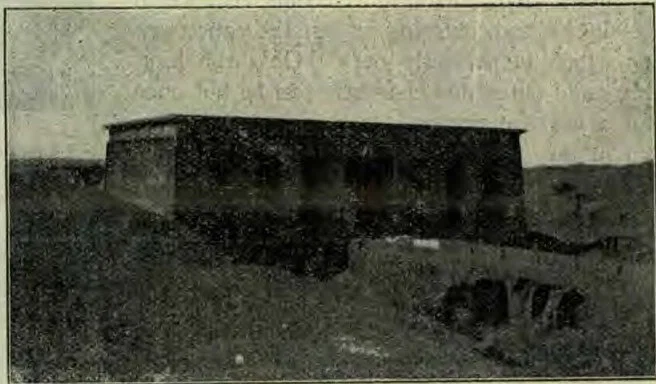
THE “BIRTH-HOUSE” AT DENDERAH
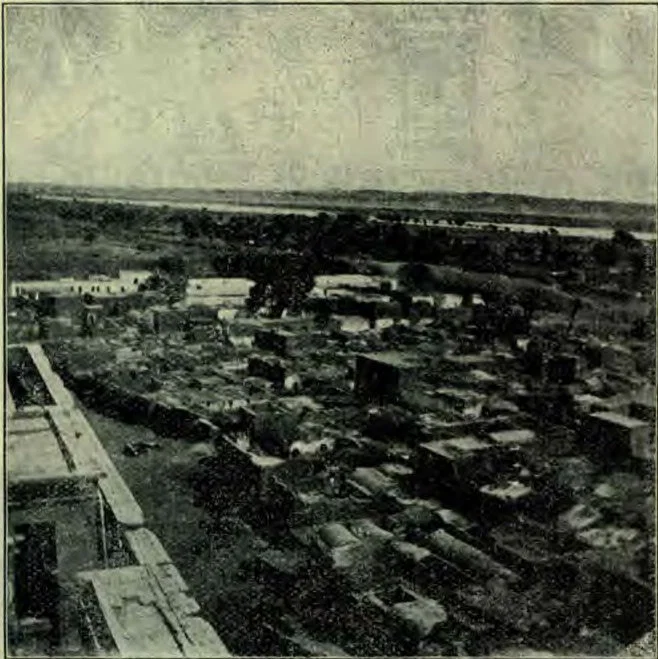
DISTANT VIEW OF THE TOWN OF EDFU
The recent establishment by the English of an agricultural bank, which loans money without interest, ostensibly to relieve the intolerable situation, has been successful principally in transferring the debts into the hands of English creditors.
In disposition these people are very affectionate, being strongly attached to one another, and most hospitable to strangers, it being their rule to keep a traveler three days before allowing him to go on. Naturally, also, they are superstitious, fanatical, and ignorant, seldom being able to read or write.
The Beduins were originally nomadic tribes of Arabs; but most of them have settled in the villages, where they eke out an existence from their small herds of goats and cattle. Many of them, however, still roam over the desert. They are often employed as antiquity guardians, guides, dragomen, etc., the latter business being a very lucrative one. The Beduins are remarkable for their fine physique and dark-bronze complexion. They are bright and intelligent, often possessing a tolerable smattering of four or five languages; but they are proud, cunning, avaricious, and notoriously untrustworthy.
The large class of townspeople who inhabit the cities are the artisans, laborers, clerks, shopkeepers. They are courteous, affable, and often quite intelligent, sustaining a conversation with remarkable ease and readiness. They are sensitive and excitable, punctuating their rapid discourse with nervous, animated gestures, and their earnestness is so great that one not understanding the language is likely to mistake an ordinary discussion for a furious quarrel. They will cheat and steal, however, to any extent, at the least opportunity; and lie with a fluency and consistency that betrays long practise. Cunning knavery passes for cleverness, and is perfectly compatible with their religion.
The dervishes are a fanatical sect, many of whom are found in Egypt. Long practise has enabled them to throw themselves into a sort of mechanical ecstatic trance, often resembling an epileptic fit. Until recently their leader, the Khalifa, reigned over the Sudan; but his power was broken by Lord Kitchener in 1898, when his fine army of forty thousand men was destroyed in the battle of Komera. The performances of the dancing and howling dervishes form a terrible spectacle of heathen fanaticism.
Living in the midst of this dense Mohammedan population is the small, but ancient and well-organized native Christian Coptic church, the members of which have, with true Semitic tenacity and fortitude, stuck to their religion through the hundreds of years of bitter persecution brought on largely by their own pride and stubbornness.
This sect is the remnant of the Egyptian branch of the Greek Catholic Church. The Copts are the direct descendants of the ancient Egyptians. They are more intelligent than the mass of the Mohammedan population. Living mostly in the cities, they are usually shopkeepers, skilled artisans, or government employees, many of them being very wealthy.
It is among the Copts that the only successful missionary efforts have been directed. Over fifty years ago the United Presbyterians sent a company of missionaries to Egypt, who founded the “American Mission” in Cairo. For several years they endeavored in vain to obtain a foothold among the Mohammedans, and then turned their attention to the Copts, with immediate success. Since then they have poured scores of missionaries and hundreds of thousands of dollars into Egypt, until now they count their schools by the dozen, and their converts by the thousand. They have schools all over Egypt, and the more promising pupils are sent to their college at Assiut. By special arrangement, the graduates of this college are placed in the way of government positions. This has proved a great attraction to Christianity; and hundreds of the postal and railway employees have attended this school, which is, at least nominally, a Christian institution.
THE TEMPLE AT DENDERAH
This class is the easiest to reach with the message, as they are intelligent, unprejudiced, and speak English. They become interested at once, and are eager for further instruction. After a few Bible readings, they usually admit the correctness of what is presented; but here is where the trouble comes. In Egypt there is no rest day. All government, railway, and general business runs on uninterruptedly seven days in the week. There is no employment to be found where one can keep the Sabbath, or any other day. The resident Europeans have so far fallen in with this custom that even the professedly religious interrupt their work long enough to attend a Sunday-evening service,—if they happen to feel like it. Of course the standard among the native Christians is no better than that of their teachers; thus the difficulty of getting these people to see the necessity or even the possibility of a strict observance of the Sabbath is very great. Most of them are dependent on their positions for the support of their families.
Another great obstacle to the progress of the work we love is the almost universal practise, among both sexes, of smoking. This terrible habit, combined with the enervating climate, has so enslaved their minds that they are not able to comprehend what it is to make a strong effort of the will. Nothing but a miracle will ever save them; but this is an age of moral miracles, and we feel sure that the Lord has a work to do among these people.
From a human point of view, the work among the Mohammedans is even less encouraging. There is no religion which presents such a satisfying element of truth, offering at the same time such an attractive license for the gratification of a man’s lower nature as Islamism: no theology which promises a future life so pleasing to the sinful soul of man, and so easy of attainment. It is just the kind of religion they desire to believe, so they cling to it, and blindly refuse to listen to anything else. The unusual difficulty of the Arabic language is another great hindrance to this work, but something must be done for these people. Native workers must be trained. The third angel’s message must be sounded in Egypt, and we know that no obstacles are too difficult for the Lord.
The most encouraging openings in Egypt are along the line of medical missionary work. The destructive epidemics of cholera have awakened a wide-spread interest among the better classes in sanitary improvements. The vegetarian pension, or restaurant, has prospered from the first, and well-conducted treatment rooms would doubtless be equally successful. A vast field of work of this kind is open to women nurses among the thousands of shut-in women of the better classes. A physician and nurses are expected in Egypt, and it is hoped that this “entering wedge” of the message will soon be in vigorous operation.
On the whole, the work in Egypt is very encouraging. We have a foothold in the largest cities, and the thousands of Arabic tracts that have been scattered are creating a wide-spread interest. The work is onward; and we doubt not that when the message is completed, and the Lord comes to take his people, a goodly company of faithful ones will be found here.