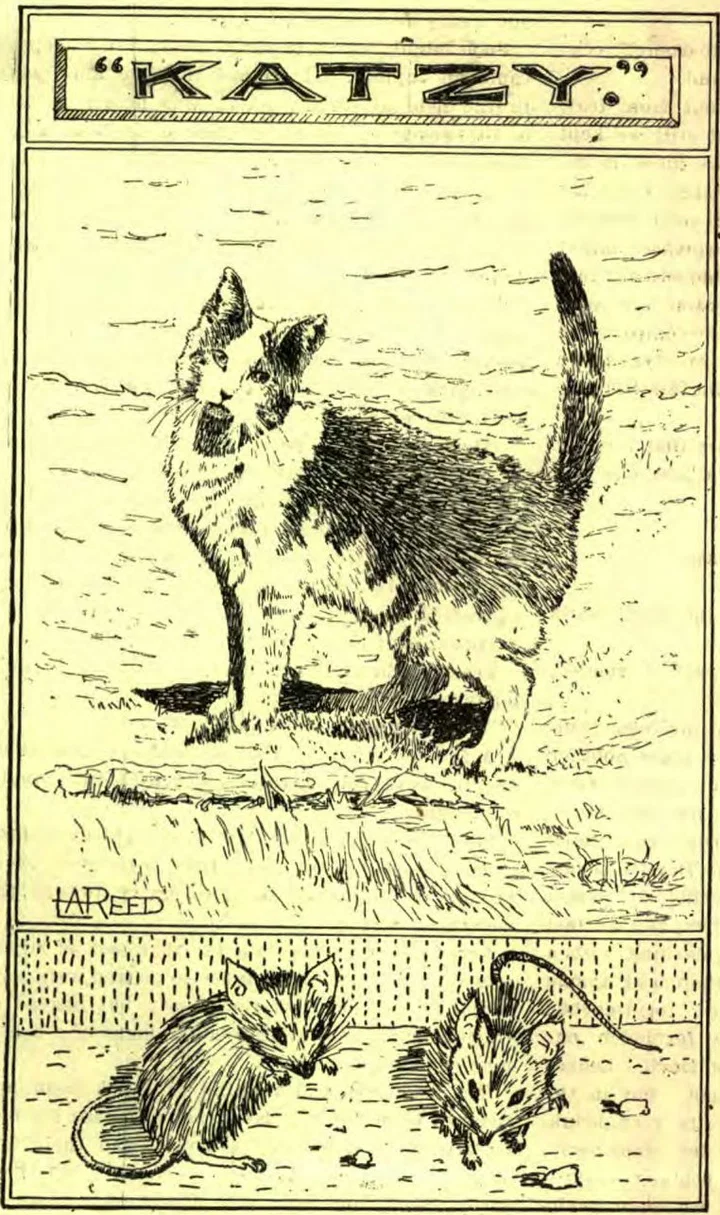
“Katzy”
JOHNNY was playing on the sidewalk when he saw a strange boy across the street lean over the fence, and drop something into Mr. Brown’s front yard. Full of curiosity, he at once left his play, and ran to the spot, where he found a tiny kitten mewing piteously. The strange boy looked back, and Johnny called to him,— “Goin’ to leave this kitten?” “Yes,” said the boy; “we’ve got too many of ’em; want to get rid of ’em.” “Can I have it?” Johnny asked, looking at the strange boy anxiously. “I don’t care. We don’t want it.” Just then the little bunch of white and gray fur turned its pink nose up toward Johnny, looked at him with blinking, plaintive eyes, and mewed faintly. “O, you dear little pussen-kitten!” cried Johnny, gathering it into his arms.
The little creature soon learned to know Johnny, and seemed to love him best of all the members of the household. At first, while it was so helpless and little, he never thought of tormenting it, and the way it seemed to trust him was something both lovely and wonderful.
But the “pussen-kitten” grew to be a “kitten-cat,” and showed more the spirit of independence. Johnny seemed to resent this, and soon began a series of little torments. One day his mama found him ill-treating the cat. First she talked to him about it and finally had to punish him.
It was strange, but Johnny did not seem to realize that a cat can feel. And yet how often she showed that her feelings were apparently as keen as his own, and her sense of the fitness of things even more developed and acute.
When she came to him in joy after a separation, and he, busy with something else, gave her a rebuff, she would turn and walk sadly away, with ears set, face averted. If he spoke kindly to her, she came instantly. If, instead, he heeded her not, she walked off to some corner, and watched him with a questioning gaze. If his disregard for her continued, she perhaps came to him again, and, gently lifting one white paw, touched him softly on the arm, seeking thus to arrest and secure his attention. If he petted her, or, better, let her climb upon him and perch on his shoulder, she showed her delight by loud and unbroken purring.
But after a time Johnny was made to realize that even a cat has feelings much as people have. It was a wonderful revelation to the boy, and a lesson he never forgot.
One noon the barn caught fire. In a very few minutes the whole structure was in flames. Fortunately, the cow was in the pasture, and Johnny’s mother had taken the horse to town.
Johnny was on the back porch, and was the first to give the alarm. As his home was on the outskirts of the city, it would take ten minutes for the fire-engines to reach the place.
At first Johnny stood and watched the fire. Now and then he cried softly. By and by something attracted his attention.
“Kitten-cat” was now full grown, so he called her “Katzy.” As Johnny stood by the porch, she came running to him, mewed, pawed at him, and then ran toward the barn. Then she came back, mewed, jumped up at him, and ran away again.
Partly understanding, Johnny followed her. This seemed to be what she wanted, for she ran straight toward the barn, now and then looking back to see if Johnny was coming. Johnny went on until he was afraid to go farther.
But where was “Katzy?”
Just then he caught sight of her on the roof of the shed. A moment more, and she disappeared inside the burning barn.
“Come back, Katzy,” cried Johnny. “Come back, Katzy, Katzy, Katzy! You’ll be all burned. O, do come back!”
And in a moment or two she did come back, carrying something in her mouth. On account of the smoke, Johnny could not see what she had, but she was soon at his side and dropped a wee kitten, whose eyes were not yet open, at his feet. Then she looked up at him, mewed, and ran away again.
This time she was in the building longer, and when she came back, bore another kitten in her mouth. She placed this beside the other, looked up at Johnny, and mewed. Her fur was scorched in places, her tail had lost most of its hair, and the smoke had blackened her face, and the fire had burned her whiskers.
She looked up at Johnny in mute appeal, and then started to make another trip, but the boy was too quick for her. He caught her by her ragged tail, and pulled her to him, sobbing as he held her, and saying, gently:— “You can’t go again, Katzy. You mustn’t go any more. The other kittens’ll have to burn. You just can’t go, ’cause you’re worth more’n a hundred kittens.”
L. A. REED