Rambles in Bermuda—II

6%

Review and Herald Publishing Assn. · Washington, D. C. · September 8, 1903

FromThe Youth’s Instructor, Vol. LI, No. 36

Read the full edition

Rambles in Bermuda—II

The People of Bermuda
THE first Bermudians were a motley collection, and gave their governors a deal of trouble. In these days the “ducking-stool” is nothing but a name, and it takes a wide stretch of imagination to invest it with its former terrors; yet if one may judge from the old records, it was once to be reckoned with by too turbulent and talkative housewives. In those days, when subjects for legislation were so scarce that it took several days to pass a suitable measure for affecting the transfer of a pump from Somer's Seat to the capital, it was considered quite proper that the courts should employ themselves with the personal conduct of each member of the community.
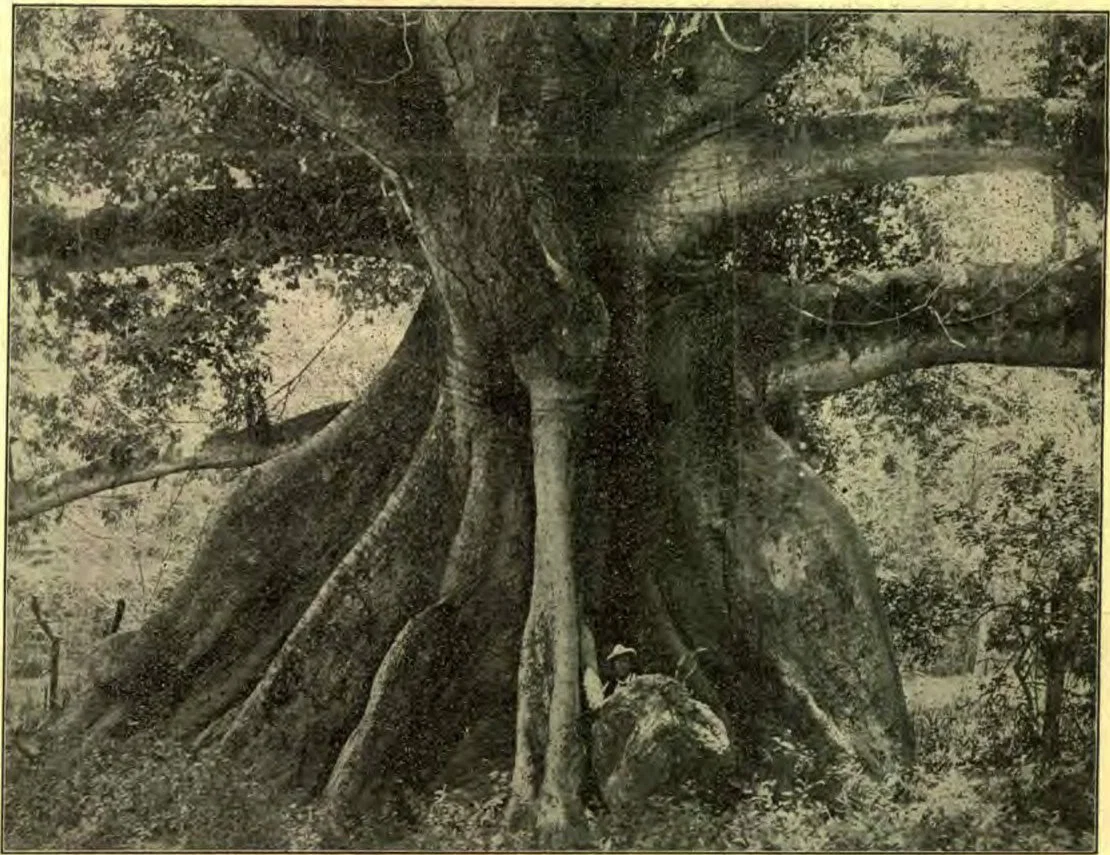
A GIGANTIC COTTON TREE
For many years the Established Church was alone in Bermuda; now there are the Wesleyan Methodist, the African Methodist Episcopal, the Presbyterian, the Catholic, and a small organized company of our own people. In the Church of England, both High-church and Low-church are represented. The large cathedral, which is decidedly High-church in its tendencies, is still unfinished. The beautiful edifice that once occupied the same spot was destroyed by fire several years ago, and only the audience-room, part of the cross of the new church, is completed. If it depends upon Bermudian workmen, it may rival the famous Cologne Cathedral, in one particular at least.
Bermudians are disinclined to exertion, or so it seems to an American. Perhaps they have chosen the wiser part; certainly they live to a ripe old age. Diseases are not common; in fact, since the yellow fever epidemic in the early part of the last century, there has been little to disturb the even tenor of the Bermudian's ways. Pneumonia is the disease most dreaded, probably because of the dampness of the climate, rendering it inimical to lung disorders. There is no malaria, however, and few contagious diseases are found, owing to the strict quarantine regulations. The islands are a favorite winter resort for nervous invalids and overworked professional people in need of rest and change.
A rest it certainly is to come from a busy, bustling country like our own into this little island paradise, where such inventions as street-cars and electric lights are practically unknown; and the greatest excitement is the weekly arrival of the New York mail. And well it is for the tourist that this little island world is able to hold her own against the change and bustle and hum that characterize the greater world outside. When street-cars replace donkey-carts, half the charm of the place will be gone.
The months from November to May bring most tourists; and in January, February, and March the streets of Hamilton are alive with Americans. The little “city” really takes on an air of energy and business. Prices are way up; rooms are at a premium. In the height of the season, an unfurnished room without board rents for five dollars a week.
It is hard at first to accustom one's self to the English currency; and when an American lady buys three yards of cloth at “one and six” a yard, the temptation, often the only resource, is to turn out the contents of her purse, and let the shopkeeper take what he will. Be it said to their credit, however, Bermudian shop-keepers are strictly honest in their change.
By the middle of May, the most delightful month in the year in Bermuda, the large hotels are closed; and the only interruptions to the summer quiet are the ship-loads of Cooks' tourists, who are beginning to find the summer months quite as pleasant for sight-seeing as the earlier ones. For the most part, summer is more endurable than in the United States, as the thermometer seldom rises above eighty-five degrees, and there is always a cool ocean breeze. The humidity of the atmosphere renders the heat oppressive at mid-day; but there is always a delightful coolness in the shade. Tourists are making the discovery that Bermuda is a summer as well as a winter resort; and it is a question of a few years at most until the hotels will be open the year round.
This transient population, however, while it enriches the shop-keepers, and helps set the fashions, can make comparatively little impression on the real life of Bermuda. The American comes and goes in increasing numbers year after year; but he can not remain except at great disadvantage. According to law, no alien can hold property; and if a Bermudian lady marries an American, and fails to dispose of her property within a given time, it is forfeited to the crown.
In considering the people of Bermuda, one must not forget that two thirds of the population, about ten thousand, are black. The early settlers, like the Virginians, had their plantations and their slaves. The black people of Bermuda have a generation's start over those of our own land, having been freed in 1838, and they have made good use of the time. One is impressed at once with the air of intelligence, in many cases of refinement and prosperity, that characterizes many of them. Some of the leading professional men are negroes. Even the poorer classes are usually well dressed; and there is little abject poverty among them. Compared with the lower classes of other countries, they seem really rich. Nearly every one who is not in service owns his own little stone hut and plat of ground, and is quite independent. It is not so hard to own a house in a country where all one has to do is to buy a tiny lot, scrape off the layer of soil, and saw out enough blocks of the sandstone to leave a cellar and build the house.
There are no beggars. The Bermudian negro is self-respecting; he believes in the equality of labor, and is proud of the position he has won by honest toil. He is not particularly submissive, and does not believe in “taxation without representation.” He is allowed a representative or two in the Assembly; but this does not satisfy him. It is prophesied by many that sometime in the not very distant future, Bermuda will be the scene of a race war.
For some time the islands have been inundated with an influx of West Indian negroes which, if continued, will do much to bring the disturbing elements into conflict. The newcomers differ from the natives in appearance, intelligence, and disposition. They are lazy, thievish, and discontented. The public house is likely to get most of their earnings. Laws have been passed restricting their immigration by making it necessary that each immigrant have five pounds of ready money in his pocket when he steps on shore; but a way is always found to evade the laws. It is very easy for the contractor who wishes to profit by cheap labor to lend the required sum to be worked out later on his estate.
Domestic labor is cheap. Ten dollars a month is a fair wage for house servants, but they make it much more by their stealings and pilferings. It is generally understood that in engaging a servant one engages also to support the entire family out of his own larder.
The color line is rigidly drawn. In churches with white and colored membership, separate sittings are maintained. Though there is an African M. E. Church, many of the negroes prefer to have their church membership with the whites. The reply of one old aunty, when questioned as to the cause, shows a lingering remnant of the old-time deference to the “massah.” “I don't min' sittin' behind white folks, but I won't take no back seat foh collud folks.” There is of course no social intercourse between the two races. While in Bermuda, I met a lawyer whose wife had fallen a victim to this social exclusiveness. He had received his education in England, and with his clear, olive complexion, crisp hair, and white features, had always passed for a white man, with possibly a strain of the Spanish or Italian blood. He married a beautiful English girl of the upper middle class, and settled down to practice law. For some reason he brought this young wife back to his old home in Bermuda. The shock was too great. She found herself shunned by all who under other circumstances would have been her friends and associates, and in less than a year she had pined away, and died, it is said, of a broken heart. The story is only one of hundreds for which the curious race tangle is responsible.
Bermuda is a faithful representation in miniature of the great world outside. Each race has its own castes, cliques, and social circles. The whole island is like a great, overgrown village, in which everybody knows everybody's business, and knows, but does not recognize, all his neighbors. To a stranger, the punctiliousness of Bermudian etiquette seems just a little absurd, but it is inevitable.
WINIFRED M. PEEBLES.