A True Story
DEVIL’S LEDGE is roaring angrily to-night, and a thick, white fog is curling up from the sea, through what is left of the dense spruce forests that surrounded my childhood home. I suppose the cranberries, too, still grow upon the bleak little island; and although it has been long since I saw them there, I shall never forget how the red clusters look, all damp with mist from the chill New England shore.
It was sixty years ago it all happened, when I was only a little girl nine or ten years old. Mother had a houseful of company, as was often the case in those good, old-fashioned times. Aunt Thankful and Aunt Mary had come with their families to spend the day, and we youngsters, of whom there was a small battalion, were having a fine frolic. Though toes were often stepped upon, and heads thumped, we constantly dodged about underfoot as mother passed to and fro before the kitchen fireplace; so, after dinner, I was not surprised to hear her say,—
“Elizabeth, take the pail, and you youngsters go down to the head of the field, and gather some cranberries.”
Now I knew well that there was an abundance of cranberries already in the house, and realized that mother only wished to be rid of our disturbing clatter for a time, in order to give our elders an opportunity for rest and a quiet little chat. But in those days, children were not allowed to argue the command of their parents, however unwilling they were to obey; so I took up the pail, and slowly set out for the head of the field, leaving the others to follow as they would. Many of the cousins, however, did not care to go, and finally, only Cousin Susan and myself, with each a small brother, Bine and Albert, found ourselves trudging in the direction of the cranberry woods.
No doubt we were an odd looking little band, with our hair cut off straight around our necks, tanned brown by the sun and the salt sea breezes. But we scurried along as unmindful of our appearance as so many Mother Carey’s chickens, down on the shore.
We were not in haste to begin gathering berriesp. 6 A few minutes’ work would procure enough for supper, and knowing the whole afternoon was before us, we romped about hunting squirrels, swinging on grape-vines, or climbing into the prickly spruces in search of pink spruce gum. Absorbed in play, none of us noticed that one of the sudden fogs, common in that locality, was rising from the ocean, and rapidly sweeping inland. By and by the sunshine began to darken, and the woods to fill with mist; then, in sudden alarm, I seized the cranberry pail, almost empty as it was, and called to the others to come on home.
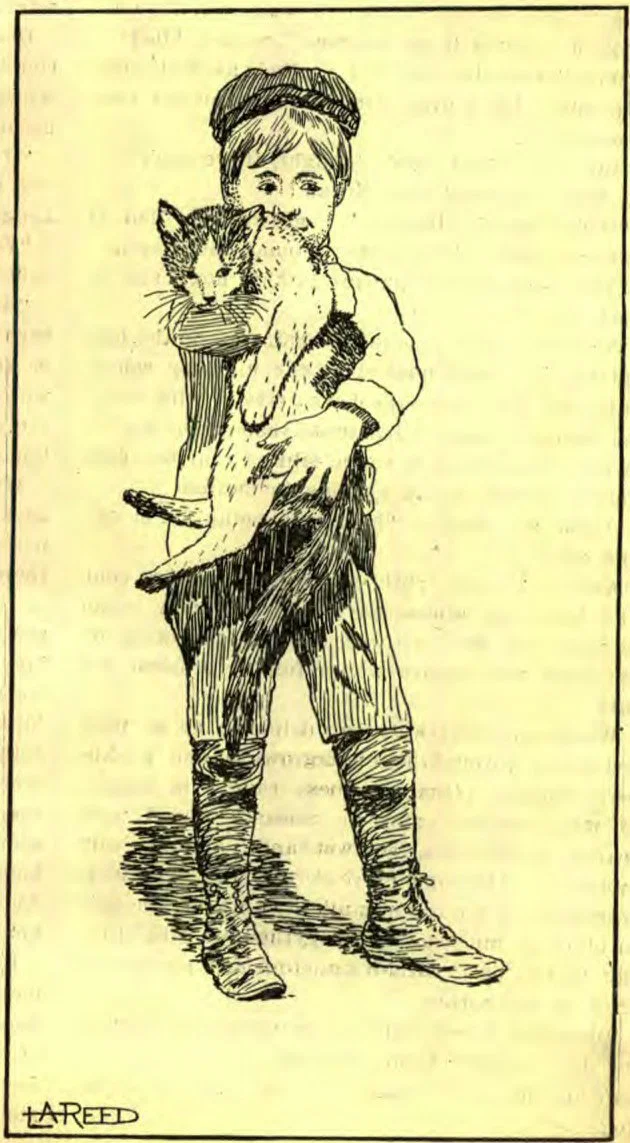
But we had played too long. Thicker and denser settled the fog, until in a few minutes we could see only a few feet in any direction. Familiar tree-trunks took on unnatural shapes, and well-known landmarks were either completely obscured, or so veiled in mist that we could not recognize them. Being the eldest, I felt responsible for the other youngsters, and hurried them as fast as possible toward home, as I thought; but as our surroundings were shut out by the ever-increasing fog, I began to grow confused, and soon could not tell where we were, or in what direction we were going. I was sorely frightened, but tried to conceal the fact from the others, as the boys were already beginning to whimper with fear for the darkness and mist and ghostly surroundings.
Suddenly a hoarse, unearthly screech sounded out toward the sea; for an instant we were terror-stricken at the unexpected sound, then recognized it as the fog-horn on the single steamer, that in those days, plied between Boston and St. Johns. Often before we had heard its dismal “Troo-o-o-nk, troo-o-o-nk, troo-o-o-o-nk!” proclaiming danger out on the ocean; now it sounded again and again, while after every whistle we became more nervous and excited as we stumbled along through the murky woods.
“It must be a bad fog,” faltered Susan.
“I guess it is,” I answered, “and I don’t see a thing I know. I believe we’re lost.”
At this, Bine and Albert set up a cry of terror, Susan and I quieting them as best we could.
“But what shall we do?” asked Susan.
“We’ll just have to keep on,” said I. “Now, Albert, don’t cry; for we’ll come out all right. We’ll be sure to see something we know before long.”
“Bu-u-t I want to go h-o-ome!” wailed Albert.
“You’ll soon be there,” I replied, as soothingly as possible, but a great deal more confidently than I really felt.
“But what shall we do to-night, if we can’t find our way?” moaned poor Susan.
“We’ll find it, though,” I answered; “but if we’re not home at dark, they’ll come out after us.”
“They could never find us in this fog,” she replied, hopelessly.
Then the fog-horn sounded again, out on the bay, and my own soul quaked at the uncanny sound, while the wail from the boys revived with terrified energy. Again I reassured them, then started on once more, with a vague feeling that our only hope of succor lay in keeping in motion.
“Come on,” said I, “let’s keep going! I’m getting cold.”
And, to tell the truth, we were all getting cold. The damp fog, almost as wet as rain, now began to penetrate our clothing, besides collecting on the trees and bushes whose foliage brushed our path.
We became first wet, then dripping, as we plodded along through the undergrowth and huckleberry bushes. Often our toes caught in tangles of wild hemlock, and we constantly trod upon scarlet cranberries, now wet and shining with moisture. Although they had been in a measure responsible for our sorry plight, we never thought to pluck so much as one berry, though still clinging to the pail, with its one forlorn handful of fruit in the bottom.
Bine and Albert kept up an unceasing sniffing as they trudged along, keeping fast hold of Susan and me, as if fearing to lose even us in the fog.
“Boo-oo-hoo! I want mother,” Albert would sob, as Susan dragged him along.
“Uh-h-h-h-hoo-oo! I want to go ho-o-ome!” echoed Bine, as I pulled him by the hand.
We went on until almost tired out from fear, cold, and the distance traveled, but still we kept on because it was the only thing we knew to do. The other youngsters depended entirely upon me for a way out of our difficulty, and as I realized more and more what serious consequences might follow if nightfall should shut us hopelessly into the wild, wet woods, I naturally became very anxious, and kept them all, our entire company, in motion while continually straining my eyes in an endeavor to catch a glimpse of some familiar object.
Suddenly a sound reached my ears that brought me to an abrupt standstill, with a new and awful fear.
“Listen!” I said.
“What’s the matter?” asked Susan.
“Don’t you hear that?” said I.
“What?” faltered Susan, while the boys’ wails began to gain strength.
“The Devil’s Ledge, right there!” I replied, pointing ahead.
Sure enough; above the constant, uniform rumble of the waves on the rocky shore, arose another sound,—a mighty, angry roar, that rapidly grew more distinct as we advanced. We had heard that roar before, and knew that it could come from nothing else on the island but the Devil’s Ledge, a rugged cliff of rock rising perpendicularly from the water, a sheer three hundred feet, and against which terrific waves were always dashing with a roar terrifying to stouter hearts than beat among that frightened little quartet of fog-drenched youngsters. Mother had always forbidden our going anywhere in the vicinity of Devil’s Ledge; for it was indeed a dangerous spot; but in the fog we had wandered almost to its very brink, now veiled from sight, but only a few steps away, with the cruel ocean dashing far below.
When we realized our danger, we were panic-stricken. Bine’s and Albert’s whimpers developed into lusty howls, and probably Susan and I would have joined in, had there been any older person to depend upon; as it was, our danger made us desperate, and as is often the case, desperation originated a way out of our dilemma.
Once more we calmed the boys as well as we could, though half crying ourselves, and as I listened to the roar of Devil’s Ledge, a happy idea flashed to my mind.
“O Susan!” I said, hopefully, “don’t you remember that there are field fences opposite Devil’s Ledge?”
“Ye-e-s,” said Susan, “Uncle Alden’s clover fields.”
“Sure enough,” I replied. “Well, then, if we turn square around, and keep straight, we will be sure to strike Uncle Alden’s fences, and then we can find his house, and he will take us home. We will get away from Devil’s Ledge, at any rate. Come on, let’s try it.”
With hope somewhat renewed, we turned our backs on the roaring cliff, and started in the opposite direction. If my idea had failed to work, there is no telling what would have become of us poor, dripping youngsters; but, fortunately, my memory was correct, and we kept a reasonably straight course as we proceeded, so finally we stumbled upon a rail fence, which, when we followed a short distance, we recognized. How delighted we were to see something familiar once more; even those old, weather-beaten rails, in the ugly worn fence, looked beautiful to us, for they were a possible connection between us and home. We quickly clambered over into Uncle Alden’s clover field and began our search for his house.
But we were by no means out of our predicament. The fog was as thick as ever, and we wandered about in the young clover with little idea of distance or direction, as we could see but a few feet at a time. Hope had revived our spirits, and stopped the boys’ wails for a time; but as we continued to wander, and found no sign of a house, our weary feet began to drag.
Soon night began to draw near, and darkness came on rapidly. It seemed that we must stay in the field all night, which was nearly as bad as the woods, except for the fear of Devil’s Ledge. Susan and I were in despair and felt like sitting down in the wet clover, and crying till we were rested; but we dared not stop, with night so near, so plodded on, almost dragging the poor little boys along.
When it became nearly dark, our feet suddenly stumbled into an uneven spot amid the clover, and looking down, I noticed a narrow, beaten track, extending as far as I could see, where it disappeared in a wall of mist.
“Here is a little path,” said I. “Let’s follow it, and see where it will take us.”
Almost mechanically, the others followed where I led, for they had all become too weary to take much interest in trifles; but we had followed the path only a little way, when Susan suddenly exclaimed,—
“Look, isn’t that a light?”
Peering through the mist, I thought I could make out a faint gleam.
“I do believe it is,” I said. “O, hurry up!”
A few steps proved that we were not mistaken, and the boys’ sobs changed to excited little laughs of delight.
“It’s Uncle Alden’s! It’s Uncle Alden’s!” they cried joyously, and their tired bare feet were aroused to life once more to hurry toward the welcome glimmer.
Light did not penetrate far that sort of night, so we had but a short distance to go, and were soon rapping at the door of the house; but instead of Uncle Alden’s, it proved to be the home of a fisherman who lived near.
The fisherman and his kind wife took us in, and listened to our story. Now that all cause for fear or excitement had been removed, and their first joy for safety was over, their bodily comfort asserted itself, and Bine and Albert once more began to cry for home and mother. This time the bluff old fisherman consoled them:—
“There, there, now, don’t cry, don’t cry! You’ll soon be home, and have a nice hot supper. It’s only a little piece farther to go—there’s nothing to cry about. You’ll soon be home. There now, there now, I wouldn’t cry!”
Thus he talked, while we stood by the fireplace and warmed ourselves by the blazing fire. The fisherman soon had his lantern prepared and lighted, and then we set out once more for home, but by the road this time, and with the cheerful gleam of the fisherman’s lantern for a guide. And never did home seem such a delightful place as when, a few minutes later, we, a bedraggled little band of cranberry pickers, saw its lights faintly shining through the dense fog that still smothered land and sea.
At home the spirit of alarm was in the air. The men had come in when the fog began to gather thickly, and when we youngsters did not appear in a reasonable time, they all grew anxious for our safety. At the approach of night, satisfied that we were lost, the men collected lanterns and lights of various descriptions, and were just about to start out in search of us, when we appeared upon the scene.
As the kind fisherman led us into the warm, comfortable kitchen, we created quite a sensation.
“Why-y-y, children, where have you been?” said mother.
Countless other questions followed, till our adventure was fully discussed and explained; but an interruption occurred in the form of a whisper, and a tired little voice from Bine,—
“I’m hungry!”
So we were hurried into dry clothes, and were soon eating a bountiful supper, which included cranberry sauce.
A night’s rest restored us completely, and the next day we had almost forgotten that we had ever been tired, and were ready for another romp in the woods.
MINNIE ROSILLA STEVENS.