It is not at all a difficult matter for an ingenious boy to construct a real loom for his little sister, with which she will be able to weave both plain and variegated fabrics. A nicely made machine, together with a few balls of colored druggist’s twine, make a very acceptable present for any little lady.
The Things Needed
These will cost nothing, because you can find them around home. A few pieces of wood, such as may be had from an old box, a broomstick, some nails, and a piece of very hard, tough cardboard, form all the needed materials.
As for tools, a knife and a hammer are necessary; a plane, saw, and brace with bit are useful.
Putting Together
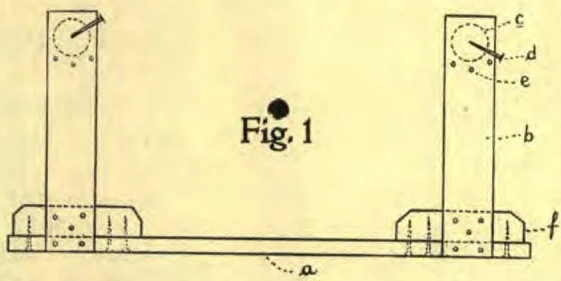
Fig. 1 shows the construction, and pieces of wood necessary; a is the baseboard; and in the model from which this description is taken, it is about 26 inches long by 10 inches wide. It can be made longer and wider if the materials are at hand. If you have a plane, be sure to dress the edges down nice and square, and make the surface smooth. Then go over it with a piece of sandpaper, giving it a good finish. There are four upright pieces, quite thick (from one-half to an inch in thickness), 2 or 3 inches wide and 10 or 12 high. These are nailed or screwed securely in place, and braced by some other pieces of the same wood, as shown at f. This makes a strong, light frame.
Now the two rollers, which should be as long as the baseboard is wide, are either pieces of a curtain pole, broom handle, or a rounded stick, 2 x 2; they are better if they are quite large, though this is not at all necessary. Two of the axle pieces for the rollers are nails driven into them. The other two, as shown at d, may also be very long nails bent to form a kind of crank. If the nails of sufficient length are not to be had, some steel wire driven in straight will do. The holes marked e in the diagram are placed there to hold a nail which keeps the cranks from turning backward while the weaving is progressing.
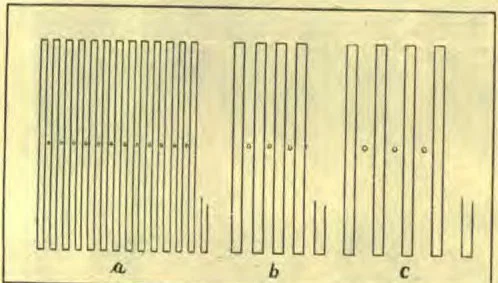
The comb is made of cardboard, which should be thick and hard (a piece of stiff binder’s board will do), cut with slits and holes as shown in Fig. 2. These slits should be 5 to 7 inches long, and wide enough to give the string or thread an easy movement lengthwise in them. The holes should also be slightly larger than the diameter of the string. The distance between these slits and holes will depend on the nature of the cardboard you are working with. If that is soft and brittle, the openings will of necessity be farther apart than with tough, hard board. The distance will also depend on the closeness of weave the machine is to make. Two or more “combs” or different styles will enable the weaver to do more than one class of work.
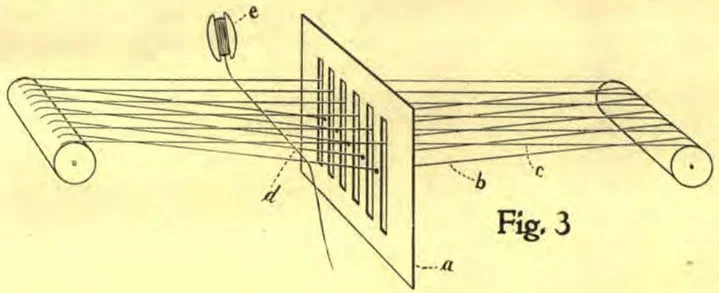
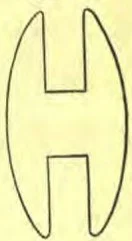
Fig. 4 shows the cardboard shuttle, which is to carry the “woof” between the strands of “warp.” Make several of these, so that the little girl who uses the machine will not be obliged to so often rewind the shuttles. They should be of the same tough, heavy card as the comb.
Operating the Loom
To one of the rollers make fast the end of a string for every hole and slit in the comb. Pass these “warp” strings through the comb, and now wind a long length of each string up on the roller to which you have fastened its end. Cut the strings off, and tack or tie them to the other roll. Fig. 3 shows the relation of part to part thus far.
In the same figure you will see that by pushing the comb downward one set of strings is separated from the other, forming a V-shaped opening between two flats of “warp.” Through this V a shuttle of twine is passed, and the comb drawn against it to force it tight up to the roller. Returned to its position, the comb is next raised instead of lowered, and the shuttle passed back through the V. The comb presses this tight up to the former woof thread, and the operation is repeated till sufficient cloth is woven, or the little weaver is tired. Of course, from time to time it will be necessary to wind up the fabric that has been made, and bring new warp into position. The cranks and nails will serve the good purpose of stretching the strings.
Colored Cloth
So far there has been woven a plain material, all of one color. Now if we had put five warp threads pink, five white, and five blue, entirely across the roller, and from different shuttles passed five white, pink, and blue threads alternately through the V’s, we should have a checkered cloth. In this way we can make any possible design in checks or stripes. Some of the color weaving done by mere children has a very rich and pleasing effect.
A Word More About the String
String is cheap—don’t pay too much for it. If you can get only white, you can dye it any color you like in the package dyes sold at the drug store. Of course, white and colored threads may be used to make a finer cloth, but the weaving of it is very slow and wearisome. Cloth of thin texture and any color, torn into long strips or sewed together, may be used on the shuttles to make very pretty little rag carpets and rugs for the children.
EDISON DRIVER.