THE ports of Korea are lively places, with their mixture of native, Japanese, and Chinese inhabitants; and there is much of interest to be seen in these cities. But for a genuine view of Korean city life, one should visit one of the large interior cities, where foreign influence has not penetrated deeply. Such a place is Pyeng Yang, the ancient capital, situated on the Tadong River, about seventy miles from the western coast.
The authentic records of Pyeng Yang are said to reach back to the times of David and Solomon. The city is surrounded by a wall of stone and earth, only the outer facing of stone, and the inner facing of the battlement, being laid with lime mortar. Of the several gates, the principal one is in the east wall, next to the river. It is surmounted by an imposing pavilion supported by immense pillars of cedar. The tiled roof of this pavilion has widely projecting, deeply curved eaves, so characteristic of Oriental temples and similar structures. The wall has not been kept in repair, and in several places it is so broken down that foot-paths run over it into the city.
Passing along the main streets, we find them thronged with white-robed people. The shops are quite small, and open to the street. Many traders, both men and women, sit in the street with their small stock of wares before them. There is loud bantering and sharp bargaining over prices; for there seems to be no “one-priced stores” in Korea. Men driving cattle or ponies bearing bulky loads of fuel or fodder, shout to the people to make room; for even the principal streets are quite narrow. In front of the butcher shops the fresh hides of the beeves are spread down in the street under the feet of the crowd, till dry. Women of the better class glide along with eyes peering from the folds of long white or green garments thrown over their heads and clutched about their faces. Here comes another shy woman almost hidden by a basket-like hat larger than an ordinary clothes-basket. She supports the sides with her hands, and elevates the front end enough to enable her to see the way.
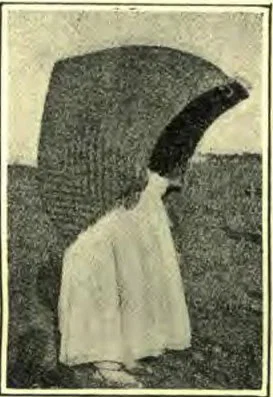
Many of the houses in the main part of the city are two stories in height, with tile roofs. But in the outskirts they are little, if any, superior to the country cottages. We notice that some of the dwellings lack doors and windows, and are told that these were broken up and used for fuel last spring by the Japanese soldiers while on their way to the war. The soldiers forcibly occupied many houses, as the weather was still cold; and the people have not all been able to repair the damage done to their dwellings.
Passing now toward the great eastern gate, we notice a constant stream of men carrying buckets of water from the river, which we learn is the source of the city’s water-supply. This river water, dipped up among the boats which line the bank, is doubtless not the cleanest; but it is probably cleaner than the water from any wells that might be sunk within the city walls. For there seems to be an utter lack of sewers and drains, and of any provision for removing the filth of the streets. The wonder is that people in such spotless garments can keep looking so clean in the midst of such surroundings. Pyeng Yang is certainly in dire need of proper sanitation.
The space between the eastern wall and the river is well covered with buildings. Here are to be found many Japanese houses. The river front is crowded with sampans and strange-looking Korean and Chinese junks. All is now bustle and confusion; for the tide is just beginning to ebb, and many boats are preparing to start down the river. A din of voices fills the air. The hoarse shouts of the crowd on shore mingle with the sonorous chant of boatmen as they labor together at the heavy cable which draws in their anchor. We step into our sampan, and are soon floating along between bold, rocky bluffs and pleasant fields, far from the city’s noise.
F. W. FIELD.