“Ho, ha, hum!” yawned Mrs. Flittermouse, stretching her wings and opening her sharp little eyes, “how sleepy I do feel! Is it really time to wake up, Flapper?”
“Indeed it is,” replied her husband. “I should think a six months’ nap was long enough to satisfy any bat, and here we’ve been dozing almost seven. Don’t you feel the spring sun warming the earth above our cave? Isn’t your appetite ravenous? Mine is. I’ll warrant the gnats and midges are whirling over the brook in clouds.”
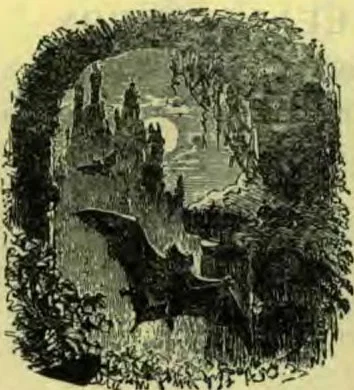
As the sun sank behind the hill, out of the cave trooped hundreds of small, dark forms, and presently the air was filled with shrill cries. All Batland was enjoying its first spring feast. Hither and thither they flitted, hawking after the insects that were out, enjoying the spring evening.
“Flapper,” said Mrs. Flittermouse to her husband, when they had eaten all the flies and midges they could catch, “let us look for a tenement. It is time we thought about setting up housekeeping for the summer.”
“Yes, my dear,” said he, and away they fluttered toward a patch of deep woods. The moon shed a soft light, which the bats liked much better than sunshine. “How does this suit you?” said Flapper, ushering his wife into the hollow in a great dead pine.
“I like it quite well,” she replied; “we will take the top story, and leave the lower part for later comers.” A few weeks afterward, the old tree was a lively place indeed. In the upper flat dwelt the Flittermice. The middle tenement was occupied by Madam Squirrel and her children, and the ground floor was a sort of wayside inn, free to any traveler who chose to pass the day or night there. Sometimes a fat coon crept into its cozy depths to sleep from sunrise till sunset. Now a shy rabbit hid in its darkest corner. Once a black snake spent three nights in it and frightened Madam Squirrel so much that she moved the next morning to the opposite side of the wood.
A proud couple indeed were Mr. and Mrs. Flittermouse when triplets arrived to bless their home.
“I think, Flapper,” remarked Mrs. Flittermouse, “that the boys are going to look like you.”
“And our little daughter,” said he, is the image of her mother.”
When the babies were still very small, indeed they were only a few days old, their mother decided to take them for their first airing, “for,” said she, “I must go out and get a meal, or I shall starve, and I surely couldn’t leave these precious babes at home. Who knows but the black snake might take a notion to dine on tender Flittermice, instead of frogs and wood mice. “Now, children,” said she, “fasten your little thumb-hooks firmly into my fur, and cling on with all your might.” Away she darted toward the brook, which wound through the meadow beyond her home wood. How good it was to be chasing the dragon flies, the fat-bodied night moths, and the mosquitoes, in company with all her friends and relatives! “Oh!” she cried, suddenly, as she saw one of her babies falling through the air. Swift as an arrow she darted downward, and just as the little one’s nose touched the water, she seized him by his tail. Scolding him roundly, she hooked him to her coat again, and started homeward. “What a fright you gave me, child!” said she, “don’t you know that you came as near as possible to losing your life?”
When the children were a few weeks older, they took their first lessons in flying, and their mother showed them how to use their tails like rudders to guide themselves through the air. It was indeed a pretty sight to see the triplets, after a night’s hunting, sitting in a row, combing their coats with their hind feet, and parting their fur neatly down the middle.
“Why, mother,” asked the little daughter, “must we always sleep with our heads hanging down?”
“In order to throw ourselves into the air and start flying at the first hint of danger.”
“And why, mother,” asked one of the boys, “must we sleep all the day, instead of enjoying life as so many of the other forest folk do?”
“We are night people,” said Mrs. Flittermouse. “If we flew out in the bright sunshine, we should be so blinded and dazzled that we could not see which way to go, and some of the fierce day folk would fall upon us and devour us. Now hang up and close your eyes and ears, my dears, and dream of the fine time we shall have to-night when the stars twinkle, and the moon lights up the meadow and the forest.—Margaret Wentworth Leighton, in Young Americans.