Insects and Their Habits, and What Harold Learned About Them
2%

Review and Herald Publishing Assn. · Washington, D. C. · August 1, 1905

FromThe Youth’s Instructor, Vol. LIII, No. 31

Read the full edition

Insects and Their Habits, and What Harold Learned About Them

“Come, Harold, I want to tell you a little story that a friend once related to me. The family had been very much troubled with ants, which seemed able to find anything and everything eatable in the house, and especially anything sweet; for as you know ants are very fond of sweets. These insects insisted upon making raids upon the sugar bowl, and would discover it no matter where it was hidden. Finally the idea came to my friend that he would place the sugar bowl in water.”
“Mama sometimes draws a heavy line of chalk around her sugar,” said Harold, “and the little thieves get their feet all dusty; they don’t like that very well, and keep away.”
“Sometimes this will stop them, but my friend tried every device before putting the bowl into the water, but it did no good.”
“The water stopped them, all right, didn’t it, uncle? I guess they didn’t care to wet their feet.”
“One would suppose so, but their extreme fondness for sweets led the ingenious fellows to invent a way of reaching the coveted prize. They actually climbed up the ceiling, and stopping directly over the sugar, dropped down into it.”
“I should think they might have fallen into the water,” said Harold.
“This is precisely what some of them did do. And it caused a great excitement among the others; but they did not dare to plunge in after the unlucky fellows, so they sent a small detachment back to the nest for help. Finally, my friend said, eight lusty fellows separated from their comrades, and, flinging themselves into the water, swam with such skill that they finally succeeded in saving most of their drowning comrades. After getting them out of the water, they, like human nurses and physicians, actually rolled, rubbed, and brushed their half-drowned friends until most of them were quite restored.”
“It looks as if they really cared for one another, just like people; doesn’t it, Uncle Frank?”
“Certainly; I am of the opinion that these tiny creatures are capable of feeling almost all the emotions of human beings: they must hate, or they would not fight; they must be jealous of the authority of others of their kind, or they would not try to kill their rivals. They certainly have great love for their offspring and for those of the same family, or they would not risk their own lives to save them from death. So I think it ill becomes us to look with feelings of scorn even upon the humble insect that creeps at our feet,—humble it may be, but the wisest man on earth would find it quite impossible to give life even to the tiniest creature; none but an all-wise Creator can do that. But I must hasten to tell you about the strange insect wrongly named the white ant.”
“Let’s go out now, uncle, and take a walk, maybe we can find some of them.”
“No; we shall not find any here; we are too far north for them to venture, and we may well be glad. But they are found in most warm countries,—in the hot portions of our own land, in Africa, in Guiana, in France, and in some other portions of Europe. They do all sorts of damage by eating whatever they find in their path. Sometimes very valuable articles are entirely ruined by them.”
“Dear me! I’m glad none of them is here. Did you ever see any of them, uncle?”
“I have often seen them in Paris. They once caused a great deal of trouble in that busy city by creeping into one of the government buildings, and eating important records. But the queerest part of the story is that they did not touch the top leaf of paper nor the margins of any of the leaves, so that the pile of papers looked as perfect as when first placed there, really the whole box was only a mass of rubbish.”
“Do you suppose the cunning fellows left it that way on purpose to cheat the people, uncle?”
“I can not tell you that, of course, but I do know that their clever work certainly had that effect.”
“Are these the ants which build such big houses?”
“Yes, their houses are enormous. I will tell you about them. These white ants are by far the most gigantic and wonderful insects of the ant tribe. The houses which they build for themselves are certainly worthy of more than a passing notice. What would you think, Harold, to see an ant’s nest which was much higher than your head? I have myself seen them ten or twelve feet high.”
“Why, Uncle Frank! that is almost as high as men build their houses.”
“Certainly; and these nests are not only large, but they are very strongly built. The sides of the house are more than a foot thick, and are just as hard and firm as a rock. There are several different kinds, or species, of this ant, but they are all expert miners.”
“Are there any carpenters among them, uncle?”
“I am sure you would think so if you could see one of their houses. O, yes; there are architects, masons, and designers also.”
“What do they build their nest of? I don’t see how they can use sand, if it acts with them as it does with me when I try to make a sand house.”
“They quite often use little pieces of wood which they have cut with their strong pincers. Then they glue it all together with a certain sticky gum, and it becomes very hard.”
“I wonder if these nests would hold a boy up; I’d just like to climb to the top of one of them,” said Harold.
“I fear you would want to beat a hasty retreat; for the insects would surely object. They have no notion of being trampled upon by boys, or men either, for that matter.”
“Why, Uncle Frank! do you mean that they could prevent it if men chose to climb upon their houses?”
“I will tell you how the negroes in South Africa manage, and then you can judge for yourself whether you would care to venture onto one of their houses. The negroes are very fond of these ants for food. They roast them like coffee, grind and powder them, and mix them with flour, thus making a sort of bread or cake. But the negroes have learned better than to attack these pugnacious little fellows at close range; for the legs of the black men are generally quite bare, and this gives the little soldiers a good chance to use their pincers on them. So the natives carefully dig a trench a little distance from the nest and entirely surrounding it, into which they pour water. Then they shoot the houses, with their guns.”
“O Uncle Frank! how funny! to think of men shooting at little ants. I wonder what the poor insects do then.”
“Well, of course they are no match for the guns of their enemies, but still the brave little creatures sally out by the million, and soon fall into the ditch which has been dug to receive them; for they are entirely blind,—poor fellows!—and can not see the trap set for them. Then the negroes carefully fish them out of the ditch, dry, and eat them.”
“Dear me, uncle; seems as if that isn’t hardly fair, is it? But I do wonder how they taste. Ugh! the idea of eating ants—and blind ones at that!” said Harold, with a look of disgust upon his face.
“No; it doesn’t really seem fair to me; but then, war of any kind is never fair, you know; but I can tell you how they taste.”
“O, did you ever eat them, uncle?”
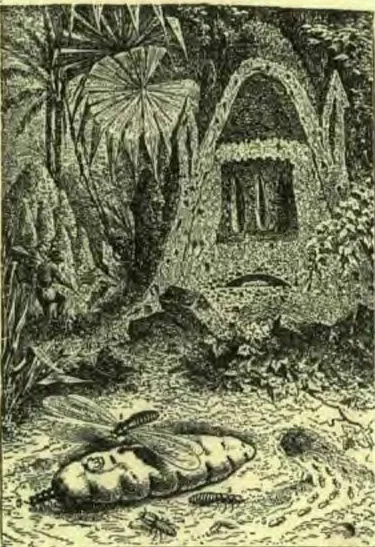
“No, but those who have, assure me that they taste much like the marrow of beef’s bone, though some kinds are sour. But see here,” said Uncle Frank, turning to his book, “I want you to see a picture of this wonderful insect and its nest.”
“O dear! is that funny looking thing the nest of an ant?”
“That is what it is, my boy; it is represented as being cut right through the center, so one can see how the inside of the nest looks.”
“But what is that odd-looking thing—like a great potato?”
“That is the female ant, the queen. You can see the workers, the soldiers, and the common ants beside her. That large fellow with wings is the male.”
“But I don’t see why the queen is so much larger than the others. Is she as large as in the picture? or is this magnified?”
“O, yes; she is much larger than she is here pictured, for she sometimes grows to be six inches in length—a perfect monster.”
“Does she lay as many eggs as the queen bee?”
“O, yes; this wonderful insect far outrivals the bee in the number of eggs she lays. Why, this ant lays as many eggs in one day as the bee produces in a year!”
“Isn’t it wonderful! wonderful!”
“O, yes, Harold; the works of the Creator are all wonderful. This insect lays an average of one egg each second, or more than eighty thousand every day.”
“I don’t see how she takes care of so many; how does she manage, uncle?”
MRS. L. D. AVERY-STUTTLE.
(To be continued)