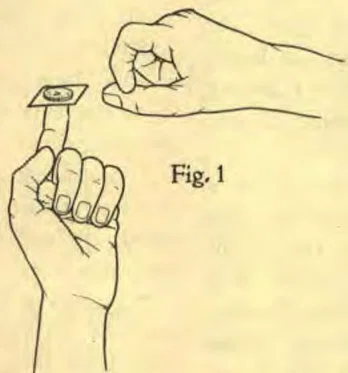
See, children, here is a nickel on the tip of my finger, with a tiny square of cardboard underneath it. Now can I remove the card without in the slightest degree moving the coin? It seems impossible, doesn’t it? And yet just a little snap of the edge of the card, and it disappears, leaving the money there.
Fig. 4
Fig. 1
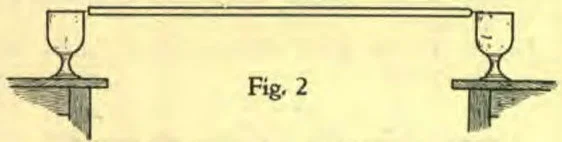
The following performance has long been a favorite with magicians and jugglers the world over: A thick broomstick is supported at the ends on two little bands of paper held up by children’s fingers. With a heavy stick the juggler strikes the broomstick a quick, strong blow in the middle, and behold! it breaks squarely in two, without tearing the paper bands at all. Instead of children’s fingers supporting the rod, the bands are often held up by the keen edge of razor blades, and still they are neither cut nor torn by the shock. Another form of the same experiment is shown in the illustration. A needle or pin is driven into each end of the stick, and rested on the edges of glasses brimming full of water. In this position the stick may be broken without spilling a drop of the liquid.
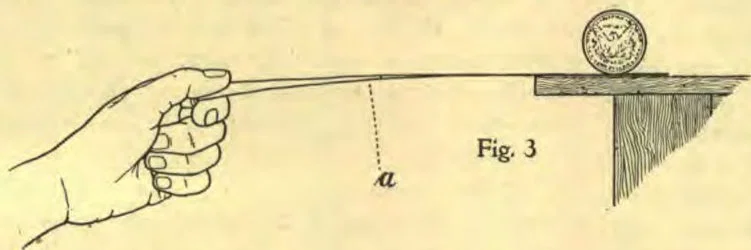
If we take a strip of paper, half an inch or so wide and a foot long, and on one end of it balance a dollar edgewise, we shall find that by striking a quick blow at the point marked a, the paper will be pulled out, leaving the dollar still balanced on its edge.
Fig. 3
Fig. 2
These experiments show us something of what is called inertia. It might just as well be called stubbornness, for that is exactly what it is. We snap the card from under the coin, before it will make up its mind to move; we break the stick without any of the shock being communicated to the paper bands or glasses; and we draw the slip from under the dollar, leaving it all oblivious to our action. In the same way we can shoot a clean round hole through a window pane with a swift-shooting rifle, and a man can hurt his foot severely by kicking an old plug hat with a brick under it. The force he puts into his kick would easily send the brick across the street if it were applied more slowly; but being applied thus swiftly, the stubborn substance of the brick will not respond, and the force expends itself in a reaction on his foot.
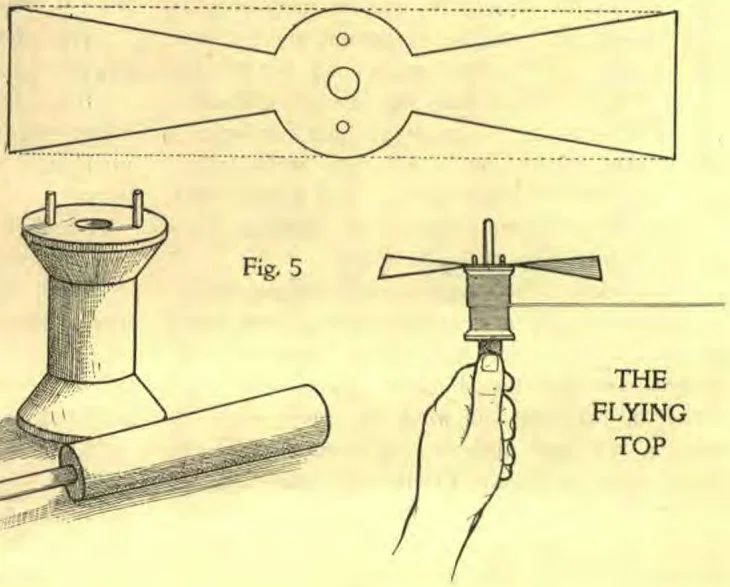
THE FLYING TOP
When we come to look for examples of inertia, we find multitudes of them. Watch a man standing in the aisle of a car as the train starts. He behaves exactly as the coin did on my finger tip. He tries to stay still and let the train go on, and so tips backward. When the train stops suddenly, he tries to keep on going, and so runs up the aisle a bit. Have you not wondered what kept a stone moving after it left your hand? Well, it is simply that unknowable, not-understood stubbornness. You put the stone in motion, and it will stay in motion forever so far as it is concerned, just as it would stay still forever if not disturbed. A swiftly moving train can not come to a stop, no matter what air-brakes are used, in less than a hundred yards or more. If anything outside of itself forces it to stop, all the force of the steam stored up in the weight of the train reacts on itself instantly, many thousands of tons, and it is no wonder that iron bends, and timbers splinter.
Continuing our experiments, we pile up a stack of dominoes or blocks on the worktable, and with a heavy ruler strike the stack quickly. One block will be removed without disturbing the rest.
Now air, which seems so light and vapory, is really possessed of many of the same properties as other and heavier substances, and among them is inertia. A bird’s wing striking backward quickly and powerfully, beats against the air as against a hard substance, for the air absolutely will not move out of the way so quickly, and thus the force of the stroke reacts on the bird’s body to carry it on and up.
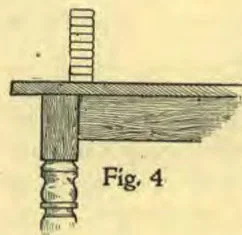
Another good example of air inertia is seen in the flying top, illustrated herewith, and which any boy can make. The top itself is cut out of common tin, and the fans bent like those of a windmill. The spool has in its top two small nails with heads cut off. These pins fit into the holes in the top, and set it whirling swiftly when a string is unwound from the spool. The nail on which the spool turns should be about an inch longer than the spool, so as to guide the top fan upward as it leaves the whirlers. With a quick, strong pull on the string this little flyer will rise one or two hundred feet. Its action is just like that of a screw in wood, the air with its immobility affording a substance through which it can screw its way. These experiments illustrate some of the great universal laws of nature.