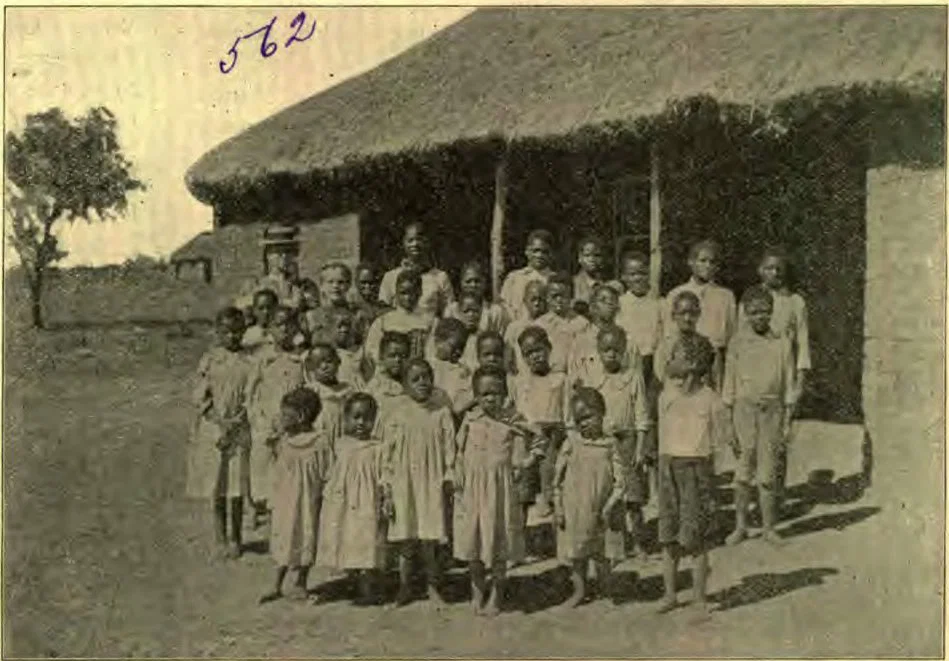
WHEN the people of Aniwa, one of the New Hebrides Islands, became Christians, the habits of morning and evening family prayer and of grace at meat took a wonderful hold upon them, and became a distinctive badge of the Christian.
This was strikingly manifest during a time of bitter scarcity that befell us. I heard a father, for instance, at his hut door, with his family around him, reverently blessing God for the food provided for them, and for all his mercies in Christ Jesus. Drawing near and conversing with them, I found that their meals consisted of fig-leaves, which they had gathered and cooked—a poor enough dish, but hunger makes a healthy appetite, and contentment is a grateful relish.
During the same period of privation, my orphans suffered badly also. Once they came to me, saying: “Missi, we are very hungry.”
“So am I, dear children,” I replied, “and we shall have no more white food till the ‘Day-spring’ comes.”
“Missi,” they continued, “you have two beautiful fig-trees. Will you let us take one feast of the young and tender leaves? We will not injure branch or fruit.”
“Gladly, my children,” I answered; “take your fill!”
In a twinkling each child was perched upon a branch; they feasted there as happy as squirrels.
Every night we prayed for the vessel, and in the morning our orphan boys rushed to the coral rocks and eagerly scanned the sea for an answer. Day after day they returned with sad faces, saying: “Missi, Tavaka jimra!” (No vessel yet.)
But at gray dawn of a certain day we were awakened by the boys shouting from the shore, and running for the mission house with the cry: “Tavaka oa! Tavaka oa!” (The vessel, hurrah!)
I arose at once, and looking through my glass, I saw that they were discharging goods into the vessel’s boats; and the children, when I told them that boxes and bags and casks were being sent on shore, shouted and danced with delight. As the first boat-load was discharged, the orphans surrounded me, saying: “Missi, here is a cask that rattles like biscuits. May we take it to the mission house?”
I told them to do so if they could; and in a moment it was turned into the path, and the boys had it flying before them, some tumbling and hurting their knees, but they were soon up and at it again, never pausing until it rolled up at the door of our storehouse. On returning, I found them all around it, and they said: “Missi, have you forgotten what you promised us?”
“What did I promise you?” I asked.
“Missi has forgot,” they whispered to one another, looking much disappointed.
“Forgot what?” I inquired.
“Missi,” they replied, “you promised that when the vessel came, you would give each of us a biscuit.”
“Oh,” I said, “I did not forget; I only wanted to see if you remembered it.”
“No fear of that, Missi!” they said, laughing. “Will you soon open the cask? We are dying for biscuits!”
At once I got a hammer and tools, knocked off the hoops, took off one end, and then gave each girl and boy a biscuit. To my surprise they all stood around, biscuit in hand, not one beginning to eat.
“What,” I exclaimed, “you are dying for biscuits! Why don’t you eat? Are you expecting another?”
“We will first thank God for sending us food,” one of the eldest said, “and ask him to bless it to us all.”
And this was done in their own simple and beautiful and childlike way; and then they did eat, and enjoyed their food as a gift from the heavenly Father’s hand.
We ourselves at the mission house could very heartily rejoice with the dear orphans. For some weeks past our European food had all been exhausted, except a little tea; and the cocoanut had been our chief support. It was beginning to tell against us. Our souls rose in gratitude to the Lord, who had sent these fresh provisions that we might love him better and serve him more.—From “The Story of John G. Paton,” by Belle M. Brain.