The plants of our gardens and fields are interesting to study in more ways than one; and the person who observes them for the sake of witnessing their peculiarities only, will undoubtedly find much to entertain him.
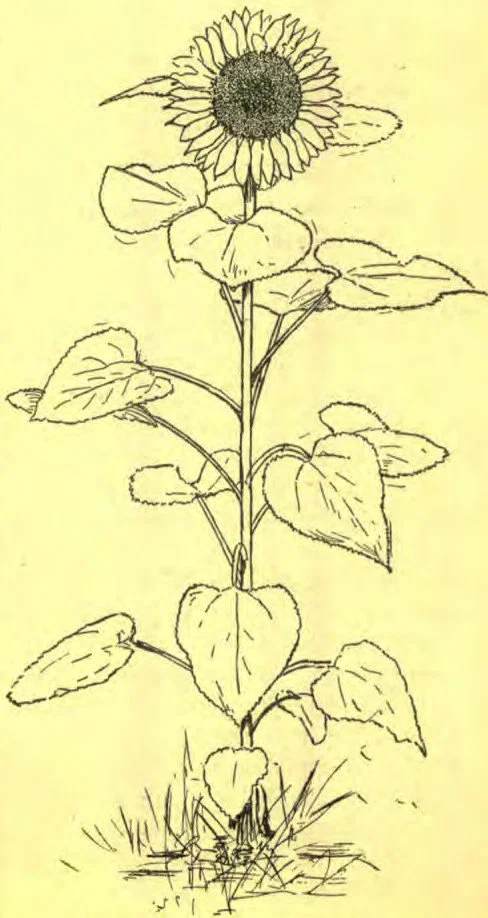
Almost everybody knows how the sunflower “follows the sun;” that is, in the morning the bright, good-natured-looking flowers will be facing the east; but as the sun mounts slowly in the heavens, and sinks down in the west, the blossoms gradually “follow” it, until at night they are turned completely around, and face the west.
One peculiarity of the sunflower is that sometimes it refuses to follow this rule, standing in the same position all day; but where there are many plants in a collection, one can usually find several blossoms that will do as they are expected. This is especially true of young, newly opened flowers.
Sunflowers planted around a yard are supposed to have the properties of a disinfectant, purifying the air and soil, and even preventing disease in live stock. Chickens are very fond of sunflower seeds, which contain much nutritive matter. The oil obtained by crushing the seed is regarded as valuable for many uses.
Ricinus sanguibarensis, or castor-oil bean, rich in its massive, tropical beauty, is an interesting plant to study. It has been supposed that the roots of this plant, growing in the soil, have the property of driving away the little moles that work just under the sod; but this idea has gradually been discredited.
Persons who have enjoyed the stately beauty of a Latania borbonica palm, and have fanned themselves comfortably with a palm-leaf fan, may be surprised to know that the latter is only one of the leaves of the former, dried, bleached, and “made over.” A close comparison of the live leaves and the dead will show many points of similarity.
Morning-glories have their own particular time of day for coming into bloom. Before their owners or any of the flowers in the garden are up, these bright blossoms are nodding and craning their necks in the early delight of a summer morning. The flowers are short-lived, however, and do not last until noon; though if they are grown where the sun can not strike them, they will remain open longer.
While the morning-glory is an early riser, the evening primrose and nicotina affinis can not be persuaded to wake from their slumbers until late in the day, though in cloudy weather the nicotina will blossom earlier, and often remain in flower for many hours, when conditions are favorable. Although a member of the tobacco family, the nicotina is beautiful, and a large plat of the white, fragrant blossoms will scent a whole yard on a summer night. Potato bugs are very fond of this plant, so do not be surprised to see them feeding on the leaves.
The evening primrose is both beautiful and interesting. Stand before a plant when twilight shadows begin to gather, and watch the buds. First there will be an exciting little “twirl” at the petals; then, almost before you know it, a great, yellow blossom will sway on the flowerless stalk of a moment before.
The oxalis, which also has its views on retiring and waking into bloom, is usually going to sleep at the time when some of our evening flowers are waking up. The oxalis rises with the sun, and the leaves and flowers gradually expand, until at noon they are fully opened. As the sun sinks lower, however, the foliage and flowers fold slowly together, and so remain until next morning. Tulip blossoms and poppies are of the same habit. The seed-pods of poppies exude a liquid from which opium is manufactured. Digitalis, or foxglove, also yields a drug often prescribed for those who suffer with heart trouble.
The water hyacinth is noted for its curious and beautiful growth, as well as its charming blossoms. The round, smooth leaves are attached to an inflated, bladder-like stem, that enables the plant to float. The roots are a peculiar shade of dark blue, and the blossoms are a handsome blending of lilac blue and azure. The plants may be placed in an aquarium, in tubs on the lawn, or in ornamental glass dishes. Place a small stone in the dish, and set the plant on this, leaving it there until the roots have become established. Change the water often.
While we at the North admire the water hyacinth, the dwellers in the Southern coast States detest it. A few years ago one of the principal rivers of Florida was blockaded because of the thick mass of plants that had grown across the bed of the stream, making it impossible for the steamers to cut through. A considerable sum of money was expended in clearing the plants away.
Parrot’s feather is another interesting plant to put in an aquarium or in well-moistened hanging-baskets. The long, feathery, drooping plumes are a bright, lively shade of green; the plant grows rapidly, and will prove a welcome addition to the garden museum.
An interesting plant is the sensitive plant, which has feathery, fernlike foliage that promptly folds together when touched by the human hand. The plant really appears to be suffering greatly, and its leaves curl up as if scorched by a hot blast, when approached too closely. While this plant has an aversion for most persons, it will occasionally allow children to touch it, so it is said, without shrinking away.
Equally amusing and entertaining is the resurrection plant, which, although apparently lifeless, will slowly unfold its brown stems when placed in a basin of water. When removed, it will gradually fold together, and remain “dead” until placed in water again.
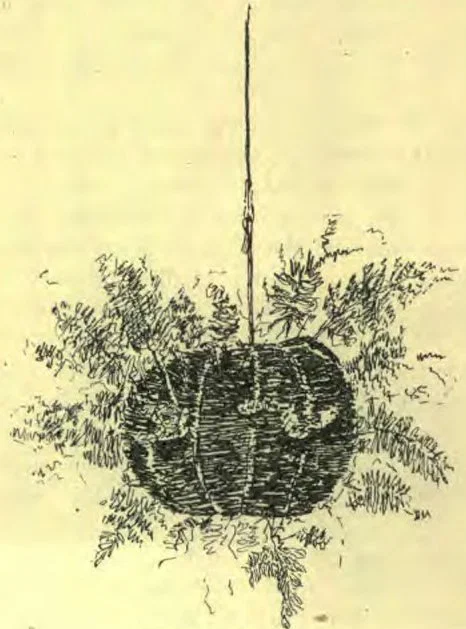
The Japanese fern-ball is another interesting plant to cultivate and study. The Japanese florists prepare it by wrapping the roots together in moss, in form of an oblate ball; and when received from the seedsmen, it is dry and seemingly lifeless. But suspend it by a string in the window or greenhouse, keep it well moistened, and in course of time the fresh, green growth will start, covering the ball with particularly graceful foliage, very pleasing to the eye. When you wish to go away on a journey, it is convenient to let the fern-ball dry up, with the assurance that it will start into growth again when more water is given.
It is surprising to note how determined most plants are to find for themselves a sufficient amount of light and warmth to carry on their business of growing. On cold, blizzardy nights it is often necessary to burn a large lamp near the window garden. When this is done, notice the plants in the morning. Most of the blossoms will be leaning eagerly forward toward the lamp, to get all the enjoyment possible from the light and warmth; but when the shade is rolled up, and the newspapers are taken down from behind the plants, the stems will graduallyp. 2 straighten up; and before night they will be leaning toward the window.
The color of unopened hyacinths may some times be told after the lamp is lighted; whereas in the daylight, one can not tell whether they are white, pink, or something else.
Did you ever go down in the cellar, in late spring, and notice under a basket or box, a long, white, brittle potato sprout, doing all in its power to grow under difficulties? A pretty good example, is it not, for persons who find it almost impossible to expand into the larger, richer growth for which they hope?
But while they may become discouraged, the potato keeps right on looking for more light; and pretty soon some one comes down, gives it a trimming, puts it in more favorable surroundings, and before it knows it, the potato is really growing . So will the discouraged person be who persistently keeps his eyes on that little gleam of light, coming in through the darkness overhead.
Even a potato may teach us, and the flowers in our homes and gardens may give us many a valuable lesson if we make ourselves susceptible. Flowers instruct, entertain, beautify, and heal. Even the weeds by the roadside are worthy of attention, for they may contribute to our amusement, happiness, and knowledge.
The queer ways of plants have only been lightly and incompletely touched upon here. The Chinese sacred lily, Chinese lantern plant, floral fire-cracker plant, pitcher plant, shoo-fly plant, cactuses, water-lilies, gourds, and other members of the Floral Kingdom, deserve one’s attention.
Make the acquaintance of all the flowers you can. They will be very cheerful companions.
BENJAMIN B. KEECH.