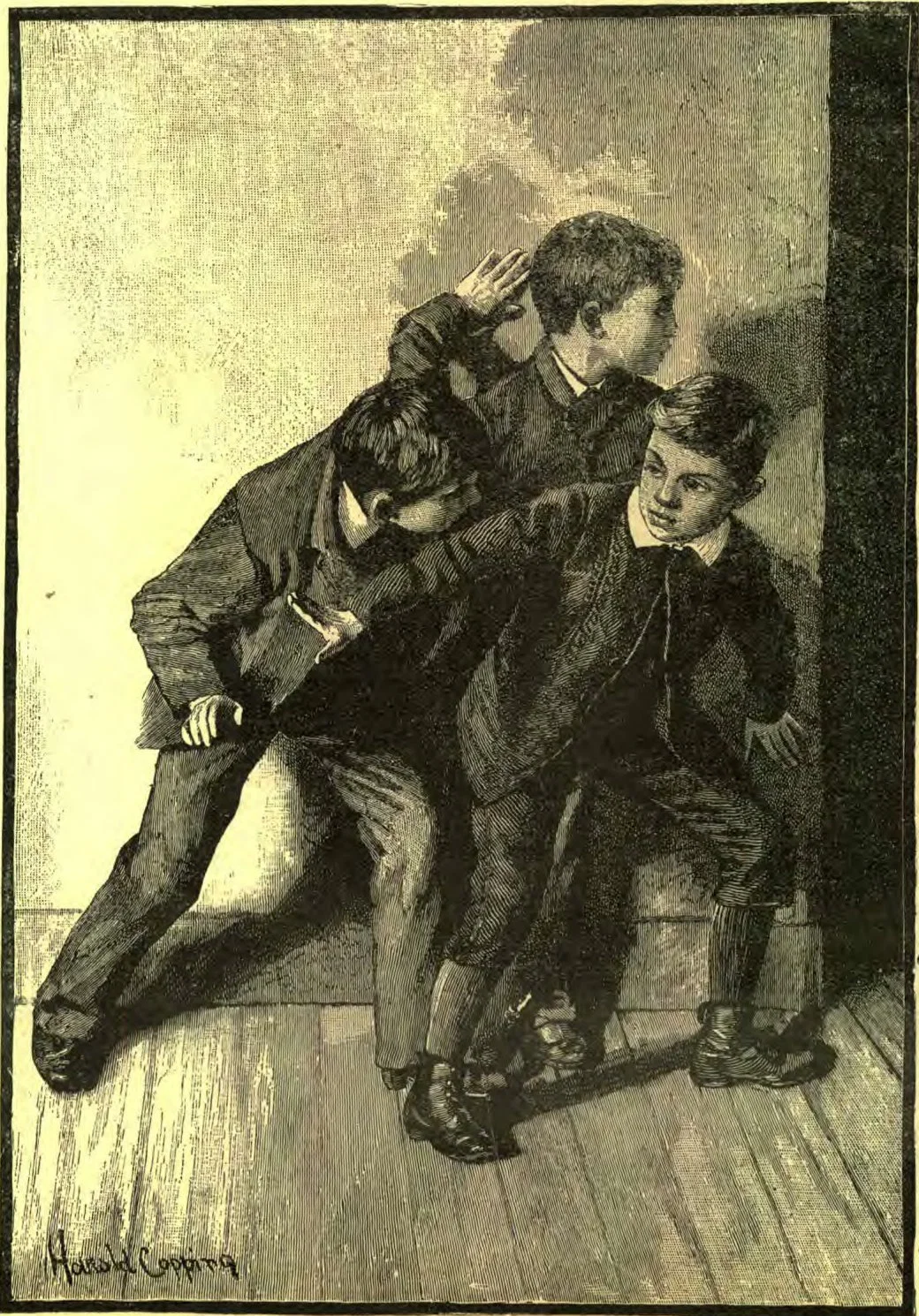
The Wind Brothers

5%

Review and Herald Publishing Company · Battle Creek, Michigan · August 27, 1903

FromThe Youth's Instructor, Vol. LI, No. 34

Read the full edition

The Wind Brothers

There were four of the Wind brothers, all very much alike in their work and manners, but having homes in four different quarters of the world. They did not meet often, except when, in their many travels, their paths chanced to cross, and they paused merely long enough to exchange greetings and good-bys.
There was one spot that was a favorite with the Wind brothers. This was a quiet lake in a dense forest, where hemlock trees threw purple shadows, and willows and sycamores leaned over to dip their branches in the still waters. The Wind brothers loved this spot, and one after another visited it often in their rambles up and down the great valley where it lay. They liked to rush merrily across the lake, until its face responded in ten thousand dimpling ripples, as if it were smiling at the frolic of its lively friend; they loved to catch a blooming branch of wild plum or dogwood, and shake it till the petals, losing hold, were scattered in fragrant showers on the waves; they loved to listen to the voices of water and hemlocks as they sang the beautiful stories of lake or wood; and, in turn, the Wind brothers breathed a pretty story of what they had seen in their travels, and what they had done in their wanderings over the earth. The best of it was, that all these songs and stories—of water, of forest, of the winds—were true and beautiful and cheering, as are all the tales the great outdoor world has to tell.
First, North Wind, the strongest and most mischievous of the brothers, came bounding across the lake and into the hemlock forest.
“Br-r-r-r! I’m cold!” he murmured, as he crept under the branches. “I’ve been traveling in cold climates, and can’t help it if I make you shiver, dear hemlocks. How cozy you are here. Let me warm myself in this snug spot, and I will tell you a story while I rest.”
“A few miles from here there is a pretty farmhouse, smothered in apple-trees and honeysuckle vines. As I passed it this morning, I saw the farmer looking to see if his potatoes had sprouted, and I set out to have some fun with him. Racing over the potato-patch, I caught up his big straw hat before he suspected what I was about, and sent it rolling and tumbling over the ground. How provoked he was, and how he did chase us, until, thinking I had teased the kind old man enough, I dropped the hat beside the largest, finest potato sprout I could see in the whole patch, and came on over forest and field. Looking back as I left him, I saw the delighted farmer looking at the thrifty young plant, and thinking about the fine crop in prospect. Ah! hope is a grand thing, dear hemlocks; do you know that? It is better to cause people to look forward to good to come, than backward at evil that is past. It is a happy thing to make a heart hopeful instead of despondent.”
And North Wind, laughing brightly in the face of a young birch tree that happened to be in his way, proceeded on his journey, filling the forest with a softly hummed song of “Hope, hope!”
He had scarcely disappeared, when from another direction, West Wind, the gayest of the Wind brothers, danced over the waves, which smiled a welcome, and rustled in the willows growing on the shore. “Dear willows,” he sang, blithely, “do you know some one is happy because of me to-day? I was passing down a green lane, when all at once I heard cries of alarm. Turning aside to learn the trouble, I found the commotion came from the top of the hedge, where some sparrows had built their nest. A bit of paper, which that mischievous brother of mine, North Wind, had been playing with the last time he passed that way, had been carelessly tossed into the hedge, and left there, and now it had become tangled among thorns and twigs, quite covering the sparrows’ nest, and keeping up such a fluttering and rustling that they feared to come near it. Meanwhile the blue eggs were growing cold, while the sparrows hovered near, repeating their pitiful cries.
“I could not bear to hear them without offering any help, so, slipping among the thorns and leaves of the hedge tree, I seized the paper with all my might. At first it held fast, but I was too strong for it, and at last, tearing it loose from tree and nest, I carried it quite a distance, and thrust it into a hazel thicket, where it could harm no one. Then as I passed down the green lane, the anxious cries gave place to a lovely song. Mr. Song-sparrow, swaying on a high twig, poured out a heartful of thanks, while the mother bird nestled softly over her eggs, and all was happy again. It made me gayer than ever to see their joy, dear willows, and I have come all this way to tell you there is no joy so sweet as giving joy to others.”
Then West Wind danced merrily away over the waters, happily singing, “Joy, joy, joy!”
The next to visit the quiet lake was East Wind, shyest and mildest of the brothers. His movements were less rapid, and his voice less loud, than the others; but he glided gently into the sheltering willows, and to the sycamores bending lovingly to listen, whispered a message no less sweet for the soft tone in which it was uttered.
“Dear sycamores,” said East Wind, “I have a pleasant story for you, while I rest in your cool shade. Last evening, as I came over the sand from the sea, I passed a poor fisherman’s cottage where a little child lay ill. The air was hot and close, and the child, burning with fever, could find no rest nor sleep, while his anxious mother watched beside him, fearful of what might come. Then I stole in at the window, and gently fanned the child’s cheek; he seemed to like my wild tossing a moment, and lay quite still. Once more I blew back the locks on his forehead, and did my best to soothe and cool the little suffering form. At first my efforts seemed vain, but I persevered, and was rewarded by seeing the child grow more and more quiet, until at last he fell into a refreshing sleep. I stayed to fan him all night, and when the sky beyond the sea grew pink with the dawn, I left him much better and still asleep, while near by his mother, too, lay sleeping, with a look of peace on her face.”
So saying, East Wind glided silently on, murmuring, as if talking to himself, “Peace, peace, peace!”
Finally South Wind, kindest of all the brothers, passed over the brightly laughing ripples, and greeted the trees on the shore where the hemlocks grew. He kissed them lovingly, but finally settled in a blossoming plum thicket, to tell his story of love and blessing, which in sweetness was fitting to mingle with the fragrance all about it.
“O plum-tree!” said South Wind, blowing a breath of perfume into the hemlocks’ dark masses; “I have found out the secret of happiness; and if you listen, I will tell you how I found it. I was passing over a high hill one morning, when the sun had just begun to light up the dew-drops. A little country maid was there, gathering a basket of wild roses. Curious to know what she meant to do with them, I followed down the hill to see. I saw the basket sent away to a great city, where wild roses are seldom seen, and finally taken to a foundlings’ home. Here it was opened by a sweet-faced lady, whose little daughter stood by in delight as she caught her first glimpse of the fresh blossoms. But when the basket began to empty as the eager, pale-faced children, with outstretched hands, crowded around for a share of its contents, she gradually became quiet, and her face took on a wistful expression. At last her longing conquered, and stealing to her mother’s side, she whispered, ‘Please, may I not have one, mama, just one?’”
“Her mother hesitated. Love for the child bade her say, Yes; but looking at the poor little faces crowding around her, she put the last rose into the hand of a tiny cripple, saying, ‘No, darling! Don’t you see there are not enough to go around? They need them most.’”
“No heart but one filled with love could understand the feelings with which she kissed the child she had denied, or the look of exalted happiness on her face. Yes, dear plum-tree, the secret of happiness is Love,—not selfish love for those from whom we expect a return, but a love great enough to take in the whole world; to care for good because it is good, not from fear of the consequences of evil; to be kind from a spirit of kindness, not for a hope of future reward.”
And South Wind shook himself free from the plum-tree, and with its perfume clinging about him, sailed on through the forest, after his brothers, singing, happily, the only song he knew, “Love, love, love!”
“Hope, joy, peace, love!” Listen to them singing in the tree-tops and over the hills, and learn how sweet are the songs of the Wind brothers.
MINNIE ROSILLA STEVENS.