“O UNCLE FRANK! Is that your microscope? May I see it?”
“Certainly you may, though there is not very much to see about the instrument itself; but it is able to show you many wonderful and beautiful things;” and Uncle Frank carefully adjusted beneath the lens, on a small piece of clean glass, something which looked no larger than a tiny speck of dust.
“What are we going to see first, uncle?” cried Harold, enthusiastically. “O, let’s put something under the glass! see, here’s a little bug on the window; I guess it’s a ladybug. Let’s put him under.”
“I have something fixed, already; that bug is much too large; you can see it very well without a glass. But come, I told you I had something ready now; can you tell me what it is?”
“I didn’t see as there was anything at all on the glass you put under—but O, O! uncle! isn’t it pretty? What can it be?”
“It is only that little speck which looked like a bit of dust. They are the shells of a tiny animal, called fossil infusoria. You will be astonished when I tell you that many high mountains are composed chiefly of these little creatures and others of the same nature. There is a very large deposit in the State of Virginia, and if you were to examine the most minute particle of this dust through the glass, you could count many of them.”
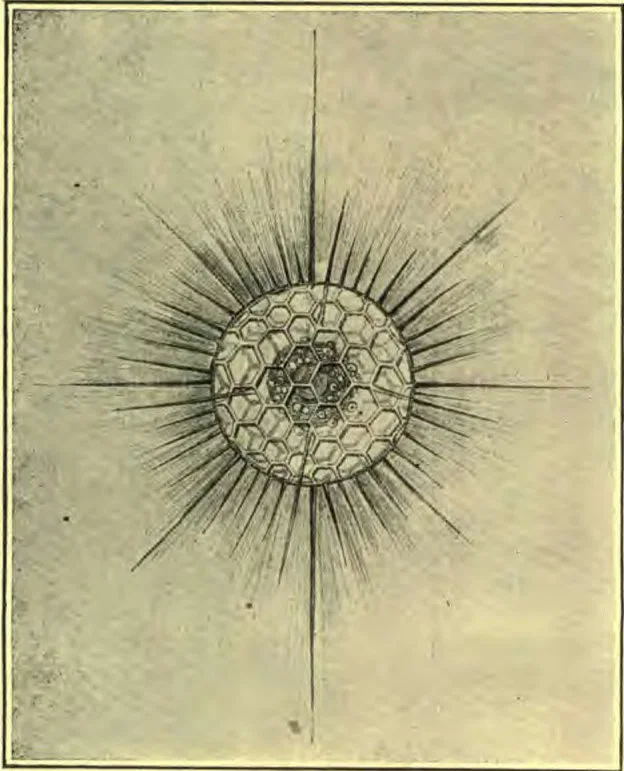
All this time Harold was gazing at the pretty shells, as beautifully marked and shaded as if traced by the pencil of a famous artist, and, indeed, each delicate line was traced by the finger of the great Master Artist, whose eye delights in beauty.
“The little animals which made these tiny shells their home, died long ago, and their houses—myriads of them—compose the foundation and substance of the imperishable mountains. Even great cities are built upon these tiny coffins, and, again, they are sometimes ground to powder and sold for polishing. Indeed, the shells of these creatures are more thickly spread over the earth than are the bones of the large animals. Nor is this all, Harold; even the very air we breathe is sometimes filled with these minute shells.”
“I suppose it is not healthful to breathe such air, is it, uncle?”
“No, it is quite harmful. I remember once as I was sailing near the Cape Verd Islands, the air seemed hazy and thick; so I examined some of the brown dust which settled over everything, and found that it contained very many of these tiny shells. They are called fossil because they are the bony remains of an animal, and infusoria because they were first discovered in water where there was decomposing vegetable matter present, and it was supposed that an infusion of vegetable product was necessary in order to produce them. This idea, however, has been proved false. But do not forget that there are very many different kinds of these delicate creatures.”
“I would like to see some real live ones,” said Harold, eagerly.
“Well, well; I am much pleased that my young scientist is so intensely interested. I rather expected it, however, and so I have been preparing a few real live ones, as you call them, especially for your entertainment. You see, a few days ago I just took a little handful of sage leaves and poured over them a cup of clean rain-water, and—well, you shall see the result;” and Uncle Frank placed under the eyepiece of the instrument a thick glass containing a little cavity into which he carefully placed a drop of the prepared water.
“There; what do you see now, my lad?”
“O uncle! the drop of water is just full of the oddest little fish; they don’t look much like fish either, but they are swimming about just as lively as if they were in a big pond of water. O! O! there goes a large one! wait,—he’s still now,—I guess he’s tired.”
“Look close, and see if you can’t see his blood circulate,” said Uncle Frank.
“O, I can! I can! he keeps his tail going, but he is resting, and I can see right through him, and something is just rushing on the inside of him,—but it can’t be blood, for it isn’t red,” declared Harold, who began to feel that he was quite a scientist.
“No, it’s not red, but it is all the blood he has, and it keeps the tiny creature alive as much as your red blood keeps you alive.”
“But where did you get these little midgets, uncle? were they in the sage leaves?”
“O, no, the eggs were floating in the air, and the rain brought them down with it, and then they hatched,—that’s all. I put the leaves in because the eggs seem to hatch better in water prepared this way, though a little wisp of hay will do as well.”
But the study hour was up now, and Uncle Frank placed his valued microscope back in its case.
MRS. L. D. AVERY-STUTTLE.
(To be continued)