WE who receive from week to week letters filled with kindly greetings from friends, seldom, if ever, think of the handsome but expensive mail service of our country that makes the enjoyment of such luxuries possible. There is no country that provides for as perfect a mail service as does our own.
The General Post-office work began in a postal system organized in the American Colonies in 1692 by patent to Thomas Neale. On the expiration of this patent in 1710, England introduced her postal system, and in 1753 Benjamin Franklin was appointed deputy postmaster-general for the colonies. The royal system was overthrown by the Revolution, but the Continental Congress established a new service, and put in charge the former postmaster-general, Mr. Franklin. The rapid, continuous growth of the mail service has been phenomenal. In the interval from 1800 to 1903, the receipts of the Postal Department grew from $280,804 to $134,224,443, and in number of post-offices from 903 to over 76,000. The task of supplying this large number of offices with the requisite quantity of stamps alone is not insignificant. The Bureau of Engraving does this work, manufacturing the stamps as well as all the paper money made by the government. Until recent times the stamps were printed by private contractors. Not until 1847 did the government adopt the use of stamps; but during 1902 more than five billion were sold, and nearly ten million dollars' worth of stamp-books. The total cost of the service for the year ending June 30, 1902, was $138,784,487, just about the pension appropriation for that year. The expenditures exceeded the receipts by more than four and one-half million dollars; but such deficits are not to be viewed with apprehension. It is the policy, whenever the postal receipts exceed or come near the expenditures, to extend postal facilities and cheapen the cost of the service to the public. One very practical result of this policy is seen in the dropping of the postage for a letter from twenty-five cents to two cents in less than sixty years. During 1902 the department handled nearly nine billion pieces of mail-matter. Seven hundred seventy millions of these were postal cards from frugal correspondents. The value of the money orders was more than seven hundred fifty millions of dollars; this feature alone is a marked source of revenue to the department. One can hardly appreciate the extensive demands made upon the government by its admirable mail service. The little item of providing wrapping-twine for the work was estimated to have cost during the past year $135,000. Entering upon the fortieth year of its operation, the city delivery service presents a record of remarkable expansion. It is the feature of the service with which the public is most familiar, and has aptly been described as the “fingers of the Department.” Were the city mail carriers to colonize, they would form a settlement of over twenty thousand, and the rural carriers a city of twelve thousand.
The rural free delivery is now regarded as a necessity, a luxury; though it is an enormous burden on the finances of the nation, and every year more is required to maintain it. It does much, however, toward maintaining itself, and it is an admitted mutual benefit to the rural communities and the nation both socially and educationally.
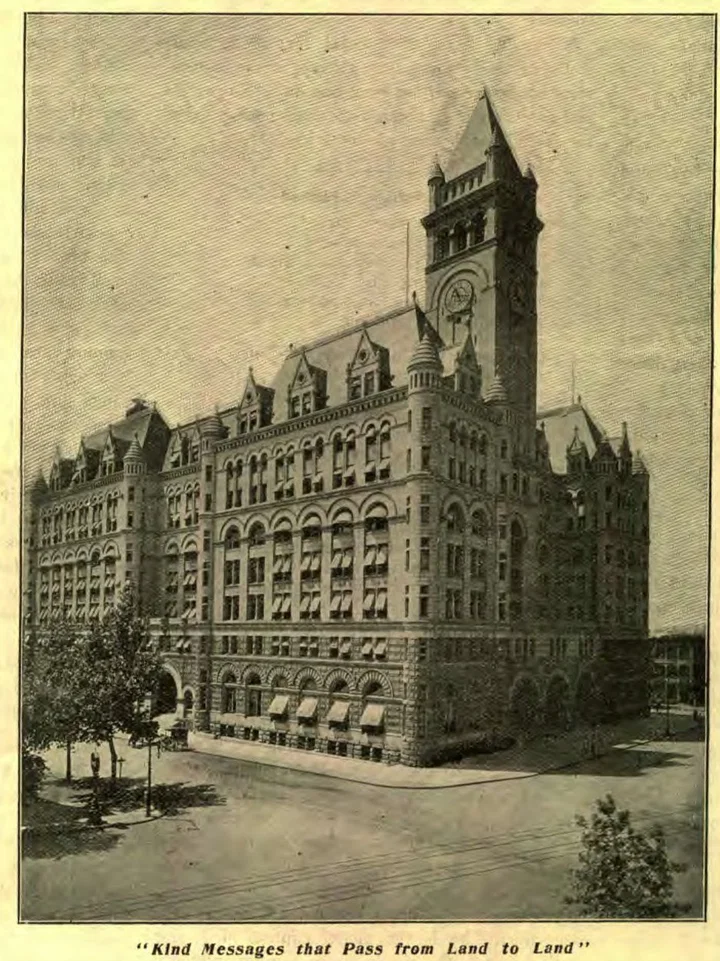
Post Office Building
The present General Post-office is a new building, having been completed in 1899 at a total cost of $3,325,200. Its lofty square clock tower makes it one of the most conspicuous of the government buildings. Its plan for securing well-lighted offices is admirable, the center being a court roofed by a skylight 180 x 99 feet. An interior skylight covers the court at the height of the first story, forming an immense room for the accommodation of the city post-office. The nine floors above the main floor are devoted to the business of the postmaster-general and his department, and contain nothing of special interest to the public, save the Dead Letter Office.
The department of the Dead Letter Office, founded in 1825, was at first quite insignificant, but has grown into an establishment giving employment to an average force of one hundred thirty-four persons. The huge piles of mail-bags along the corridors, holding the unclaimed mail of one month only, and the scores of busy persons looking over the packages, papers, and letters that have found their way to this “last resort,” must certainly determine the visitor to be careful in the future to properly address his friends, and make a full, clear superscription on every letter. The fact that in one year nearly 50,000 letters and 41,000 parcels were received at the office without any address whatever shows clearly that there is need of many abiding by a resolve of future carefulness.
Interesting Figures
During the fiscal year ending June 30, 1903, 10,153,000 pieces of mail-matter were received at the Dead Letter Office, or about 33,000 pieces for every working day in the year. Through the generosity of the government nearly four millions of these found their way back to the sender; but the “leftovers” were sufficient to provide Uncle Sam with interesting reading-matter and curios in abundance. Of the ten-million pieces received, 977,286 were of foreign origin, and were returned unopened to the countries from which they were sent. The United States had the compliment returned by receiving 688,000 pieces that had failed to reach those for whom they were intended. From ten to fifteen persons are constantly employed in opening letters and parcels. Of course they in time become expert, and often some of the most rapid counters exceed the daily average of two thousand or three thousand pieces.
A Paying Business
During the last year $48,634.04 in actual money was found, or nearly $160 for each working day. About $33,800 of this amount reached the owners, the rest was turned over to the Treasury. Thep. 2 face value of the commercial papers found was $1,493,563.65.
One unregistered letter was found containing three one hundred-dollar bills, and one letter had three one-dollar bills sent by a son to his mother, saying that this was all he had; but as soon as he could get more, he would send it to her. Fortunately the money was returned to the young man, but the delay doubtless caused the mother anxiety. If all the disappointments these millions of unfortunate letters have caused were rolled into one, would it not make a big heartache?
Unregistered parcels received numbered about 250,000, of which nearly one half were in time delivered. Over 80,000 photographs were received, and nearly 250,000 stamps came in letters. The number of registered packages was 62,986. Articles of value that can not be identified are recorded, and laid aside for six months; at the end of this time they are sold at auction. The annual sales occur in December. The amount realized from the December sale of 1902 was $3,535.85, 22,382 parcels having been disposed of. At a special sale held in February, 1903, 104,854 parcels were sold for $5,244.15. These two sales made the year’s auction receipts nearly nine thousand dollars.
From the large quantity of printed matter received, including papers, pictures, fancy cards, thousands of pieces are selected annually and given to the benevolent institutions of the District of Columbia; the rest are destroyed.
The Museum
The museum of the Dead Letter Office reveals an endless variety of things that have found their way into the mails. Some of these are now on exhibit at the World’s Fair in St. Louis. “All sorts of small animals, stuffed, dried, in alcohol, and otherwise preserved, are here; a human skull and many bones; surgical instruments and death-dealing implements. Books have been gathered by thousands, dolls and toys enough to furnish half a dozen kindergartens might be taken from here, and, in short, it would be hard to find a path of industry or a region of pleasure or profit of which some reminder might not be found among this queer conglomeration of lost property.”
Foreign Service
The little mail-bag is the star passenger on the great Atlantic steamers. Everywhere it is given the right of way. The flight of the foreign mails now is marvelous, and does much toward lessening the separation that the great sea makes. Our country regards the postal service as a mere matter of business, and so sends its mails by the fastest lines, irrespective of the flag the vessel floats. England is more conservative, patronizing only those carrying the British flag. As only two English mail lines sail a week, there are only two American mails, while from this country there are five sent out. Mr. Roger Waite, in speaking of the foreign service, says:—
“Look in at the foreign branch of the New York office about nine o’clock some Saturday morning. Things are on the run about that time. Two thousand sacks have already gone down to the boat. Now they are handling, on the jump, the supplementary mails. The fingers of the clerks fairly fly. The sacks are not hung up on racks as they were last night and yesterday; men stand on the alert holding them open, and the instant the last letter is in, snap goes the cord, and the bag is thrown into the last mail wagon to make the trip. Down West Street it goes, and just before nine-thirty, the sailing time of the American liner, it dashes up on the pier. At the vessel’s side a string of men seize the bags as they are dumped from the van, and run them up the gang-plank. Everybody and everything else is aboard and waiting.”
“Even during the voyage Uncle Sam keeps at it, racing against time, always. On several of the big liners to-day is the ocean post-office, where from port to port, mail clerks are hard at work sorting letters. In this way hours of time are saved; for instead of the entire mail going to the London office and being rehandled there, it is properly bagged at sea, and on landing is sent direct to its destination.
“On the Liverpool route, when Fastnet Light peers above the horizon, the mail-bags are hoisted from the hold and piled high on the deck, ready to be moved at an instant’s notice. Off Queenstown out comes the tender. The liner stops her engines, the tender is made fast alongside, and down the run-ways slide the sacks. In a short time the liner proceeds, and in sixteen to twenty hours you are landed at Liverpool, but the letters are ahead of you. By dropping them off at Queenstown, they went up through Ireland on the fast mail-train, across the Dublin ferry, and up to London, while you were asleep that last night of the voyage in St. George’s Channel.
“On the Southampton route, the American liners cut down the mail time considerably between New York and London by touching at the first possible English port, Plymouth. Off the sacks are rushed here, and as the train can always beat the steamer, the mail is in London long before the ship reaches its final port, Southampton.”
Expensive as is the postal service, a panic would certainly follow any attempt of the government to suppress it for even one day. So perfect and extensive is it, that no adequate reason exists for friends neglecting absent friends.