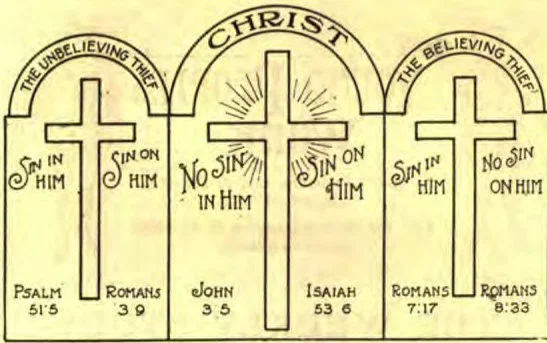
The Three Crosses
By William P. Pearce
WHEN Jesus was crucified, we are told that two other men were crucified with him. “There they crucified him, and the malefactors, one on the right hand, and the other on the left” (Luke 23:33)—three crosses in a row, and three different characters on them. On the center cross was the sinless Jesus. Peter, speaking of him, said, “Who did no sin.” 1 Peter 2:22. Paul declares, “He knew no sin” (2 Cor. 5:21), and John affirms, “In him is no sin.” 1 John 3:5. But sin was upon him, as Isaiah said, “Hath laid on him the iniquity of us all.” What a shame that Jesus should bear your and my sins, and yet what a blessed thing; for without that Sinless Bearer there would be no way to approach God.
It is said that many years ago when the Swiss were fighting against the Austrians, they saw that the enemy had arranged themselves in a solid phalanx. To break it seemed out of the question, but Arnold von Winkelried rushed out in front of his regiment, and shouted: “Make way for liberty!” The weapons of the enemy were plunged into his heart, but while they were slaying him, a gap was made in the ranks, and the Swiss dashed to victory. Christ saw that all sin and sinners were arrayed against him, and he knew that if any of the human family were saved, he would have to die. So he marched to Calvary, and while the weapons of infernal hate struck him, he opened a way for the redemption of the world.
The cross on the left may be called the unbeliever’s. Upon it a thief hung. Differing from Jesus, he, like us, had sin in him; for all are “shapen in iniquity, and born in sin.” Ps. 51:5. But like Christ he had sin on him—not the sin of others, but his own, for Paul tells us that all are “under sin.” Rom. 3:9. This thief was very impolite. He insulted Jesus even in his dying moments. The scripture says that he railed on Christ, saying, “If thou be Christ, save thyself and us.” One would think a dying man would be more considerate; yet more than one have died like him, with blasphemy upon their lips. Thousands have died unbelieving, and the Word tells us of the awfulness of such. “He that believeth not shall be damned.” Mark 16:16.
The cross on the right may be called the believer’s. Upon it another thief hung. Like the other, he had sin in him. He could say, as did Paul, Sin dwelleth in me (Rom. 7:17), but unlike him and Jesus there was no sin on him. There had been such, for he confessed that his punishment was the due reward of his deeds (Luke 23:41), but sin had been removed, he had become one of God’s elect, and “who shall lay anything to the charge of God’s elect? It is God that justifieth.” Rom. 8:33. This thief believed Jesus was Christ. He did not sanction the way his companion spoke to Jesus; for we read he “rebuked him, saying, Dost not thou fear God, seeing thou art in the same condemnation? And we indeed justly; . . . but this man hath done nothing amiss.” This thief did not question Christ’s divinity with an “if,” as the other did; but he said, “Lord, remember me when thou comest into thy kingdom.” What a beautiful petition! What a simple faith in Jesus! And what a blessed assurance from Jesus! “Verily I say unto thee to-day, shalt thou be with me in paradise.”
What lessons we find here! Jesus on the center cross dying for sin, the thief on the left cross dying in sin, the thief on the right cross dying of sin. Dear readers, if you “believe on the Lord Jesus Christ,” as this last thief, the promise is that you, too, “shalt be saved” (Acts 16:31); for—
“The dying thief rejoiced to see That fountain in his day; And there may I, though vile as he, Wash all my sins away.”
WILLIAM P. PEARCE.