Do not forget that it is the chlorophyll-granules in the green leaves that perform the great work of starch-making, or food manufacturing of all plants.
The formation of plant materials always begins with the decomposition is carried on only by that protoplasm in which are imbedded chlorophyll-granules. This protoplasm can accomplish the task indicated only by the aid of these granules, and it is therefore the chlorophyll-granules upon which everything depends.
These granules always appear imbedded in protoplasm, but they are sharply defined from it, and in their entire development exhibit a certain separateness and individuality.
The quantity of organic substances formed in a cell, by the decomposition of carbon dioxide, is greater the larger the number of chlorophyll-granules, provided all of them are arranged within the protoplasm in such a manner that they can discharge their functions. The granules must be so arranged that no one deprives another of light. Each granule must labor as if there were no other, and yet with due consideration of every other.
If the granules “get in one another’s light,” the shaded granules are deprived of their power, for they can work only under the influence of light. But there is perfect adaptation and harmony between these granules; they seem endowed with intelligence, perfect and efficient for all their tasks and conditions of existence.
Each species of plant requires a definite amount of light, and the chlorophyll is perfectly adapted to obtain this certain amount. Under all the varying degrees of light and shade they seek to obtain the required amount.
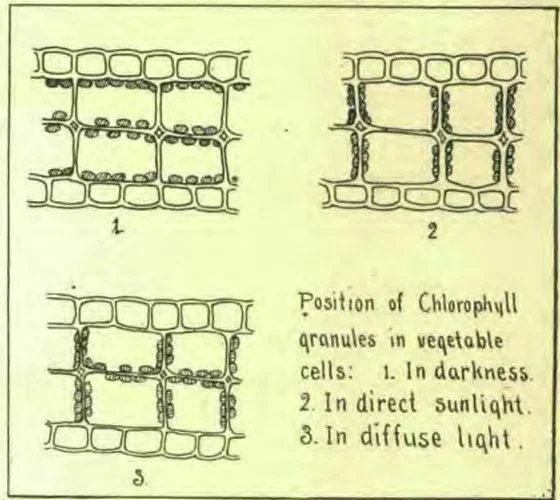
If the foliage is weakly illuminated, the granules maintain a broader side, and more favorable position toward the light, in consequence of which they present the largest possible surface to the sun’s rays. If the foliage is strongly illuminated, they assume a narrower side, and less favorable position to the light, by which the smallest possible surface is exposed.
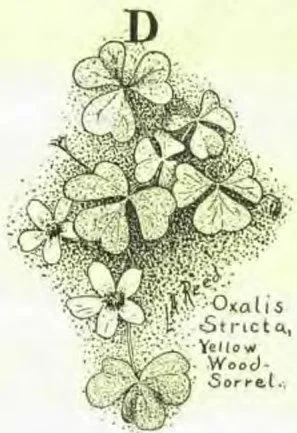
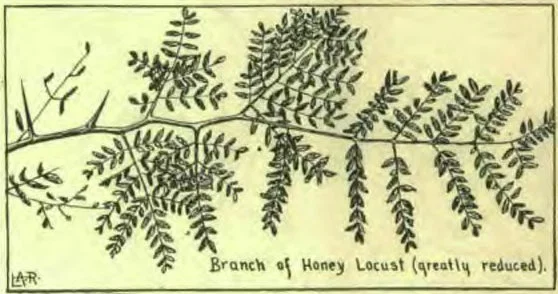
At the same time the leaves themselves assist in also adapting themselves to the light. For instance, the leaves of the honey-locust, when weakly illuminated, will spread their blades as broadly as possible to the light; when, however, they are strongly illuminated, they partly close, back to back, thus shutting out to some extent the intense light. This folding of the leaf is a common method in many plants. The wood-sorrel leaves are also an excellent example; each leaflet folds through the center, closing to shut out the light.
Of course, these actions of the chlorophyll-granules in the protoplasm all take place through the sensitiveness of the cells. The protoplasm acts in response to the stimulus of light. But to say this, is not, by any means, to clear the mystery. How happens it that there is this marvelous relation between light and the watery protoplasm? Instrumentality does not explain the why of things; it shows only part of the process.
When we seek to understand these things, “we find ourselves in the position of an inquirer who visits a chemical laboratory without a guide, and wishes to ascertain in what way some material — for example, a pigment — is manufactured. “He notices apparatus set up there, sees the raw materials heaped together, and also finds the finished product. If the manufacture is actually proceeding, he can also observe whether warmth or cold and greater or less pressure are brought into action as propelling forces, and he can, if entrusted with the manipulation necessary to the production of such pigment, imagine the relation of the different parts to the whole. Of the details, indeed, much must remain incomprehensible, or quite unknown. Especially with reference to the quantity of the transformed raw material, and with regard to the propelling forces, must the visitor’s knowledge remain incomplete.”
It is somewhat like this when we attempt to inspect the processes carried on in the cells where chlorophyll-granules develop their activity. “We see the effective apparatus, we recognize the food-gases and food-salts collected for working up, we know that the sun’s rays act as the motive force, and we also identify the products which appear completed in the chlorophyll-granules.”
“But what is altogether puzzling is how the active forces work, how the sun’s rays are able to bring it about that the atoms of the raw material abandon their previous grouping, become displaced, intermix with one another, and shortly appear in stable combinations under a wholly different arrangement.” — Anton Kerner von Marilaun, Professor of Botany in the University of Vienna.
Thus does a great scientist write concerning the chemical decompositions and combinations which take place in the cells of plants. He says that we are able to see that these chemical actions take place under the stimulus of sunlight, “but what is altogether puzzling is . . . how the sun’s rays are able to bring it about.”
L. A. REED.