There was formerly so much mystery regarding the transmission of diseases that it is not surprising that superstitious people attributed disease to the agency of evil spirits or offended gods. Now that the cause of various diseases is definitely known, and the action of these diseases in animals can be studied, many things which were once mysterious can be understood, and much done toward preventing disease. Instead of going through incantations and attempting to frighten away the devils, men now study the habits of the germs, how they gain admission to the body, and how they may be successfully combatted. The germs of anthrax (malignant pustule), tetanus (lockjaw), diphtheria, typhoid fever, yellow fever, tuberculosis (consumption), and perhaps some others, have been successfully studied. There is much yet to learn regarding these diseases; but what is already known has done much to put the prevention and treatment of the diseases on a scientific basis.
In diphtheria it is known that the discharges from the throat contain the infecting material. More than once a doctor has lost an eye because a diphtheria patient coughed while he was examining the throat, and a bit of the sputum went into the doctor's eye. In other cases doctors or nurses have died by getting infected around the mouth with the coughed-up matter from the little patient.
So now a careful physician, in examining such a throat, looks at it through a pane of glass, so that if the patient coughs, anything coughed up will strike the glass, and not the face of the examiner.
Doctors or nurses handling such patients have learned to disinfect their hands before eating, as their hands may have become infected while around the patient. Another excellent precaution is to wear a linen duster over the suit when in the room with the patient, so that the diphtheria germ may not get lodged on the clothing ordinarily worn.
In tuberculosis it is usually the sputum that contains the infectious matter, and here again the necessary precaution consists in taking proper care of the sputum. It should not be coughed upon streets or sidewalks or in rooms. The cities which have provided a fine for expectorating in public places are making a move in the right direction.
It is not only unseemly and filthy to leave such unsightly masses around, but it pollutes the air with myriads of tubercle germs; for as soon as the sputum dries, it turns to dust, and is carried everywhere by the wind.
All consumptives should carry a receptacle for catching the sputum, which should be emptied and disinfected at frequent intervals. It may be small enough to carry in the pocket, and may be covered with a handkerchief in order not to attract attention. Some persons carry loose squares of old cloth which may be used and burned. The handkerchief should not be used for catching the sputum, as it dries, and soon infects all the clothing.
With the best of care, the room of the consumptive will be found to contain large numbers of tubercle bacilli, so it should occasionally be gone over with a cloth moistened in bichlorid solution. It is dangerous to raise a dust in sweeping such a room.
Insects as Transmitters of Disease
Insects may carry disease germs in various ways. They may carry them on their legs, and leave them on food on which they crawl. Flies, perhaps, light on some loathsome material, and afterward make their way into the dining-room and kitchen. Fleas, bedbugs, and similar insects may bite people or animals suffering from some transmissible disease, and then carry the infection to some other person or animal. Flies caught in the rooms of persons suffering from consumption have been found to have living tubercle bacilli in their intestines.
But the most interesting forms of insect transmission are those connected with malaria and yellow fever. The malaria parasite is not a plant, but a microscopic animal which gets into the blood current, and there destroys the red blood cells.
For many years it has been believed in Italy that mosquitoes were responsible for the transmission of malaria, but only recently has it been definitely proved. The word “malaria” means bad air, and is a relic of a former belief that malaria was caused by the inhalation of impure air. Later it was generally believed that malaria was caused by drinking impure water; and that the prevention of malaria consisted in drinking nothing but boiled water when in a malarious district. Finally it was found that the mosquito (a certain kind of mosquito known as anopheles) is responsible for the transmission of malaria to man.
It was found that by protecting about one hundred laborers in a very malarious part of Italy, from mosquito bites, only three of the one hundred four persons were infected. At the same time the other laborers, who were not protected from mosquito bites, were suffering from malaria. Mosquitoes that had bitten a malarial patient in Italy were taken to England, and there permitted to bite a young man, causing in him a prompt appearance of malaria, though he had not been in a malarious country since he was a child.
You all know that a butterfly undergoes various transformations. It is first an egg, then a caterpillar, then a chrysalis, and finally a butterfly. The malarial parasites undergo a series of transformations, one of which must take place in the body of a mosquito; so it would seem, if there were none of this particular kind of mosquito, there would be no means of transmitting the malarial parasite from one person to another, and the malaria would soon cease to exist.
There have been found places where the anopheles lived, and there was no malaria. As long as there was no case in the neighborhood, the mosquitoes could not transmit it, but as soon as one person with malaria came into the district, the mosquitoes would bite him, and soon the disease would become general.
In order to avoid malaria, keep away from malarious districts. If necessary to be in such a district, avoid being bitten with an anopheles mosquito. This may be accomplished by having the house well screened, and keeping inside when the sun is out of sight. The anopheles do not bite when the sun is shining.
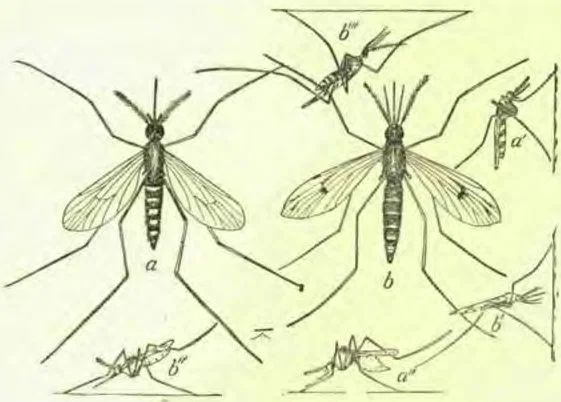
The anopheles may be distinguished from the culex, or ordinary mosquito, by the position of the body. The body of the culex stands parallel to the surface upon which it is resting. The body of the anopheles is directed almost perpendicularly or at right angles to the surface it is standing on, so that its head and bill are pointing down ready to strike. (See cut.) Another difference: the culex usually pauses a momentp. 4 after lighting before proceeding to business, while the anopheles begins as soon as it lights.
But remembering the tendency of the insect to bite only after sunset, one in a malarious country may, by taking proper precautions, avoid an attack of malaria.
Yellow Fever
Havana was formerly the hotbed of yellow fever. Efforts were made there and in the Southern States to quarantine against the disease, which was supposed to be highly contagious. These efforts were unsuccessful because the method of transmission was not understood. When it was discovered that a kind of mosquito (Stegomyia fasciata), differing from the culex and the anopheles, was the means of transmission, it did not take long to rid Havana entirely of yellow fever. All that was necessary was to isolate every person having yellow fever, and prevent his being bitten by mosquitoes, and to destroy all mosquitoes that succeeded in getting into the house occupied by yellow fever patients. Now yellow fever, which was once the scourge of the South, is no longer so dreaded.
Experimental work has proved conclusively that the disease is not contagious. People have been allowed to sleep for days in the soiled beds on which yellow fever patients had died, without producing the disease. At one time it was thought that all excretions from such a patient were highly dangerous. Now the evidence all seems to indicate that every case of yellow fever is transmitted from some previous case by means of the mosquito.
So you can understand that the work in the “canal zone,” on the Isthmus of Panama, is now progressing under much better hygienic conditions than when DeLesseps tried to dig the canal many years ago.
Hundreds of thousands of yards of wire screen have been sent to Panama, for protection against mosquitoes, and the physicians in charge are doing all in their power to destroy the mosquitoes.
Mike Rose.