In a preceding number of the INSTRUCTOR it was stated that many queer birds are found in the southern hemisphere. This is a fact at once noticed by all travelers and naturalists who cross the equator, but it is particularly noticeable in that part of the southern world known as Australasia.
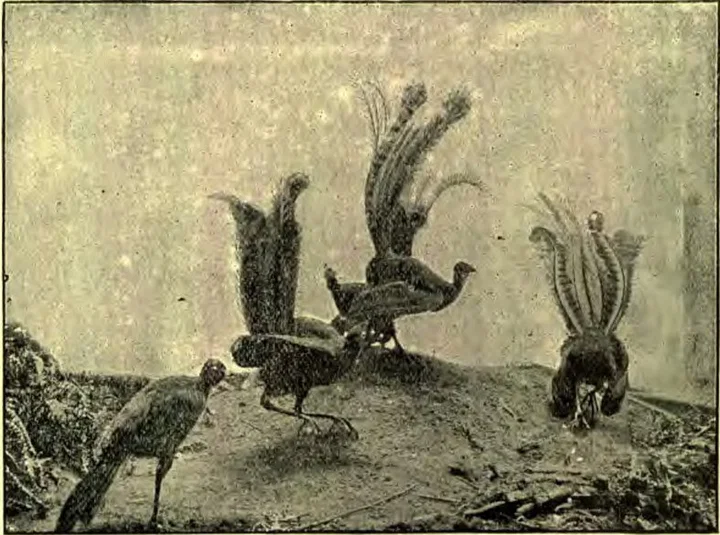
The laughing jackass, before described, is classed as a kingfisher by naturalists, but he is quite different from the birds known by that name in England and America. The lyre-bird is another specimen, which, in the absence of any nearer relative, is called pheasant; but it is the only known species of its genus. It takes its name from the appearance of its long tail-feathers, whose arrangement resembles the stringed musical instrument of that name.
This bird has several peculiarities. It lives in secluded gulleys in Australian forests, and is very shy. Round hillocks, or mounds, are built by it, around which it dances morning and evening, uttering at the same time a loud musical whistle. It is insectivorous, never flies, but runs at an extraordinary speed, disappearing like a flash if discovered. The accompanying photograph shows five of these birds performing their morning waltz. They mock all other birds, but especially the magpie and the laughing jackass.
The cockatoo, often seen in captivity in all parts of the world, is a purely Australian bird. Once while on a visit to the forest of Gippsland, in southeastern Australia, unusual screeching sounds were heard; and on inquiry as to their source, the answer from one well acquainted with the country was, “Cockatoos.” Immediately overhead, at such a height as to be at first scarcely discernible, several of these white birds were pointed out as they were flying round and round, apparently for exercise. The person who directed attention to them, a man of undoubted veracity, stated that he had seen flocks of the birds so dense that they formed a cloud, also that he had seen a flock of them alight in a tree, and literally make it white and pink with their plumage.
These birds like to hang by their beaks and claws. There is an overland telegraph line from Port Darwin in the northern territory of Australia to the southern part of the continent. At one time two wires were placed one above the other, about eighteen inches apart, on the poles, but for some reason, messages were frequently lost, and communication was very difficult. Investigation revealed the fact that the cockatoos, taking one wire in their beaks and the other in their claws, made a connection between the wires, and thus disabled the line. It was found necessary to place the wires so far apart that the birds could not reach from one to the other.
The kiwi of New Zealand is a lonely bird, having no relative in the world. It sleeps during the day, and gathers its food during the night. It has a very long bill, but its wings are so small as to be of no use. It is supposed formerly to have been much larger than at present, as the female lays an egg out of all proportion to her size.
Although the kiwi is a very peculiar bird, New Zealand has, or did have, another that is even more odd,—the moa. As far as wings go, it was worse off than the kiwi, for it had not even a place for them. The bird is now extinct. The moa stood about twelve feet high, and could run faster than any other living animal. It had an enormous appetite, and could eat almost anything. In this respect it resembled the ostrich. There are legendary accounts among the Maoris that it swallowed men.
There is no record that any European ever saw one of these birds alive. They are supposed to have become extinct about four hundred years ago; and, this being so, some have even doubted whether such a bird ever existed. But there need be no doubt about the matter. In the natural history museum connected with the public library in Melbourne are two or three well-preserved skeletons of the moa. The head of the largest was several feet above the writer’s head as he stood beside it. Its leg bones are much larger than those of a horse.
The emu, still quite common in Australia, probably comes from the same family as the moa, although it has wings. It differs from the ostrich of Africa in that it has three toes instead of two on each foot. It stands about four feet high, not quite as tall as its African cousin. A heart-shaped design, with an emu on one side of it and a kangaroo on the other, with a few symbols of the stock- and sheep-raising and mining industries interwoven between them, is the sign, or seal, of Federated Australia. H. E. SIMKIN.