LIFE acts only in the light. “Light is not simply a stimulus under which the life acts; the plant feeds upon the light, and completely appropriates it. The luminous waves which beat upon the green surface of the leaf are there arrested;” and their moving power is so completely absorbed that the reflected rays will not even affect the exquisitely sensitive plate of the photographer.” The plant lives and feeds upon the light; it takes the light into its inner self, and converts the energy of the light into the energy of life and growth. In the same manner, spiritual light is not a mere influence under which spiritual life acts; it is a condition of life; it is appropriated into spiritual lives; it is to be lived and fed upon. It is thus converted into the energy of spiritual life and growth.
But remember that life acts only in the sunlight. Have you ever noticed the potato plant? If it grows in a darkened cellar, it is a weakly, white, frail thing, with no strength or vigor; it has had but little light, so it has but little life. But when it grows out in the garden plot, it has a far different appearance. It is then one of the most vigorous and thrifty of our plants; it has plenty of life, for it has had abundance of light. Fulness of life comes only with fulness of light.
Are you dwelling in the sunshine? Are you basking in the sunlight? “Unto you that fear my name shall the Sun of Righteousness arise.” Our “God is a sun.” Let us not try to live in the cellar, but rather in the light, where we can grow and thrive. The church is filled with weak plants that have grown in the shade, the basement, and the cellar.
Is this because there is not enough light?—Of course not; there is fulness of light out in the open field. Abundance of light is beating down there upon the waving heads of wheat. There, too, the grain is ripe for the harvest. In the field you will find light; in the field you will find labor: light and labor, these are life. Yes, light is the condition of life; for light acts only in the light. Let your soul, then, bathe in the light of God; let your soul drink it in. God sheds every ray for the life of your soul. If you shut the light away, you shut out that much of life and God. There is enough of darkness at night; let us not make any darkness of our own. Remember you can have fulness of life only by dwelling in abundance of light. Do not attempt to be a basement Christian; do not try to be a cellar Christian; do not try to grow in somebody’s shade. Grow in God’s sunlight. So shall you be a living Christian. “Ye are all children of the light, and the children of the day; we are not of the night, nor of darkness.” Can it be truly said of us that we are not children of the night, nor of darkness? Do we ever seek darkness? Do we love, even for a moment, to dwell in the blackness? It is the baneful plants that grow in the darkness. It is the fermentations of death and decay that thrive and increase in the absence of the light.
Some of the most deadly germs are speedily killed when exposed to direct sunlight. Koch says that the “tubercle bacillus is killed by the action of direct sunlight, in a time varying from a few minutes to several hours, depending upon the thickness of the layer exposed.”
The only hope of the consumptive is abundance of pure air and sunlight. The admonition to the consumptive is the admonition to the Christian,—Keep out of the shade and the darkness; live in the sunshine. “Live not in the shadow” even of the cross of Christ; “but on the sunny side of the cross, where the Sun of Righteousness may shine into your heart.”
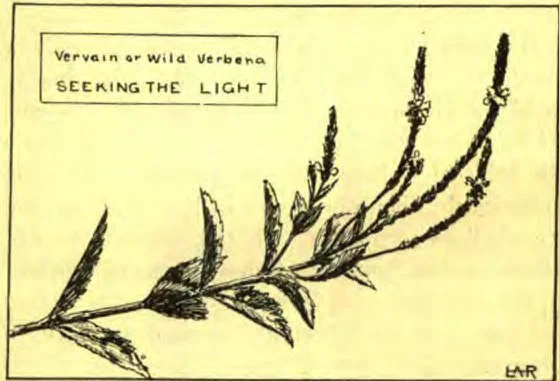
O, how the plants condemn our ways of living! We set our potted plant in the window, and, in a few hours, we find its leaves and blossoms all turned toward the light. It seeks the light; for light is necessary for its very existence. Some of our common weeds are very sensitive to the light. Late one afternoon I brought home a downy vervain, and, to keep its roots moist, threw it carelessly into the sink. Although the plant lay prostrate, it could lift its blossoms to the light; in a very short time the flower-stalk was bent at a right angle with the plant, thus lifting the flower upward as far as possible to receive every living ray of light.
Often I have found this same plant, lying prostrate on the ground, where it had been trampled by unheeding feet, and always the flower-stalk is bent upward to lift the blossom toward the light. The picture is of one of these plants which, growing on the edge of a bank, had been thrown over from its original erect position. True to its nature, its blossoms are lifted to the sky. There is a lowly little weed, called the mallow, which ordinarily closely hugs the earth. It lies so close to the ground that a lawn mower will scarcely cut it. And yet, when it happens to grow where the grass and weeds are uncut, it will run long stems up out of the rank weeds, thus carrying its foliage into the sunlight. The yellow sorrel, the clovers, and many other plants will do the same.
How fully sin has perverted our natures that we act so differently with reference to the light of heaven! The plant will violate every law of its being, before it will refuse to seek the light. It must have light, and every influence of its life works to this end. L. A. REED.