THE drawing instrument explained this week is called a pantograph, and is very useful to draftsmen in enlarging plans, diagrams, and maps. It may also be used in reducing; that is, in making a diagram smaller than the original. I have seen some excellent work done by children with it in one of our church-schools, where they made neat enlargements of the maps in their geographies, colored them with water-colors, and tacked them up on the walls.
The construction is simplicity itself; and if careful attention is given to one or two essential points, a boy’s home-made pantograph will work quite as well as one costing several dollars.
The frame is best made of four bars of hard wood. The dimensions may be large or small, according to the size required, but a common and useful size has bars 13 x 3/4 x 3/16 inches. Holes are bored in these four bars an equal distance apart; say three quarters of an inch, and care is taken that this work shall be done accurately. The opposite bars must always work parallel to each other, and this is effected by having the holes bored right. If the holes are uneven, the copy, or enlargement, will surely be a distortion of the original, and will not please you.
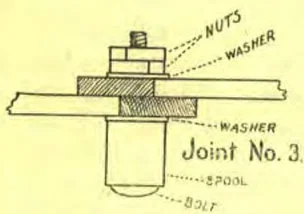
Another point to be careful about is the joints. Those which I have illustrated may seem somewhat complicated to you at first; but on the contrary, they are very simple and accurate, and better than those shown in Fig. 3, because they will not wear loose and “wobble.”
Notice that two nuts are used on each bolt. The reason for this is that one is used as a lock nut, to keep the joint from loosening or tightening while in use. Simply screw the first nut down on the washer till the joint is tight enough, then screw the second nut down on the first tightly, to lock it and keep it from turning.
Joint 3 is so arranged that the smooth head of the bolt slides over the paper or table without catching or jerking.
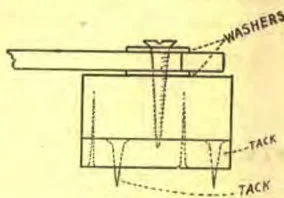
Joint 4 is the support of the pantograph, and requires sharp points projecting from its lower side, which may be forced into the wood of the table.
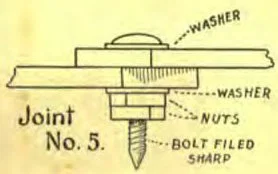
Joint 5 has a sharpened bolt, which is called a tracer, because it traces the outlines of the original picture. In drawing, the operator does not watch his pencil point at all, but leaves it to take care of itself while he gives the closest possible attention to the tracing point.
The whole cost of making a good pantograph of this description is not more than ten or fifteen cents.
EDISON DRIVER.