MARTENIS is a large Indian reservation ten miles north of Mecca. The government has established here an industrial school, and put up a church building. It has provided seeds, implements, and water for agricultural purposes. As we drove through this settlement, we could see everywhere evidences of thrift and prosperity. The people seemed to take pride in their gardens and farms. Basket-making is also an important industry with them, some of their best-made baskets bringing ten dollars apiece.
We will describe more particularly the little settlement just south of us, as I have become better acquainted with its people. They are a remnant of several tribes that have escaped destruction by water. The only history they have of their ancestors and of this country is the record of the Gulf waters rushing in at two different times and sweeping away most of the inhabitants. They can not tell whether it was one hundred or five hundred years ago. Most of the Indians can talk English, and some read well. They are honest and agreeable, and the most of them are Catholics. They are becoming more and more like the white man in their habits of eating; they use dried and canned fruit, also fresh fruits in warm weather, but more heat-producing foods in winter. They use much soap, and keep their clothes very respectable. Their houses are made by skilfully working arrow weed into a frame of timber and wire, which is so tight that they will turn water and keep out dust, and indeed they trim off the rough edges so neatly and nicely that they look quite homelike. Their houses are always built beneath some large shade trees, as cottonwood, willow, palms, or pala verde, and then they are sure to be near water. They spend most of their time out in the shade of their yard trees.
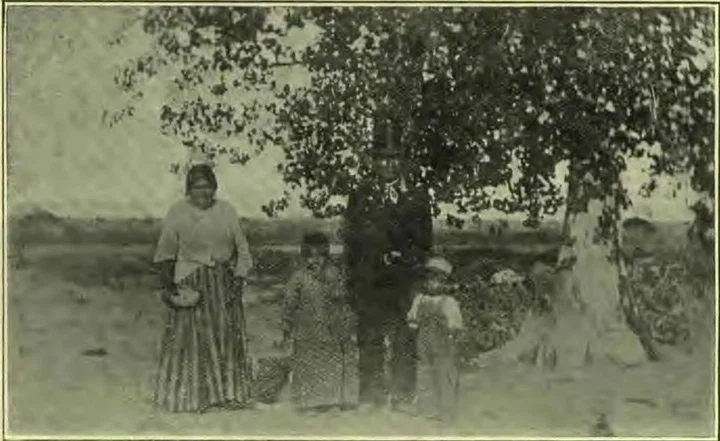
One old Indian chief known as Fig Tree John got his name from the large old fig-trees which he has. Thirty of his trees are at least thirty years old, then he has quite an orchard of younger ones. He says he once found a little wild tree and got a start from its cuttings; however, his trees are now of the finest and earliest bearing of the country. The figs are about the size and shape of a turkey egg, and delicious in flavor, being very sweet. They ripen the first of May. and his son ships them to the Los Angeles market at twenty-five cents a pound. The picture is of Fig Tree John, his wife, and two of his grandchildren. Indians do not like to have their pictures taken, but as we visited them, gave them some oranges, admired the fig-trees and baskets, we gained the old man's good graces. Still when he heard the word pictures he began to move toward his cabin, but on the offer of money he soon made ready, and having the dollar safely in his own hand, he stood up for the picture.
One of Fig Tree John's sons spent five years in the Kansas and Arizona school, and he seems quite intelligent. After he had read several copies of the YOUTH'S INSTRUCTOR, Signs, and Life Boat, he told me that he loved to study the good things in my papers, and if I did not care, he would like to rent or borrow my Bible, as his had been stolen from him by another Indian. I put him off, and began to plan and pray to see what I should do, and at last I decided to give up my cherished treasure, which was the first Bible I ever called my own, having worked hard when but a child to earn it as a premium. I gave it to him the next time he came, and the many “Thank you’s” and happy smiles more than paid me for the Bible, as I have a new one. Since then he told me that it taught him to be good, and he loved it very much. He has also ordered “Steps to Christ.” Now the other poor Indians are asking if I have any more Bibles for them. I have given away many tracts and papers to both Indians and passing white people. I leave the results with God, and let all praise be given to him, for it is he that worketh in us.
An old Indian woman who has lost all her own children comes over and spends hours watching my little Bertha. Though the child is but four years old, she shows the old woman her Little Friend, points out Jesus’ picture, and sings “God Is Love,” “Little Feet, Be Careful,” and “Two Little Hands for Jesus,” which the woman seems to enjoy very much. She can not read, and talks very little English; but every time she comes, she asks Bertha to “sing Jesus,” and as soon as one song is finished, she says, “Sing Jesus more,” till the three are finished. She seems to understand that the child knows no more; so she waits till her next visit, when she repeats her requests.
There are so many hearts waiting to learn of the wonderful love of Jesus, from the highest classes of humanity to the poor ignorant Indians. May we each keep ourselves on the altar of sacrifice continually so that we may be used to help some soul to the kingdom.
MRS. JOCIE WALLACE.