FROM the observance and study of the life of insects, we may learn many lessons of truth. By beholding God’s care for these tiny creatures, we are encouraged to be patient, and to trust him to protect and to provide for us; for, “Are ye not much better than they?”
Let us not think that insects live by chance, that God has no direct care for them. David said of beasts and creeping things innumerable, “These wait all upon thee; that thou mayest give them their meat in due season.”
Of insects there are more than a hundred thousand recorded species. In whatever light we view this great number, whether we consider their curious transformations, their varied forms and colors, their remarkable instincts, or their effect upon our persons or property, we find much to command our admiring attention.
Insects, in their perfect state, are distinguished from other articulate animals by the possession of six legs and two antennae, or “feelers,” and by the division of the body into three distinct parts, the head, thorax, and abdomen. The organs of locomotion are borne by the thorax.
Insects generally have wings, and almost always undergo a process of transformation, called metamorphosis, before arriving at their mature and reproductive form. Their bodies are composed of rings, or segments, which are generally of a horny texture, united to one another by a membranous skin, in such a way as to admit of motion.
Insects breathe in a very curious way. They have no lungs nor gills, but the whole body is permeated with a network of tubes, called trachea, through which the air is conveyed, and by means of which the blood is brought in contact with the oxygen of the atmosphere. These air tubes penetrate to the extremities of the limbs, the antennae, and even the wings. Their external openings are called spiracles, and are set along the sides.
The eyes of insects are among the most wonderful objects in nature. They are composed of thousands of little lenses, which really are perfect eyes. The eye of the common house-fly has four thousand of these lenses; that of a dragon-fly more than twelve thousand; of a butterfly seventeen thousand; and of a small species of beetle, no less than twenty-five thousand.
In addition to these compound eyes, many insects possess two or three simple eyes, placed on the head between the compound ones.
The antennae, commonly called feelers, are usually attached to the front of the head between the eyes. They vary greatly in form, and probably to quite an extent in function, although their general office seems to be that of organs of touch.
Marked modifications are exhibited in the structure of the mouth. In some it is formed exclusively for biting, in others for suction, while in still others it is fitted to perform both these actions.
The wings, legs, and feet are variously adapted to the different species.
The nervous system of insects consists generally of a brain, placed above the esophagus, with ganglia distributed according to the species. The organs of sense vary in acuteness in the different classes.
The metamorphosis of insects has from earliest ages been noted as one of the most remarkable phenomena in nature, and well deserves our attention. This transformation, in its most complete form, as exemplified in the butterflies, moths, beetles, and many other insects, takes place in three distinct stages. In the first, or larva state, the insect has the form of a caterpillar or a grub. During this period of its existence, its whole business seems to be eating. And this business it performs usually with the greatest voracity, changing its skin repeatedly to allow for its rapid increase in bulk.
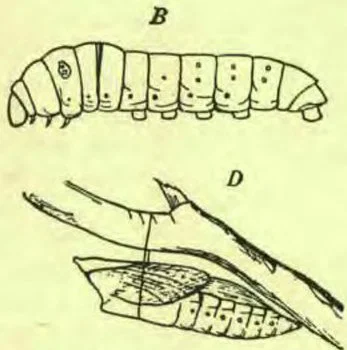
After remaining in this condition for a time, it passes into the second period of its existence, when it is called a pupa, or chrysalis. In this state the insect is quiescent, neither eating nor moving. It is enclosed in a case, usually of a horny substance, which serves to protect its tender and helpless inmate, until, after a longer or shorter period, the insect, arrived at maturity, bursts from its prison in the full enjoyment of all its faculties. It is then in the imago, or perfect state.
To see the same animal, first as a soft, worm-like creature, crawling slowly along, greedily devouring everything that comes in its way, and then, after an intermediate period of deathlike repose, emerging from its sleep, furnished with wings, adorned with brilliant colors, and confined in its choice of foods to the most delicate fluids of the vegetable kingdom, is a spectacle of the highest interest. Although the majority of insects undergo a complete change of this kind, there are many in which the only transformation consists in a series of changes of skin, without any period of rest or sleep between. In this case the larva gradually acquires the organs which it originally lacked.
The immense number of insects and their diversified forms and habits, render their classification a matter of difficulty. So without attempting to classify, we will consider some of the interesting features of a few of the more prominent orders.
Let us begin with the Orthoptera, or strait-winged insects. This class includes the cockroaches, crickets, grasshoppers, locusts, praying-mantis, and leaf insects. The cockroach is very familiar, and though now so common over Europe and America, it is supposed to have been originally a native of India, and to have been gradually carried west by the progress of commerce. These insects are nocturnal in their habits, concealing themselves in dark places during the day, and making their ravages in the night. Where they exist in large numbers, as they usually do in ships, they become a nuisance.
We have all seen and heard the noisy cricket, that short, stumpy insect with large hind legs. The field-cricket lives in burrows made at the foot of hedges or old walls, and sits at the mouth of the burrow to chirp, if a sound caused by friction can be called chirping. The house-cricket is much like the field-cricket, and both are so familiar as to need no description.
The mole-cricket is one of the oddest-looking of insects, and gets its name from its burrowing habits and altogether mole-like aspect. This cricket is common, and destructive to vegetation in the warmer portions of the United States.
Locusts and grasshoppers are interesting families of the Orthoptera class. They feed on vegetables; and where they exist in large numbers, they often destroy every vestige of vegetation, and devastate the country as if a fire had swept over it. This is especially true of the migratory locust, which congregates in vast armies, and flies like winged clouds over the earth, making a noise like the roaring of the sea. Wherever they alight, they strip every plant of its verdure.
A prominent class of insects is the Hymenoptera, which includes the bees, ants, and wasps. These insects have four wings, which are transparent and membranous, with comparatively few veins, and the fore pair larger than the others. The honey-bee, from earliest ages, has excited man’s admiration by its industry and its wonderful instincts. To it he is indebted for honey and wax. In the year 1850, fifteen million pounds of honey and wax were gathered from bees in the United States only. The quantity obtained annually throughout the world amounts to hundreds of millions of pounds. These little creatures are said to be natives of Greece, but have since spread all over the world. They live in colonies of from ten to thirty thousand neuter, or working, bees; from six to eight hundred males, called drones; and a single female, which seems to reign as queen. They make their dwelling in the trunk of an old tree, or in the hive which man prepares for them. There is a division of labor among the working bees. Some are the wax gatherers, which collect material for the construction of the comb; some are nurses, to which is assigned the task of watching over and feeding the young; and others are the honey gatherers, whose work is familiar to us.
We might well heed Solomon’s advice to go to the ant and consider her ways. Many interesting things might be said of this wonderful little insect. We have not space to do it justice, and so will attempt no description of it.
A familiar class of insects is the Diptera. These have but two wings. The common gnats and flies are examples of the class.
Lastly we shall mention the Lepidoptera, that class which includes the most beautiful of all the insects, the butterflies and moths. They have four wings of richly varied hues. Those species which take any nourishment in the imago state subsist entirely upon liquid food, which is drawn into the system by suction. Butterflies and moths may generally be distinguished from each other by the form of the antennae, those of butterflies having knobs at their tips, while those of the moths are usually pointed or feathery.
Let us acquaint ourselves with our little insect neighbors, and humbly learn from them the lessons they teach. ESTELLA L. MURPHY.