DURING the last sickness of Pope Leo XIII, and especially since his death, the entire world has been told again and again, through the newspapers and magazines, of the interesting ceremony of electing a new pope; but it may be quite as interesting to the readers of the INSTRUCTOR to read the story as it was told to us a few months ago by one of the leading official guides of the Vatican, as we stood in the magnificent assembly-room of St. Peter’s, facing the beautiful marble sarcophagus which will be the temporary resting-place of the pope, while the permanent tomb and the ornamental decorations and statuary are being prepared.
We were fortunate in obtaining the services of an intelligent guide, who had long been in the service of the Vatican; and while we can not vouch for the accuracy of his statements, we were impressed with the apparent sincerity of his effort to give a faithful narration of the interesting proceeding.
When the attending physicians have made their final examination, and have declared life to be extinct, they retire from the death chamber, and the doors are securely locked; then the Cardinal Chamberlain, who has stood next to the pope as the highest and most trusted official of the Vatican, approaches the door, and knocks three times. On receiving no answer he enters, and with a silver hammer taps lightly three times upon the forehead of the dead man, and calls him by name. There still being no answer, the Chamberlain retires from the room, and announces officially that the pope is dead.
The Cardinal Chamberlain immediately assumes the high office, and takes charge of affairs until the election of a new pope has taken place; but as a precaution against an abuse of this temporary power, three other trusted cardinals are appointed to guard the interests of the church.
According to the laws of the church, the balloting for the election must begin in ten days, or in twelve days at the latest, after the pope’s death.
Through the ambassadors of the countries where they reside, the death of the pope is immediately announced to the seventy cardinals of the church, known as the Sacred College, who alone are eligible to office; and they are summoned to hasten to Rome in order to participate in the election. In the meantime the embalmers are summoned; the body is removed from the death chamber to the throne-room adjoining, and is there prepared for the tomb. Then the body is removed to the auditorium of St. Peter’s, and placed in the marble sarcophagus previously mentioned.
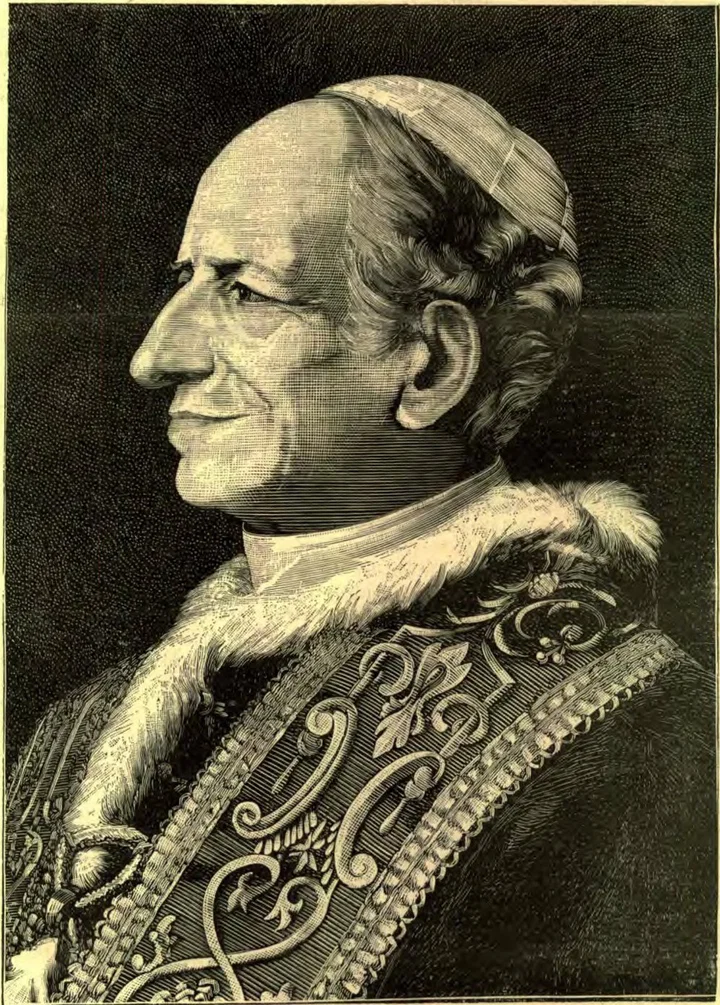
The funeral lasts nine days, during which time thousands assemble to pay their last respects to this great sovereign of the Catholic Church. As the cardinals arrive, they are assigned to their apartments, each being allowed two rooms and a kitchen. Each cardinal may have with him two attendants, one an officer of the church and the other a layman, besides a cook and any other necessary attendants; but all are closely guarded, and are actually held as prisoners, so that they may have no communication with the outside world until the solemn conclave is over. The election is held in the beautiful Sistine Chapel of the Vatican, a little private assembly-room, beautifully decorated with paintings by Michelangelo and other celebrated masters.
On the day fixed for the sitting of the conclave, the cardinals assemble to hear the mass of the Holy Spirit, and take the oath of allegiance, faithfulness, and secrecy. Then they march in double file to the Sistine Chapel, which has already been made secure from all outside worldly influences by every window and every door except the main entrance being walled up solid with bricks and mortar; and every aperture of the room, by which communication with the world might be had, being securely closed. When the cardinals with their attendants and the six scrutineers have assembled, the entrance door is also walled with masonry, with the exception of a small square opening, through which food and other refreshments may be passed in. “So you see, my friends,” said the guide, “the cardinals must elect a new pope, or they will never get out.” The cardinals are thus confined to insure the election being purely ecclesiastical, and free from political influences or intrigues; for there have been times when the election of a pope has been made the occasion for an uprising or revolution, with the hope of influencing the election for political purposes.
Before the balloting begins, each cardinal is required to make a declaration in writing, indicating whether he is willing to accept the sacred office as head of the church, and be bound through life by the many oaths to which a pope must subscribe; one of the most important of which, and the one most likely to be embarrassing to the cardinals, being the oath of self-imprisonment until death within the walls of the Vatican; for it is well known that after his election the pope can never again set foot outside his temporary dominion, which consists of St. Peter’s, the Vatican, and their adjacent gardens. Only those who are willing to be thus bound are eligible to the high office; and the number is usually quite limited.p. 2
A two-thirds vote is required for the election of a pope; and any one of three methods may be employed,—acclamation, compromise, or ballot. Pope Leo XIII was elected by acclamation, or by “inspiration,” as the church is pleased to term it, “when all the cardinals, as if by the inspiration of the Holy Ghost, proclaim one candidate pontiff by voice and unanimously.” Election by ballot is far more common. In that case balloting papers are distributed, as in a political meeting, and each cardinal writes his preference in the following words: “I, Cardinal ——, elect my Lord Cardinal —— to be supreme pontiff.” Then the cardinals, one by one, step forward to the altar, hold the ballot aloft in the right hand, and with the left hand upon the Bible, say, “I call to witness Christ the Lord, who is to be my judge, that I elect him whom I judged according to God ought to be elected, and that I do the same at the succession.” The ballot is then placed in the chalice.
When the full number of votes has been cast, the six scrutineers come forward and examine the ballots. If less than a two-thirds vote for any one cardinal has been secured, the ballots are placed upon a quantity of wet straw in a little fireplace used only for that purpose, and are burned. Thousands of people assembled outside watch for the smoke from the chimney, which by its appearance will announce to them the result. When the heavy black smoke from the damp straw is seen, they know that the ballot has not been successful. Sometimes the balloting continues for several days. If at the close of the first day no successful ballot has been taken, an announcement is made of the name which has received the largest number of votes; and when the cardinals renew their balloting on the following morning, chief consideration is given to the most favored cardinal, and an attempt made to secure a two-thirds vote for him. On the ballot being successful, the Cardinal Chamberlain comes forward, and announces the result. The favored cardinal receives the congratulations of his fellows, and announces to them the ecclesiastical name by which he chooses to be known. Then he retires to the dressing-room, and is arrayed in the pontifical garments.
In the meantime the successful ballot papers are sprinkled with holy water, and burned; and the cloud of vapor ascending from the chimney announces to the crowd without that the ballot has been successful. The masons come with their hammers and remove the bricks and mortar; and the cardinals are set free. The new pope is ushered out to the great balcony in front of St. Peter’s, and there introduced by his new name to the people. The First Cardinal Deacon presents the pope to the people in these words: “I bring you tidings of great joy. We have a pope, the most high and reverend [giving the name of the new pope]. He has taken upon himself the name of [Pius X or Leo XIV or whatever the name may be].” Then the people hasten to the great auditorium of St. Peter’s, there to receive the blessings of their Sovereign Pontiff, and witness the grand parade, as the successor of St. Peter passes before the assembled thousands, wearing the triple tiara, arrayed in the richest gold-wrought vestments, and followed by all the great cardinals and highest princes of the church. Then, attended by the Noble Guard, the fine body of Swiss Highlanders who are the bodyguard of the pope and the protectors of the Vatican, the newly elected head of the church is escorted to his royal apartments.
E. R. PALMER.