“If you wish to be successful in life, seek out some righteous but unpopular cause and stand by it till its triumph.” Surely truer words were never uttered; and to the truth of this principle an innumerable cloud of witnesses bears unerring testimony.
OUR QUAKER POET
Though Whittier’s poems in general delight our varied moods, my loving hope for our dear young people is that the principle in the man that caused him to dare stand alone, if need be, for right, in the face of unpopularity, derision, persecution, yea, even death itself, will most forcibly challenge their admiration and emulation; for we, too, have a cause to stand by, than which one more righteous never demanded our loyalty. And it is bound to triumph gloriously. Its triumph means not the suppression for a time of one evil in one little spot, but the utter annihilation of all evil forever from God’s entire universe. Its triumph means not simply the emancipation of a few thousand people from one little phase of slavery, leaving them still in vastly more galling soul-slavery, but eternal emancipation from every form of bondage, because of the chaining and final execution of the chief of slaveholders — Satan. And when this great struggle shall have thus ended, it will not leave us on this poor sin-cursed earth, to toil on a few years, then decay and die; but lands us with —
“Our toils all past, our joys complete,
Safe in our Father’s home.”
With these thoughts in mind, let us for a little time study the life of John Greenleaf Whittier, with the special object of viewing in that life “whatsoever things are true, whatsoever things are lovely, whatsoever things are of good report.”
Doubtless, as in the case of Timothy, those principles of loyalty to right dwelt first in his “grandmother Lois,” and in his “mother Eunice.”
Whittier was born a come-outer. His ancestors had severed from the English Church and cast in their lot with the despised Quakers, “when to be an advocate of this new doctrine was a sure road to martyrdom, when for preaching according to the dictates of conscience, men were flogged, chained in loathsome dungeons, half-starved, banished under pain of death, yea, more. — men of blameless lives were actually hanged as malefactors on Boston Common.”
As the history of those times was told around the old fireplace in the Whittier home, doubtless John Greenleaf’s boyish heart burned within him, and found vent in later years in earnest, fiery words resembling the lofty tone of the ancient prophets.
But let us now for a little time glance at the early life of our Quaker poet.
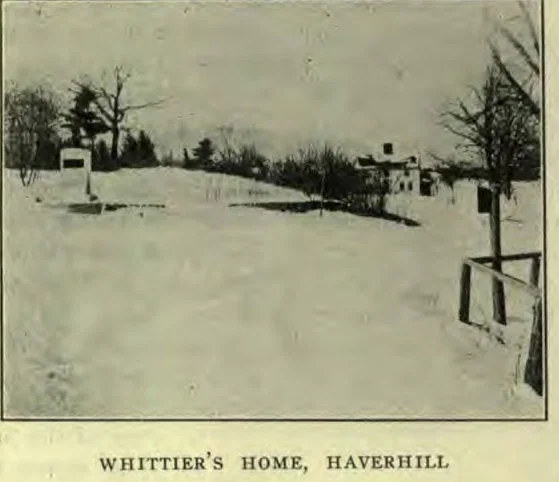
“About three miles from Haverhill, on the electric line to Amesbury, the conductor calls out, ‘Whittier’s Birthplace.’ I would very much enjoy having the INSTRUCTOR family visit this place with me. In fancy we may take the trip, stopping at a number of places of interest on the way. As we get off the car in answer to the conductor’s call, we notice a large granite slab by the roadside, bearing the inscription, ‘Whittier’s Birthplace.’ Looking up the road to our left, in plain sight from the main street, we see the house in which our poet first opened his wondering eyes. As we pass over the little old bridge spanning the brook made memorable in ‘Barefoot Boy,’ we realize we are entering memory-haunted grounds. As Whittier himself has so well described the place in ‘Snow-Bound,’ ‘Barefoot Boy,’ and other poems, I will not now go into details in my description.”
Within a few years the Whittier Club, of Haverhill, has obtained control of the place, and through the kindness of friends and relatives, has refitted it with many of the old Whittier furnishings, including chairs, tables, the poet’s old desk, his mother’s dishes, and various other things. In a large front room on the lower floor, John Greenleaf was born, December 17, 1807, the same year as his brother poet Henry W. Longfellow.
Among other interesting things in this room is a collection of old silhouettes of different members of his home. Also one of the little girls who, in his poem, “In School-Days,” says:—
“I’m sorry that I spelt the word:
I hate to go above you;
Because,”—the brown eyes lower fell,—
“Because, you see, I love you!”
But we must hasten on up the well-worn staircase to the room above, which Whittier occupied as a boy.
It has been but little changed since those boyhood days, and even now fits his description of it, where he says:—
“We heard the loosened clapboards tost,
And board-nails snapping in the frost;
And on us, through the unplastered wall,
Felt the light sifted snowflakes fall.”
Perhaps no other room is quite as interesting as the kitchen, the living-room of this estimable family. As we sit down in the now lonely and quiet room, we will let Whittier himself tell us about the dear ones who once made the room merry and bright as they sat around the very fireplace about which we are now sitting.
Of his mother he says:—
“Our mother, while she turned her wheel,
Or run the new-knit stocking-heel,
Told how the Indian hordes came down
At midnight on Cochecho town,
Then, haply, with a look more grave
And somberer tone, some tale she gave
From painful Sewell’s ancient tome,
Beloved in every Quaker home,
Of faith, fire-winged by martyrdom.”
From a picture we have seen of this sweet, benign, dignified mother, we do not wonder that her boy was a credit to her. A strong but very brief picture of his father also comes to mind. It is the first morning after the storm. We can easily see this resolute father at the foot of the old staircase, calling his boys to their share in the day’s toil; but we will still let Whittier speak from “Snow-Bound:”—
“A prompt, decisive man, no breath
Our father wasted: ‘Boys, a path!’”
In those few words it is not difficult to detect the sturdy character that would dare be loyal to an unpopular cause.2
His Aunt Mercy Hussey, for many years a member of the family, is thus tenderly remembered:—
“Next, the dear aunt, whose smile of cheer
And voice in dreams, I see and hear,—
The sweetest woman ever Fate
Perverse denied a household mate.”
Uncle Moses, his father’s brother, is not forgotten, and from the following description, one fancies that the poet was more like this uncle, in some respects, than like the very practical father. He thus speaks of him:—
“Our uncle, innocent of books,
Was rich in lore of fields and brooks,
Himself to Nature’s heart so near
That all her voices in his ear
Of beast or bird had meanings clear.”
Then came the description of his older sister Mary:—
“A full, rich nature,
free to trust,
Truthful and almost
sternly just,
Keeping with many a
light disguise
The secret of self-sacrifice.”
The large braided mat before the fireplace reminds one of his description of the baby of the family:—
WHITTIER'S HOME, HAVERHILL
“Upon the motley-braided mat
Our youngest and our dearest sat,
Lifting her large, sweet, asking eyes.”
This baby was Elizabeth, the noble sister of later years, who was so closely associated with her brother’s joys and sorrows, as well as in his literary pursuits.
At the time “Snow-Bound” was written, in 1866, the entire family except himself and his only brother, were sleeping in the cemetery at Amesbury.
The poet thus sadly writes:—
“Ah, brother! only I and thou
Are left of all that circle now.”
We must leave the old homestead, with its many pleasant memories; but we will still study the life which began in this old home.
Of Whittier’s babyhood we hear little; but his mother, doubtless, treasured in her heart his little experiences, including his baby lispings and childish trials, though of the latter we fancy he had less than the overpetted child of the present.
We do hear in due time of the little seven-year-old John Greenleaf as starting for school. There was usually but one three-months’ term of school in the year; and with a new teacher every winter, it is readily seen that Whittier’s educational advantages were limited.
Unlike George Washington, we have no record of immaculate copy-books, in connection with Whittier’s school record; but we do know that after-years proved most indisputably that somewhere, somehow, he had amassed a store of information and acquired an unusual mastery of his mother tongue. Who shall say that there was not a compensating string in his missing the privileges of a classical education? Had he been longer amid the clatter of the schools, might he not have missed hearing Nature’s finer notes?
In those early days Whittier’s reading was also limited in variety, which also may not have been so great a calamity, as it led him to dig deeper into the few books at his command. It is safe to say that the bulk of the future poet’s reading was the Bible. His cousin, Mrs. Gertrude Cartland, of Newburyport, thus describes Whittier’s Bible training: “In the Whittier home the reading of the Holy Scriptures was a constant practice. On First-day afternoons, especially, the mother would read them with the children, endeavoring to impress their truths by familiar conversation; and to this early and habitual instruction we may attribute in great measure the full and accurate knowledge of Bible history which the poems of Whittier indicate.”
The family attended church in Amesbury, eight miles away. The simple church still stands, a monument to Quaker simplicity. Neither steeple nor bell adorns it.
Well has Underwood, one of Whittier’s biographers, said: “If the energies and resources of Christianity are to be expended in building gorgeous temples furnished with luxury and adorned with triumphs of art, where professed musicians and singers are employed to display their accomplishments, and great men give scholarly lectures to people of the highest fashion, that is one thing. But if Christianity reverts to its primitive type, its home will be once more in the ‘upper chambers,’ among humble and sincere believers who are alive with divine love, and from whose hearts worship arises as naturally as fragrance from flowers, whose songs and ascriptions of praise are not echoes from the opera or the mass, and who are not ‘conformed to the world,’ but are ‘unspotted’ from it, and who live ‘as ever in the Great Taskmaster’s eye.’”
What would have been the result had the influences which molded the character of Longfellow, Bryant, Holmes, Emerson, and Lowell been thrown around Whittier, we can not say. Doubtless something gained, and probably something lost. May we not believe that God was training him in this quiet life for his future work, even as Moses was trained during those quiet years in Midian’s pastures?
“Whittier seems to have made the most of his opportunities, and his sincere and just mind and character, aided by unfailing tact, seem to have supplied the place of what are termed cultivated manners, so that the plowboy manifested the simple dignity and courtesy of a gentleman.”
A few years at Haverhill Academy supplemented his district school-days. During these days poems were frequently written by him. His first poem was published when he was about nineteen years of age. Up to this time he had only written poems to hide them; but his faithful sister Mary sent one of these hidden poems to a newspaper, and its appearance in print of course greatly surprised and delighted the young writer.
Burns and Scott are the only poets who can be said to have influenced in the least Whittier’s poetry.
Among his early poems was the well-known “Vaudois Teacher,” picturing the faithful Waldensians, who under disguise of peddlers, carried the “Pearl of great price” to the needy.
Another poem dear to us is a selection from “Tent on the Beach,” describing the wonderful dark day of May 19, 1780. He thus speaks of it:—
WIDEST STREET IN ZANZIBAR
“’Twas on a May-day of the far old year
Seventeen hundred eighty, that there fell
Over the bloom and sweet life of the spring,
Over the fresh earth and the heaven of noon,
A horror of great darkness, like the night. The low-hung sky
Was black with ominous clouds, save where its rim
Was fringed with a dull glow, like that which climbs
The crater’s sides from the red hell below.
Birds ceased to sing, and all the barn-yard fowls
Roosted; the cattle at the pasture bars
Lowed, and looked homeward; bats on leathern wings
Flitted abroad; the sounds of labor died;
Men prayed, and women wept; all ears grew sharp
To hear the doom-blast of the trumpet shatter
The black sky, that the dreadful face of Christ
Might look from the rent clouds, not as he looked
A loving guest at Bethany, but stern
As Justice and inexorable Law.”
As students of prophecy we are surely grateful for this testimony.