St. George's
I had heard much of St. George's and its peculiarities before I had time to explore it for myself, and my curiosity was fully aroused; so it was with pleasure that I accepted an invitation to spend the Easter holidays there at the home of a friend.
I rode down from Hamilton on my bicycle along the North Shore road, passing the governor's residence on Mt. Langton, and here and there a tiny village like Devonshire Dock, Crawl Point, The Flatts, and Barley Bay. The road is everywhere very near the ocean,—so near that it is dashed in many places by the salt spray. The constantly changing hues of the water, now a bright sapphire blue, now shading into reds and purples under the setting sun, present a picture that, if seen in an artist's studio, would be at once declared untrue to life. The coloring is so vivid—the blue so intensely blue, the white so white!
“The Flatts” is a collection of houses near the outlet of Harrington Sound to the Ocean. A post-office, a grocery, and a bicycle shop, with one or two hotels for the accommodation of winter guests, form the business part of the little village.
The road leads past Shelley Bay, named from Captain Shelley; Bailey's Bay, a beautiful little inundation where the path hugs close to the water's edge, and down to the causeway connecting St. George's Island with the Great Bermuda. The causeway is two miles long, divided into two sections by Bird Island. It was once built of solid masonry, but the severe storm of September, 1899, one of the most disastrous that has ever visited the islands, destroyed it, the great waves heaping the masses of sandstone one on another like children's toy blocks. In rebuilding, it was decided to leave free passage to the water by supporting the roadway on piers and arches.
My first trip to St. George's was taken before the storm, and was uneventful. After the storm I rode down again on my bicycle, intending to take thep. 2 ferry that had been established to accommodate travel until the causeway could be rebuilt. Just as I reached the ruined causeway, I saw the ferry-boat leaving the landing several rods away. It was Sunday, and the trip was made once in three hours. I had promised to attend church with my friend in St. George's at eleven o'clock, and it was now ten. I looked at the causeway, and saw that a narrow plank bridge about a foot wide had been laid for the convenience of the workmen. Two men were coming toward me, and in desperation I decided that what others had done I could do. My wheel was in the way; but I picked it up and started.
It took some courage to keep on, when I looked down at the waters swirling against the piers; but I had gone the distance of three arches when the two men, soldiers of the garrison, passed me, also carrying their bicycles. I noticed that they looked at me rather strangely, but attributed their manner to a man's natural surprise at seeing a woman carrying a bicycle over a footpath in mid-ocean. I had gone but a few steps, however, when I heard a voice behind me, and, turning, saw one of the soldiers approaching. He told me that there was a strong wind blowing, and that it was with the greatest difficulty they had gotten across. In fact, more than one person had fallen in that morning, and he would not think of attempting to cross again. He begged me to turn back, and let him look up a boat that could take me to the still unharmed part of the causeway. It was an hour's work to find an old negro who had a boat and time to spare; but I was glad enough to take him at any price.
I did not attend church that day, however. Before leaving Bermuda, I had the privilege of riding over the new causeway.
After reaching the Island of St. George's, the road winds in and out, curving along the water's edge, skirting the hillside with a fringe of houses on either side. The houses are quaint and old-fashioned, and in the town itself are build closely, one upon another in Spanish style. St. George's is said to be Spanish in appearance. It nestles at the foot of a range of hills bordering the ocean and has one of the finest harbors in the islands. Castle Harbor was once the stopping place of all vessels that visited Bermuda. At present it harbors a few coal-barges and merchantmen.
To a stranger the most noticeable feature of the town is the narrowness of the streets. In some of them two persons in the center, holding hands, can easily touch the houses on either side. Many are not only narrow but crooked as well.
On one of the principal streets is an old church that appeals to one in search of antiquities. Services have been held in it for nearly four hundred years. One may see there a silver goblet presented by the Company in 1626 and an entire silver service presented by William and Mary in 1693. Along the walls are marble slabs with curious epitaphs, inscribed to former governors and great ladies. The following inscription on a tablet in honor of one Governor Papple, as nearly as possible an exact reproduction in arrangement, spelling, and capitalization, is an example of these epitaphs:—
“Died at Bermuda, Nov. 17, 1744, In the 46th Year of his Age, After Nine Days Illness of a Bilious fever, The Good Governor, Alured Pappie, Esq. During the Course of his Administration, Which to the inconsolable Grief of the Inhabitants Continued but Six Years, Of the many Strangers who resorted hither The observing easily discovered in Him Under the graceful Veil of Modesty An Understanding and Abilities equal To a more important Trust. The Gay and Polite were Charmed with the Elegance and amiable, unaffected Simplicity of his manners, And all were cheer'd By his Hospitality and diffusive Benevolence Which steadily flowed, and Undisturbed From the Heart. To praise according to his Merit The deceased Would be but too sensible a Reproach To the Living; And to enumerate the many rare Virtues Which have united in the Governor of that little Spot Were to tell how many great Talents, And Excellent Endowments, are Wanting in Some, Whom the Capriciousness of Fortune Exposes In a more elevated and Conspicuous Station.
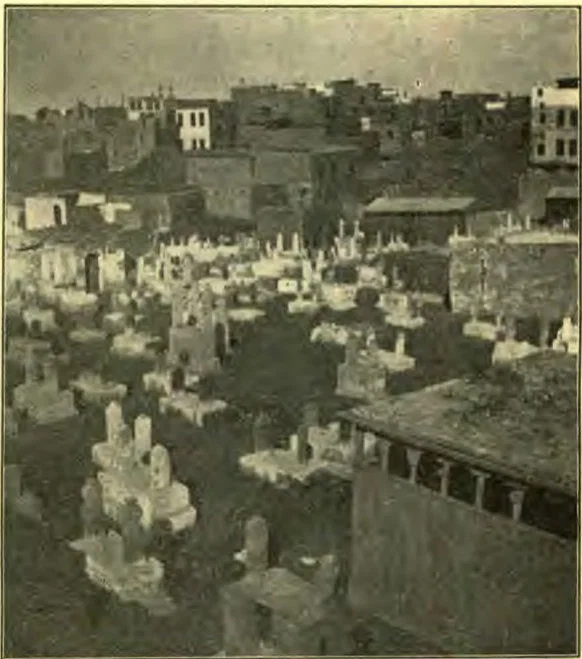
In the churchyard are other epitaphs quite as curious. In Bermuda the dead are buried, not in graves, but in tombs; and one raised slab or stone or marble marks the resting-place of an entire family. In the Public Gardens there is a tablet erected to the memory of Sir George Somers, whose heart was buried in that place, though his body received interment in England.
The Public Gardens are exceedingly interesting from the variety of tropical and semi-tropical trees and shrubs gathered there. Different varieties of palms—the date palm, sago palm, cabbage palm, the monkey tree and the bamboo, are among some of the most interesting.
St. George's, like Hamilton, is surrounded by forts. Fort George is on a hill overlooking the city, and is a fine look-out station. The garrison is not so large as that at Hamilton, and the soldier's barracks are nearer the town.
There can be few sights in the world more beautiful than the view of Castle Harbor from Fort George,—the bay of Naples, to which it is often compared, included.
Opposite the town is the Island of St. David's, where the smaller of the two lighthouses is situated. This, with Castle Island and the other islands inclosing the harbor, will furnish material for another chapter. WINIFRED M. PEEBLES.