ONE familiar with the best of Washington always gives to another anticipating a first visit to the capital city, the following advice: “Don’t fail to go to the Congressional Library.” The wise heed the instruction, and are well repaid. Lowell said, “There is no work of genius which has not been the delight of mankind.” So the Library, which is a gigantic triumph of genius, is of special delight. Its corridors constantly echo and re-echo the footfalls of visitors from all parts of this country, and across the waters.
The Library was founded in 1800; but the present building was not begun until 1888. It was finished in 1897, having cost $6,617,124, only about one half, however, of the cost of the Capitol.
The plan of the building for its service as a library is unique and admirable; but the general interest is concerned chiefly in the magnificent series of mural and sculptural decorations that greet the eye of the observer everywhere,—above, below, and all around. We who are artists in appreciation, if at all, rather than in touch, can be entranced by a few strokes of the brush in the hand of a genius; so it is not strange that the combined harmonious grouping together about the walls and ceiling of one building, the results of the best work that threescore celebrated men in their profession could accomplish in a year and a half, should prove highly interesting and instructive to you and me. Both inside and out, the predominating style of architecture of the building is the Italian Renaissance—that used in Italy at the time of the Revival of Learning, or about the fifteenth century—a style constructed chiefly from the long-neglected models of Greece and Rome.
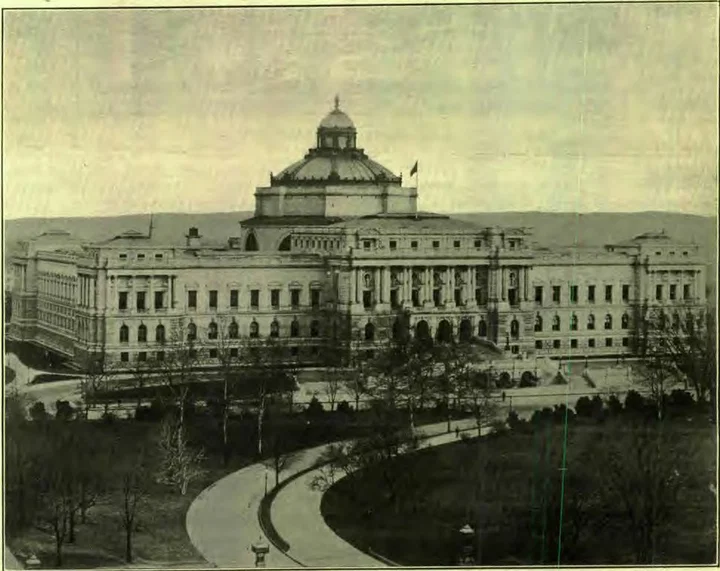
The walls of the Library are made of New Hampshire granite; “the stone is a close-grained variety, so even and light in tone that when the sun is shining upon it, the effect is almost as brilliant as if white marble had been used.” The building is four hundred seventy feet long and three hundred forty feet deep, and faces the east front of the Capitol. Though it is nearly a quarter of a mile away, its grounds seem to form a part of those of the Capitol, and the two buildings are connected by a tunnel. Through this an endless cable carries two trays back and forth at a speed between the terminals of six hundred feet a minute. Thus a book may be ordered by telephone, and received by an enthusiastic debating Senator within three minutes after it has left the Library—less time, it is said, than was required to receive one when the library occupied the Capitol itself.
Its floor space, exclusive of the cellar, equals an area of eight acres. The exterior walls form a great rectangle, which encloses a cross dividing the open space into four courts, each one hundred fifty feet by seventy-five or one hundred feet. At the intersection of the cross is an octagon, serving as the main reading-room. This octagonal Rotunda is conspicuous because of its gilded dome and lantern, which is surmounted by a great blazing torch with a golden flame—the Torch of Learning.
It is claimed that the Library is the most perfectly adapted for convenient use and storage of books of any large library in the world, and that it is the largest, costliest, and safest. Since it is the Nation’s Library, loyal Boston can take no offense at the claim, though her library as a marvel of art is an honor to the country. The shelving space in the Congressional Library amounts to nearly one hundred miles, making it possible to shelve about 4,500,000 books, reckoning nine to the foot. For the securing of sufficient daytime light 2,164 windows are pressed into service. Each window lighting the book-stacks consists of a single piece of polished plate glass three feet wide, and permanently sealed so that no dust or moisture can penetrate it.
Approaches and Main Pavilion
Even a detailed description of the large, costly, and unique fountain at the base of the broad entrance flight of steps, of the entrance porch itself, of the arches, carvings, and statuary, would only serve to show that the approaches to the building are extensive and imposing; therefore, with the bare statement that such is the case, I pass on to the doors that admit one to this hall of learning.
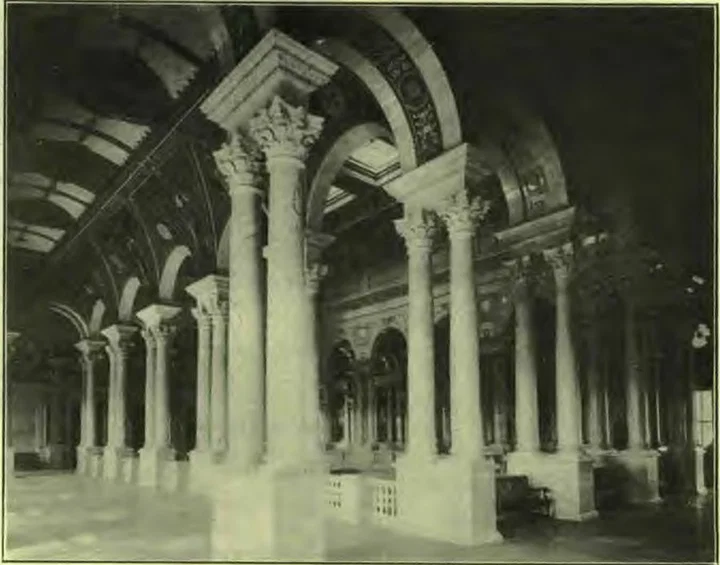
The three deep arches of the entrance porch, which can be observed in the main illustration, mark the site of the bronze doors which are “covered with a design of rich sculptural ornament in relief.” The subject of the decoration of the middle door is “The Art of Printing,” that of the one to the left is “Tradition,” to the right “Writing.” The three in their proper relation indicate the successive and gradually perfect ways in which the nations have preserved the history of their religion, literature, science, and history, namely,—tradition, writing, and printing. The happy, artistic combination of symbols chosen by the artist to express his thought, reveals the secret of the charm of the entrance doors. Entering byp. 2 any one of these, the visitor passes immediately through a deep arch into the main entrance hall. The snowy whiteness of the glistening Italian marble columns, the gold and white of the paneled ceilings, the harmonious blending of colors in the mosaic floors, the commingled glory of color from the artists’ brushes concentrating upon one in the well or center of the Main Pavilion, produce an effect hardly to be equaled elsewhere in the world—“a vision in polished stone” and exquisite color! One must study the meaning of each stroke of the artist, if he would fully appreciate what he sees; for almost every kind of ornamentation used is symbolic, and a volume is expressed in a single production. It is not color effect alone that was desired, but the expression by it of many principles and events relating to the world’s history.
At the ends of the corridors in panels on a deep-red background are white, floating figures of women, symbolizing justice, fortitude, courage, patriotism, temperance, prudence, industry, and patience. The style of the paintings is Pompeian. The inscriptions in gold occurring frequently on the walls are of interest, President Eliot, of Harvard, having been given the honor of selecting a large number of them. A few of these are given on the last page of this number.
Facing the entrance to the Staircase Hall is the arch, commemorating the erection of the Library. In the spandrels of the arch are two life-size marble figures entitled “The Students,” one a boy, the other an old man, indicating that books are alike for the instruction and pleasure of youth and age.
Frescoes
Passing under the arch, one comes into the east corridor. Here the six paintings illustrating the evolution of the book are found.
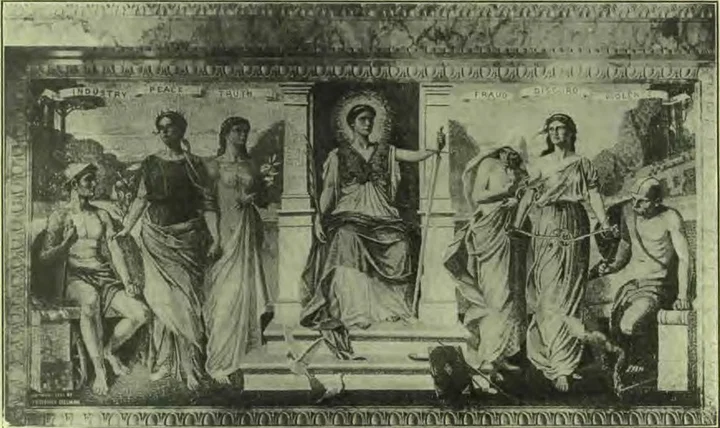
The soft colors and clearness of outline make these among the most attractive frescoes in the Library. Beyond this corridor is the small lobby leading to the central reading-room. Its walls are ornamented by a series of decorations, illustrating government. The painting in the central tympanum, representing the abstract conception of a republic as the ideal state, is entitled simply “Government.” The other paintings suggest the nature of good and bad administrations, and the results to which each leads, good government resulting in peace and prosperity, and corrupt legislation in anarchy. In the painting Good Administration (see illustration), the central figure is that of a grave and mature woman sitting on a marble throne, and holding in her right hand a pair of scales evenly poised, and with her left laid upon a shield quartered to represent the even balance of parties and classes. The frame of her chair is an arch, a form of construction in which every stone performs an equal service. On the right a youth casting his ballot into the voting-urn carries a book under his arm, suggesting that education should be the basis of suffrage. To the left is another urn into which a girl is winnowing wheat, symbolizing the care with which a people should choose its public servants.
The field of wheat and the fruitful tree in the background are symbolic of the prosperous and careful labor fostered by a good government. A striking contrast to this is the panel entitled “Corrupt Legislation,” which is “represented by a woman with a beautiful but depraved face sitting in an abandoned attitude on a throne, the arms of which are cornucopias overflowing with the coin which is the revenue of the state. But this revenue is represented not as flowing outward, for the use and good of the people, but all directed toward the woman herself. The path in front of the throne is disused and overgrown with weeds, showing that under such a corrupt government the people have abandoned a direct approach to Justice. With her right hand, the woman waves away, with a contemptuous gesture, a poorly clad girl—representing Labor—who comes, showing her empty distaff and spindle, in search of the work which should be hers by right, but which she can not obtain under a government inattentive to the wrongs of the people. In her left hand the woman holds a sliding scale—used as being more easily susceptible of fraud than a pair of balances, and the proper emblem therefore of the sort of justice in which she deals. A rich man is placing in it a bag of gold; he sits confidently beside her, secure of her favors in return for his bribe. At his feet are other bags of gold and a strong box, together with an overturned voting-urn filled with ballots, signifying his corrupt control of the very sources of power. In his lap he holds the book of Law, which he is skilled to pervert to his own ends, purchasing desired legislation. In the background are his factories, the smoke of their chimneys testifying to his prosperity. On the other side the factories are smokeless and idle, showing a strike or shut-down; and the earthen jar in which the savings of Labor have been hoarded lies broken at his feet.”
Reading Rooms
This lobby leads the reader directly into the Rotunda, the Main Reading-room; but the visitor must pass to the gallery above before he is allowed a view of the room where art and wealth together have conspired to make a scene that defies the pen’s description. At the landing of the stairway leading to the elegant marble gallery, is an arched panel, fifteen and one-half feet high, and nine feet wide, containing a marble mosaic of Minerva, the goddess of wisdom. How such beautiful, graceful figures, with such exquisite blending of delicate colors, can be made by building them out of tiny stones is a problem that only the skilled Italian of Venice, with his enamels of twenty-five thousand different tints, can satisfactorily solve.
The Representatives’ Reading-room is ornamented with two beautiful mosaic panels, “History” and “Law,” each more than seven feet long, and made in Venice. Law is typified by a beautiful young woman seated on a massive throne, holding in one hand a sword to be used against skulking Fraud, Discord with her malign serpents, and Violence with torch and sword. The palm in the other hand suggests the reward she offers to Truth, Peace, and Industry. She wears the ægis on her breast to signify righteousness and wisdom. On the steps of her throne are the scales of justice and the book of the law, and a pair of white doves emblematic of mercy.
Just opposite the Senators’ Reading-room is the general news reading-room, where the most omnivorous reader surely may satiate his appetite, for here between seven and eight thousand papers and magazines are at his service.
There are corridors and pavilions filled with works of art of various nations, and a room in which books printed when the art was in its infancy are displayed. Here one can see original copies of Poor Richard’s Almanac, bearing the date of 1741. A unique contrast do the newspapers of 1600 make when placed beside the voluminous Sunday editions of many of the leading newspapers of to-day; so do the volumes of poetry and prose of the sixteenth and seventeenth centuries when associated with the beautifully illustrated, clearly printed, and velvet or morocco covered books of the twentieth.
One pavilion and a large share of another room are filled with the etchings and hand engravings of one man, Albrecht Durer, a Dutch engraver, who lived from 1741-1528. That one man could accomplish so much in a short lifetime is a marvel to all who observe case after case filled with the fruits of his patient toil and skill.p. 3
Congress has made the Copyright Department a division of the Library of Congress; two copies therefore of all copyrighted productions, are required to be deposited in the Library. There were in the year 1900, nearly one hundred thousand entries of titles made in the Copyright Office.
It is to be regretted that the public are excluded from some of the most handsomely ornamented rooms, it having become necessary on account of lack of room to use them for offices.
Over one of the entrance arches is a fresco consisting of two floating figures bearing a scroll which contains the inscription, “Give instruction unto those who can not procure it for themselves.” The Library of Congress is a magnificent monument of learning, reared in accordance with this advice of Comenius, and that fact expressed by Bacon, “The inquiry, knowledge, and belief of truth is the sovereign good of human nature.”