Boys, would you like to make a telephone this week? Sound is exceedingly accommodating, and will work with very crude apparatus, so we will make an attempt.
This telephone we are going to construct, if you make it right and do everything just as I tell you, will work well to a distance of half a mile, and if you are very careful indeed, to a distance of two or three miles. However, you would better not lay your plans for anything but a short line, and you will be more than pleased. Say, for instance, you want to connect your house with that of your friend—how interesting it will be some evening when you want to call up Jack. Tap, tap, tap! goes your pencil on the diaphragm of your phone. Tap, tap, tap! comes the answer back. It sounds loud and clear, and would call you from any place. “Hello! Is that you, Jack? All right—how do you work the twenty-first in that arithmetic the teacher gave us to-day? It almost seems that I had worked on it a week here to-night, and I can’t get it yet—” and so on till Jack knows just what you want, and the two of you put your heads together half a mile apart, and work it all out.
The Things You Will Need
Go first to some slaughter-house and get two beef bladders, or, if they are not to be had, take any other kind that are offered, providing they are large enough. Be careful also that they are not broken. Get a box of good strong tacks, four blocks, each ten inches square, of smooth, one-inch pine, or other soft wood, and four pieces of blotting-paper, new or old, of the same length and breadth as the blocks. A ten-cent coil or two of stovepipe wire will do for the line, though wire a little larger would work some better. Two rubber coat or vest buttons complete the list of materials.
For tools you will need the use of a pair of shears, a hammer, a saw, brace and bits, bracket or keyhole saw, a screw-driver, and sandpaper. If you do not have all these tools yourself, a good-natured carpenter will probably do all the work there is to be done with bracket saw or brace and bits for you in ten minutes. Possibly you could borrow some of his tools to use yourself.
Construction
As soon as you get home with the two bladders, wash them very clean in cold water, blow them up tight, tie a string around the neck of each, and let them stay that way for a whole day and night, at least, while you prepare the rest of the phone.
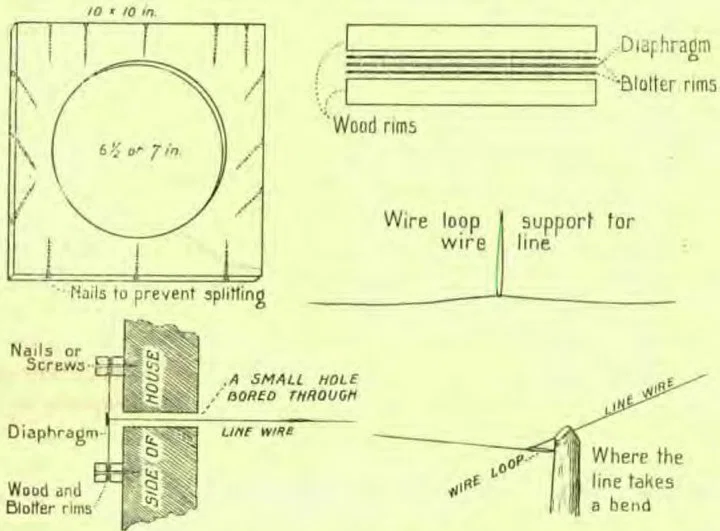
Mark out circles about six and one-half inches in diameter on the four planed boards. After boring a hole in each for the saw to work in, cut out the wheel indicated by the circle. Be careful not to split the rim that is left, for this is the part you will use in making the phone. If you think there is any danger of the rim splitting, you would better drive some long slender nails in as indicated in the diagram. Make the four rims exactly alike. Sandpaper the openings neatly, and cut out four rims from the squares of blotting-paper, to make them exactly correspond to the wooden rims.
The bladders having stood the necessary time, cut off the necks, soak the rest in warm water, and clean and wash till they are soft and pliable, and light in color. Take plenty of time, and let the bladder get quite soft before you take the next step.
Stretching the diaphragm, or drum, is a carefulp. 4 operation, and if it is not well done, there is no possible satisfaction in the making of the phones.
Lay the bladder on one of the blotting-paper rims, over the board rim, and tack it down with many tacks, taking care that it does not wrinkle. At first, leave the tacks so that they can be removed and the bladder membrane stretched again in case it wrinkles. Have patience, don’t do a poor job here, but be determined that there shall not be a wrinkle in the whole diaphragm. It only requires time and patience.
That having been done alike for both diaphragms, lay the other blotting-paper rims in their places on the wooden rims, and, having punched or bored holes to start the screws, fasten down tightly. If you use screws instead of nails, you can take the phone rims apart to readjust the blotter cushions at any time, which you could not do with nails.
Now take a piece of soft, flexible wire about five feet long, fasten it through the eyes of one of the buttons, and then pass the free end through a tiny hole in the exact center of the bladder diaphragm. Do the same for each diaphragm, and then as shown in the illustration hang weights, like flat-irons, to the end of the wires. This should be done in a warm, dry place, as in the sunshine, and the phones left till perfectly dry. When dry, the diaphragms will be taut as a fine drum-head. But you see if you did not tack them firmly enough they will not be, because the few tacks will give with the pull of the drum, and your phone will not work. This is just another caution to use plenty of tacks, and to do your work well.
I have shown in the illustration the way to set the phones up. Notice the following points: The diaphragms are nailed substantially, or screwed, in their places. The line wire is kept stretched at all points between the two diaphragms. There should be as few bends in the line as possible, and what there are should be through wire loops, which are free to move with every vibration of the line. All supports for the line are made in the same way, and they should be as few as possible. The reason for using care in supporting the line is that everything that touches it, interferes with its motion, and takes that much away from the free vibration and clear sound as heard at the distant phone.
I have given all these details that you need make no mistake. All the operations are perfectly simple, and the cost is practically nothing, and I am free to say that the results, if you do your part well, will fully equal those obtained on the expensive electric phones.
Simpler Forms of Telephones
Somebody asks, Isn’t there an easier way?—Yes, certainly; I told you sound was very accommodating, and you will find it so. Take two tin cans, such as old quart fruit cans. In the exact center of their bottoms punch a small nail hole. Connect them by means of two hundred feet or less of well-waxed string, and you will find you can hear quite comfortably, providing you keep the line wires well stretched.
Another plan is the following: With a pair of pincers, or in any other convenient way, tear the bottom off two baking-powder cans. Wet some of the toughest paper you can get, like thick drawing-paper, or parchment, and tie it smoothly over each of the cans. Allow it to dry. Use waxed string for the line. This makes an excellent little phone. Where a support is necessary for the line, let it be a loop of string, and should a bend be made in it, let it be supported by a string loop also. These two simple phones are generally clear sounding, but not loud, nor will they work at great distances.
EDISON DRIVER.