Model No. 7
MATERIAL, reeds Nos. 1, 3, 4, 5, and 6. Diameter of base, seven inches; top, ten inches; height, four inches. Thirty-seven stakes, sixteen inches long, of No. 4 reed. Insert one each side of each spoke but one. At the last spoke use but one, to make an odd number, as the stakes will be used singly. Use No. 3 reed for all the weaving.
Rope twist, three rows of triple twist, two inches of single weaving. Above the single weaving put one row of triple twist. At the point where this row ends, insert two new weavers, one in each of the first two vacant spaces at right of the three weavers already in use. These five weavers are used to form a ridge on which the cover may rest. Take the one at left, pass it to right in front of two stakes and back of three. This will bring it out in first vacant space at right. Continue the same stroke once around the basket, always taking the left weaver. Notice the ridge formed by passing back of three stakes. When a weaver reaches the space where the first extra one was inserted, lift the inserted end, pass the other end back of it under the ridge, and draw it through to the front. Make the next stroke with left weaver, and bring this out back of second inserted weaver below the ridge. This completes the ridge, and leaves it even.
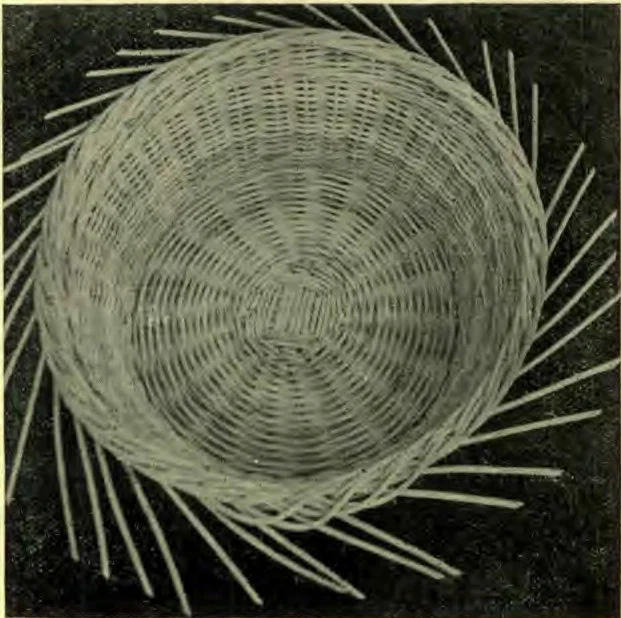
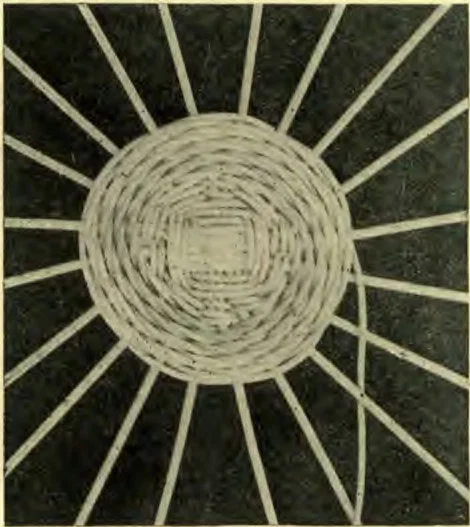
Cut these two weavers on outside of basket. With the remaining three weavers make three rows of triple twist. Using five weavers makes no difference on outside of basket, as each stroke is in front of two stakes, same as with triple twist. The border is slightly different from that on the “handy basket.” Turn down four stakes each back of two. Pass the left one over the other three, in front of first standing stake, back of the next, and out at first vacant space at right. Lay first standing stake down back of it. Repeat until finished. Fig. 1. Weaving the last ends in may be somewhat perplexing, but will not be too difficult for those who have followed the work from the beginning.
For the cover use ten fifteen-inch spokes of No. 5 or No. 6 reed. Split five and insert five. Open the center as usual. Notice that the second row of pairs does not divide the first row, because there is now an even number of spokes.
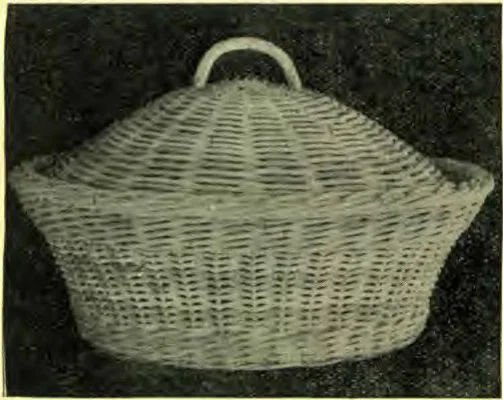
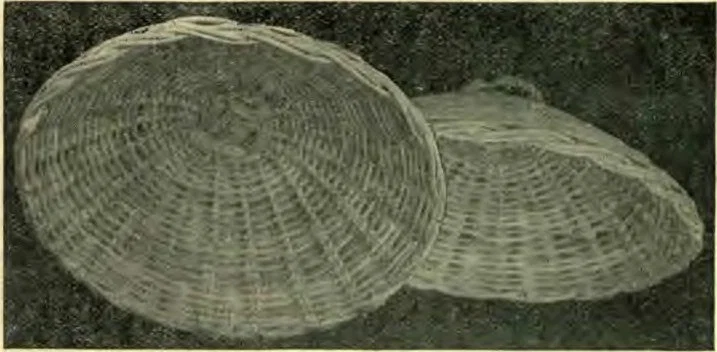
When the second row of pairs is completed, drop the short weaver; with the long one pass in front of two spokes, and back of one. Fig. 2. (This gives the same effect as the triple twist.) Continue this weave until the cover is the right size, which is when the diameter is one-half inch less than that of the inside of basket just above cover ridge. In using larger or smaller reeds a different allowance would, of course, be necessary. Shape by bending spokes well from you and drawing weaver tight at each stroke. Bind off by passing weaver under last row of weaving at each downward stroke last time around. Cut spokes close to cover. Insert one nine-inch stake of No. 4 reed beside each spoke for border. Pinch close to cover. Hold the cover on edge with the under side toward worker. Turn two stakes down, each back of first one at its right. Pass left one in front of first standing stake at right, back of next, and out at first vacant space. Lay first standing stake down back of it. Repeat until border is finished. Fig. 3. It should be very firm and close. See that the cover is just the right size before trimming stakes. It should go on without crowding, and should not be so small as to slip below cover ridge. If it is a trifle large, it may be sufficiently reduced by giving each stake a firm pull. If a little small, lay it on the table right side up, and with the palms of the hands apply firm, even pressure to the top. If proper care is used in measuring, it will need no more adjusting than can be done in this way. But if necessary the border may be taken out, and more or less weaving used as the case may require.
For the handle use a five-inch piece of No. 6 reed. Sharpen each end on the under side only a distance of half an inch. Insert slanted ends on top of middle spoke just outside of the two rows of pairs on either side of center. Wind same as handles on plain waste basket and handy basket. Use No. 1 reed for winding.
MRS. E. M. F. LONG.