Costumes of the People
WEALTHY Koreans wear garments of rich and costly silks; but I prefer to describe the costume of the masses. The most marked peculiarity of the clothing worn is that almost every garment is white, or at least uncolored, though it may not be bleached. However, small children are often dressed in very bright colors, with somewhat startling combinations. I have seen a small jacket with body and sleeves of pink, collar of greenish yellow, cuffs of bright blue, and a sash or tie of a rich red. The jackets worn by boys are often of a pale-pink color. The long outer garments for men are sometimes black. The hats and jackets of the servants are black or some dark color. Men and boys wear a loose-fitting jacket reaching to the waist. The sleeves are loose and rather short. The pantaloons are very loose and baggy, and are made with a wide band. They are confined about the waist by a cord, the upper part of the band hanging down over the cord. A sleeveless waistcoat or vest is sometimes worn over the jacket just as described. The feet are covered with socks made of white cloth, padded with cotton; these reach several inches above the ankles. The wide trouser legs are wrapped about the ankles, over the socks, and then tied with a cord or narrow band. Over the socks are worn slippers of white rawhide or slipper-like sandals, which so enclose the feet that they require no fastenings. The former are worn by well-to-do people.
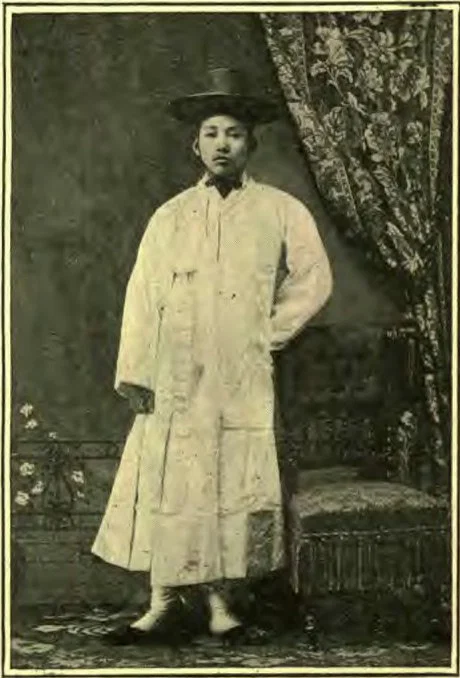
This is the costume worn about home. But when a Korean gentleman goes abroad, he dons a long loose gown or coat, reaching almost to the ankles; and a hat with a small, tapering crown, and a stiff, straight rim. The material for summer clothing may be of cotton or linen, often very light and gauzy. Winter garments are made warm by being padded with cotton.
Women and girls wear a waist or jacket barely long enough to allow sleeves to be set in; an under garment very much like the pantaloons worn by the men; and over this a long, full skirt, with a wide band at the waist. This band covers the breast and reaches to the short jacket, at least in the case of well-dressed and modest ladies. With the common people in their work-a-day clothes, the jacket falls considerably short of our ideas of modesty, leaving the breasts exposed. The footwear of women does not differ materially from that of men. The common head-dress worn by women is simply a wide piece of white cloth folded, and tied about the head with a single knot, the ends hanging down behind; or so starched and tied, that the ends project upward behind the head. Arranged in this way, it looks very quaint and tasty.
A Korean has no pockets in his clothes; so his purse and tobacco pouch, and possibly a knife and a spectacle case, dangle from bright-colored cords tied about his waist. His long-stemmed pipe, a constant companion, he usually carries in his hand.
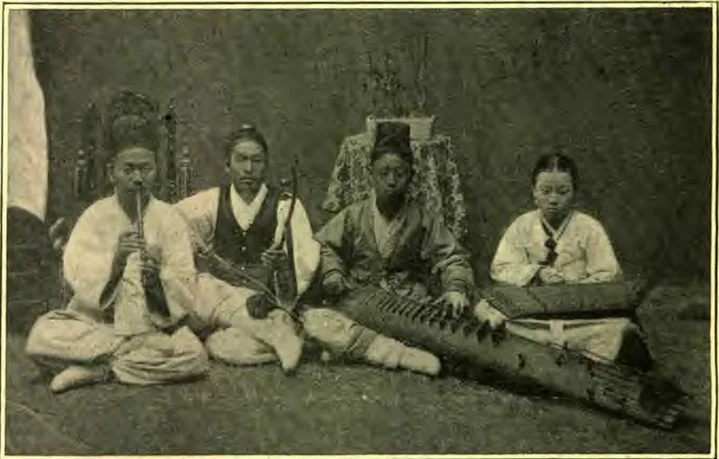
Korean women wear very few ornaments. Occasionally one sees a girl with ear-rings made simply of silver wire with the ends twisted together. Some women wear silver finger-rings, two on a finger, yet so thick and wide that they are removed when their owner has work to do. But if these people have few outward adornments, it may be all the easier to teach them how to possess “the ornament of a meek and quiet spirit.” F. W. FIELD.