Korean Houses
The average Korean dwelling is among the humblest on earth. Only among savage and barbarous peoples are the houses so poor as in this “land of the morning calm.” Let me describe the construction of such a dwelling. A framework of small timbers is first erected, then the walls are completed by filling in between the upright timbers with mud, or with stones laid in mud. These walls are made smooth by being plastered with mud inside and outside. A thatch of millet straw, reeds, or like material completes the roof. Inside, the spaces between the rafters are plastered with mud, and this answers for ceiling. The windows, and sometimes the doors, are of lattice-work, covered with white paper to admit the light, and are usually located in the front of the house only. There is no other provision made for ventilation.
The floors deserve a detailed description, for thereby the heating of the house is understood.
In all the rooms except the kitchen, parallel walls of stones and mud about a foot high, are built upon the ground. The spaces between these walls are then bridged over with flat stones, and the whole leveled up with a layer of mud. Thus these spaces under the floors are like so many flues, and are connected with the earthen stove or fireplace in the kitchen. The hot air and smoke traverse these flues, and finally reach the chimney, which is usually placed near one corner of the house. Often the chimney is only a foot or two high, and the smoke blackens the wall of the house; sometimes it is six or eight feet high, topped out with a roll of cane matting, its mud sides thatched with straw to keep the rain from dissolving them.
This arrangement for heating seems to be quite effective, but is said to be very expensive. The common fuel is the small branches of pine and other trees, dried with the leaves on, and is gathered from the scrubby trees which grow upon the otherwise barren hills and mountains. These pines look as if the people had got the start of them; for they are kept cut back almost to the ground, to furnish fuel.
The cottage in which I am sitting as I write this sketch, is in a little country village in western Korea. It is about fourteen feet wide and thirty feet long. The kitchen is at one end, and occupies about one third of the whole length. The remainder is divided into two equal rooms by only a partial partition. The main timbers of the frame are crooked and unhewn. The rafters are poles about as thick as a man's arm, such as might be picked from an American farmer's wood-pile. The walls are scarcely six feet high next to the eaves, and I can easily reach the ridge-pole with my fingers while standing erect. The earthen floors are covered with cane and reed mats, upon which the inmates sit.
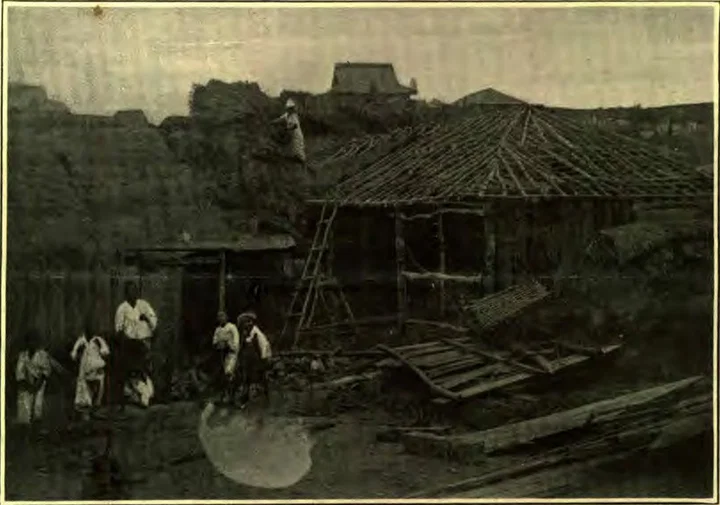
The newcomer is liable to conclude that the simplicity of Korean houses is due to the poverty of the people; and doubtless there is some truth in this. But those who are well informed affirm that even people of means dare not show their wealth by erecting decent dwellings; for to do so would be to expose themselves to the extortion of dishonest government officials. Government positions are sought for the express purpose of enriching the officials at the expense of the people. It is largely this corrupt condition of the government that makes Korea such an easy prey to her grasping neighbors.
But this very poverty and oppression of the people render many of them all the more ready to receive the good news of salvation, and to prepare for the life to come, where they will exchange their rude dwellings for “a house not made with hands, eternal in the heavens.”
F. W. FIELD.