Making a Bichromate Tumbler Battery for Running Small Electric Machinery
By Edison Driver
A good battery for running experimental electric machinery is the Bichromate Tumbler. It furnishes a powerful current for half an hour or so at a time, and is very easily renewed when worn out. It will not, as a rule, be found to work well on long runs, say for four or five hours. The reason for this you will learn later. Its simplicity recommends it to all students and experimenters.
The cells, or containers, are either large-size jelly tumblers or beer bottles cut off to the right height. This may be done by wrapping a string that has been dipped in kerosene around the bottle at the desired height, burning it, and dipping the hot bottle quickly in cold water. It will crack right where the string was wrapped.
Solution for running the battery: 1 pound bichromate potash (should cost twenty cents), dissolved in 3 pints cold water. To this solution add 1 pint commercial sulphuric acid (should cost ten to fifteen cents), pouring it in very slowly. If poured too quickly, it may cause the liquid to boil, and fly up in your face.
Making the Cell
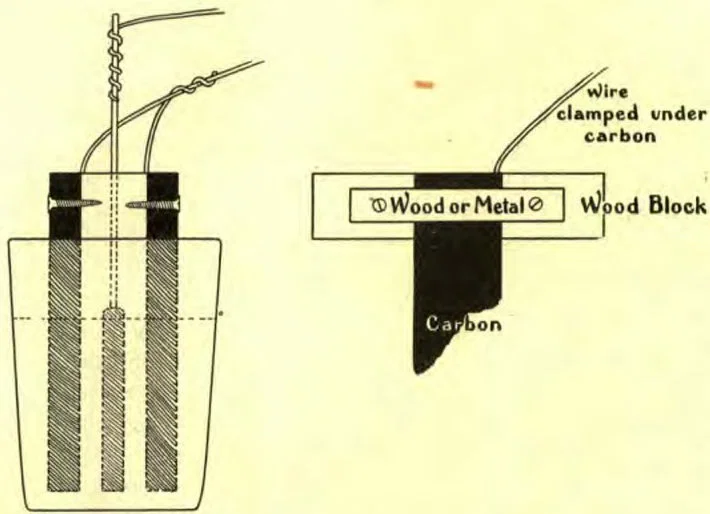
At any telephone station, or almost any junk dealer’s, old, worn-out dry batteries may be purchased for about two and one-half cents each. These you need for the carbons and zinc they contain. Each dry cell has one carbon, and for a bichromate cell you need two. Carefully dig out the carbons from two dry batteries, saw them off the right length with an old, fine-toothed wood-saw, bore holes through the ends with an old drill, and screw to each side of a block of wood 4 × ¾ × ¾ inches. There are, of course, other ways of fastening these on the wood without boring the holes, as you can see by the diagram.
Melt up the zinc cases of the old batteries in the fire shovel, held in a hot fire. Straighten and clean several pieces of brass, copper, or iron wire, six or eight inches long. With a little square block of wood make a depression, or mold, a quarter of an inch deep in a box of moist sand or earth. Lay one of the wires you have straightened so that an inch of it will penetrate one end of the mold. Pour in the melted zinc, and let it harden. If you have zinc enough, make several of these for future use.
Dip the zinc in the acid battery solution, and rub a drop of mercury over it till every part of the surface is silvery white. This protects the zinc from speedy destruction in the acid. Now make a hole through the block that holds the carbons just large enough to fit the zinc’s wire tightly, push the wire through, clamp some wires under the carbons, wrap one around the wire of the zinc, and the cell is complete. By raising or lowering the zinc in the acid, the strength of the current may be varied; and when not in use, it should be kept entirely out of the jar. Keep it bright with mercury.
A Strong Battery
By combining several cells, a strong battery may be made, capable of running a larger motor, or of lighting a small electric lamp. When using two or more cells, be sure to connect them properly; that is, connect the carbons of one cell to the zinc of the next, and the zinc of that one to the carbons of the next, and so on, running the two remaining free wires away to your machinery. EDISON DRIVER.